Apple Intel Chip Pact Signals Supply Shift
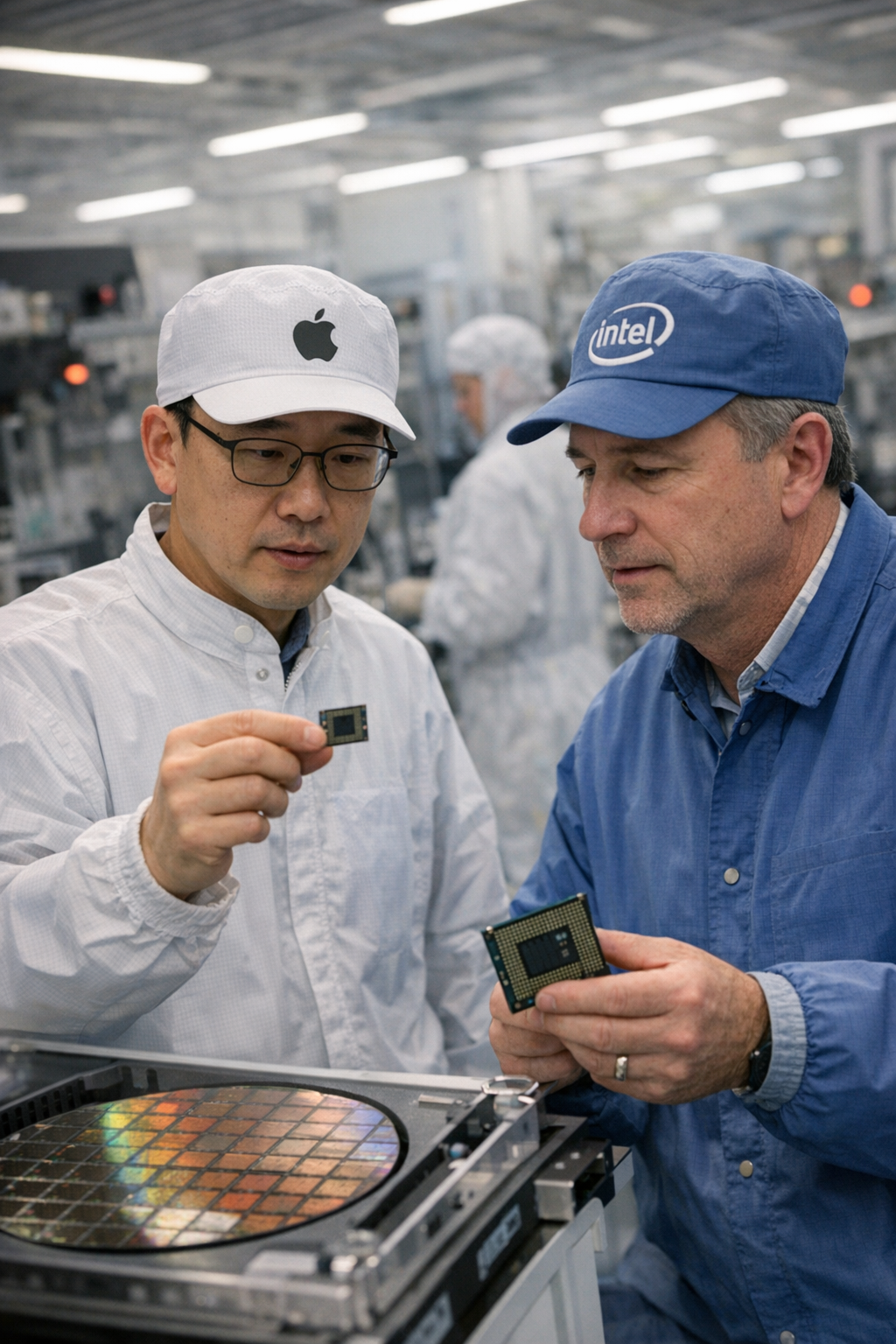
Apple and Intel have reached a preliminary agreement to collaborate on advanced chip manufacturing, a development that could reshape dynamics in the global semiconductor industry, according to The Wall Street Journal’s report titled “Apple, Intel Have Reached Preliminary Chip-Making Agreement.”
The reported arrangement signals a potential shift in Apple’s strategy as it seeks to diversify its semiconductor supply chain beyond its longstanding reliance on Taiwan Semiconductor Manufacturing Company (TSMC). While the details remain limited and the agreement is described as preliminary, the move underscores Apple’s growing interest in securing additional manufacturing capacity amid ongoing geopolitical uncertainty and intensifying competition for advanced chips.
Intel, which has been working to expand its contract manufacturing business under its foundry initiative, stands to benefit significantly if the agreement progresses. The company has invested heavily in rebuilding its position as a leading-edge manufacturer after years of ceding technological leadership to overseas competitors. Partnering with a demanding customer like Apple would represent both validation of Intel’s manufacturing ambitions and a major commercial opportunity.
Industry analysts note that Apple’s chip designs, which power its Mac computers and mobile devices, are among the most sophisticated in the market. Any partnership would therefore require Intel to meet stringent performance, efficiency, and yield standards. The reported talks suggest Intel’s manufacturing processes may be approaching the level needed to compete for such high-profile contracts, though significant technical and logistical hurdles likely remain.
The prospective deal also carries broader implications for U.S. efforts to strengthen domestic semiconductor production. Policymakers have prioritized reducing reliance on Asian manufacturing hubs, and a collaboration between two prominent American technology companies could align with those goals. Intel has received government support to expand its fabrication facilities within the United States, and securing Apple as a customer could bolster the economic rationale for those investments.
At the same time, the preliminary nature of the agreement means it is far from certain to materialize. Apple has historically favored established manufacturing partners with proven track records at scale, and shifting even a portion of its production would involve considerable risk. Analysts caution that negotiations could stall or evolve into more limited cooperation, such as testing or development partnerships rather than full-scale production.
Still, the discussions reflect a broader recalibration within the semiconductor ecosystem, where supply chain resilience and technological sovereignty are becoming as important as cost and efficiency. As The Wall Street Journal report highlights, even tentative moves by companies of Apple’s and Intel’s stature can signal deeper changes in how and where the world’s most advanced chips are made.