Air Force and Space Force Test Unified AI Systems to Accelerate Battlefield Decision-Making
The U.S. Air Force and Space Force are advancing efforts to integrate artificial intelligence into military command and control, underscoring a broader Pentagon push to modernize battlefield decision-making through data-driven tools.
According to the DefenseScoop report titled “Air Force, Space Force combine AI tools in battle management experiment,” the two services recently conducted an experiment aimed at merging their respective AI-enabled systems into a unified battle management framework. The effort reflects an ongoing attempt to improve how commanders process vast streams of operational data across domains, particularly as future conflicts are expected to unfold at faster speeds and greater complexity.
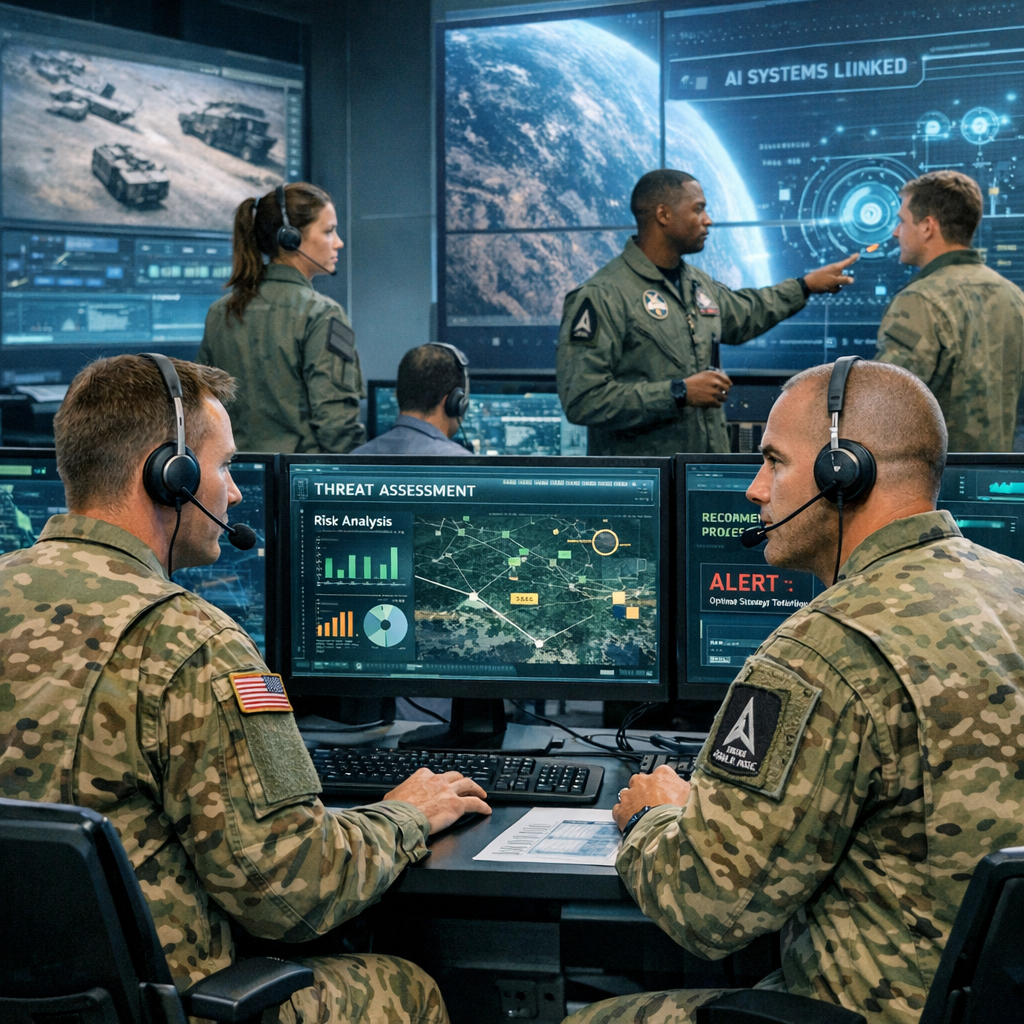
The experiment brought together multiple AI systems designed to assist with tasks such as identifying targets, prioritizing threats, and recommending courses of action. By linking Air Force and Space Force tools, officials sought to test whether disparate platforms could operate cohesively, sharing data and generating synchronized outputs in real time. The objective was not only technical integration but also the creation of a more seamless decision-support environment for commanders overseeing air and space operations.
Military officials cited in the DefenseScoop article indicated that one of the central challenges is ensuring interoperability between systems developed by different teams, often with varying standards and architectures. The experiment attempted to address these gaps, exploring how AI models can communicate effectively and provide consistent recommendations even when drawing on different data sources.
The initiative is part of a broader concept known as the Advanced Battle Management System within the Air Force and similar efforts in the Space Force, both of which aim to connect sensors, platforms, and operators into a unified network. It also aligns with the Pentagon’s wider Joint All-Domain Command and Control (JADC2) strategy. By incorporating AI, planners hope to reduce the cognitive burden on human decision-makers, enabling faster and more accurate responses in high-pressure scenarios.
However, the experiment also highlighted persistent issues, including data compatibility, latency, and the need for human oversight. While AI systems can process information at scale, military leaders remain cautious about overreliance on automated recommendations, especially in situations involving lethal force. Guidance such as the Pentagon’s AI Ethical Principles emphasizes the importance of responsible use. Ensuring transparency in how AI reaches its conclusions remains a key concern, as does the ability of operators to trust and verify those outputs.
The test reflects growing urgency within the Department of Defense to operationalize AI capabilities rather than confining them to isolated demonstrations. As highlighted in the Pentagon’s push for AI adoption, U.S. military leaders have emphasized the importance of maintaining a competitive edge through rapid experimentation and iteration.
The DefenseScoop report suggests that future efforts will likely expand on this initial integration, incorporating additional services, more complex scenarios, and refined algorithms. These efforts are closely tied to broader digital modernization strategies outlined by the Department of Defense Digital Strategy. The long-term goal is a fully networked battle management system capable of coordinating operations across air, space, cyber, and other domains with minimal friction.
While still in development, the experiment signals a shift toward more interconnected and AI-enabled military operations, where speed, data integration, and cross-domain awareness are expected to play a decisive role in determining outcomes on the battlefield.