Fiber-Optic Guided Drones Emerge in Southern Lebanon, Challenging Israel’s Electronic Warfare Edge
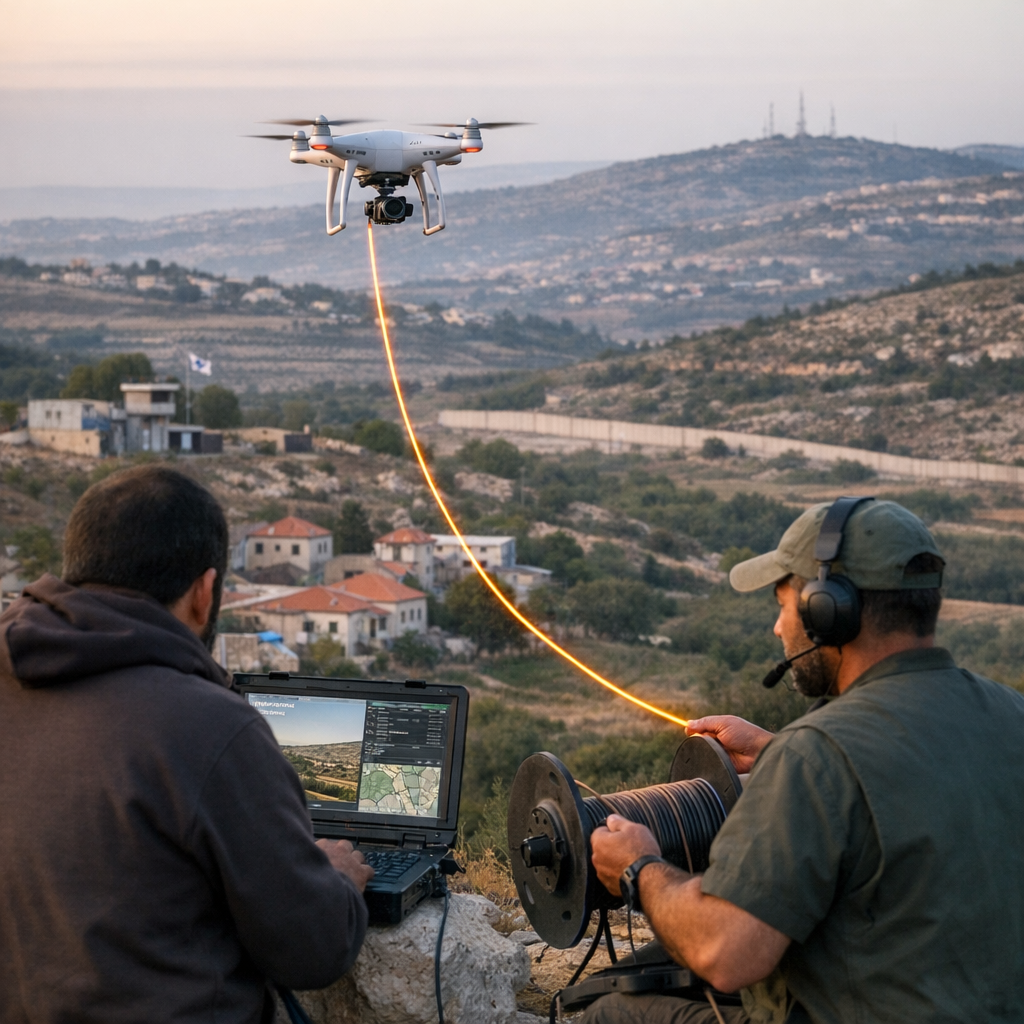
Reports that a new class of “fiber-optic” guided drones has appeared in southern Lebanon are drawing increasing attention from military analysts, underscoring a potentially significant shift in the tactical balance along Israel’s northern border. According to the Defense News article titled “Frustrating Israel: Fiber-optic ‘killer drone’ technology has arrived in southern Lebanon,” the emerging systems are designed to overcome some of the key limitations that have shaped drone warfare in recent years, particularly vulnerability to electronic jamming.
Unlike conventional remotely piloted drones that rely on radio-frequency communications and GPS signals, these systems are tethered to their operators via ultra-thin fiber-optic cables. This physical link allows operators to maintain direct, uninterrupted control while receiving high-resolution video feeds in real time. Because they do not depend on wireless signals, the drones are largely immune to electronic warfare countermeasures that Israel has heavily invested in, including jamming and spoofing technologies intended to disrupt or hijack unmanned aerial vehicles.
The introduction of such drones in southern Lebanon, widely believed to be in the hands of Hezbollah or aligned groups, represents a tactical innovation with immediate battlefield implications. Israeli forces have relied on layered air defenses and electronic warfare tools to counter the growing proliferation of drones across the region. Fiber-optic-guided systems complicate that framework by denying defenders one of their most effective tools: the ability to sever the communication link between operator and drone.
Military experts note that these systems are not entirely new in concept. Variants of fiber-optic-guided munitions and loitering systems have been observed in other conflicts, including in Ukraine, where both Russian and Ukrainian forces have experimented with similar technologies to evade dense electronic warfare environments. Their appearance in Lebanon suggests a diffusion of lessons learned from those battlefields into the Middle East.
The operational advantages are balanced by constraints. Fiber-optic cables limit the drone’s range and maneuverability, typically confining operations to several kilometers and requiring careful handling to avoid entanglement or breakage. Nevertheless, within those constraints, the systems can be highly precise and difficult to detect or counter. For militant groups operating in terrain like southern Lebanon—characterized by dense vegetation, urban pockets, and fortified positions—short-range but resilient systems may prove particularly effective.
Israeli defense planners are likely to view this development with concern, not only because of the immediate tactical challenge but also because it signals an ongoing evolution in asymmetric warfare capabilities among non-state actors. The steady integration of more sophisticated technologies into such groups’ arsenals is a recurring theme in regional security assessments.
As highlighted by Defense News, the arrival of these drones underscores a broader trend: the rapid adaptation cycle in modern conflict, where countermeasures prompt innovations that, in turn, demand new defenses. This dynamic reflects the evolving role of counter-drone technologies in contemporary warfare. In this case, a technology designed specifically to neutralize electronic warfare advantages suggests that the contest between drone capabilities and counter-drone systems is entering a new phase.
Whether fiber-optic-guided drones will become a widely adopted tool or remain a niche capability will depend on their performance in operational conditions and the speed with which countermeasures can be developed. For now, their emergence in southern Lebanon adds another layer of complexity to an already volatile frontier.