Small Drones Signal a Big Shift in Future Air Warfare at Berlin Air Show Alternate options if you want a different tone: – Swarms Over Supremacy: Tiny Drones Redefine Airpower in Berlin – Berlin Air Show Highlights Rise of Low-Cost Drone Warfare – From Jets to Swarms: The Quiet Transformation of Airpower – Small, Smart, Scalable: The New Face of Military Air Systems – Drone Swarms Take Center Stage in Evolving Air Combat Strategy
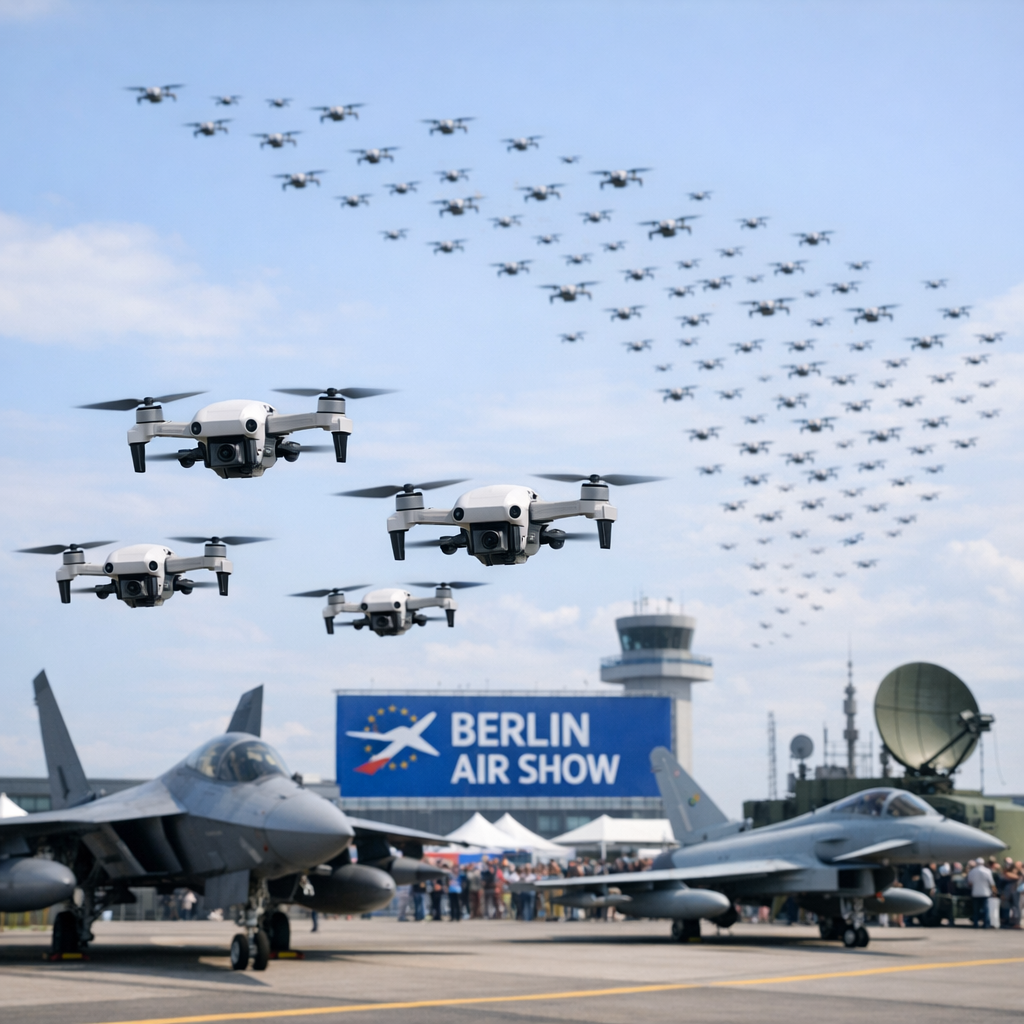
At this year’s Berlin Air Show, a quieter revolution in airpower is drawing attention alongside the usual display of jet aircraft and heavy military hardware. As reported by Breaking Defense in its article “Tiny drones making a buzz at the Berlin Air Show”, defense firms are increasingly focusing on compact, low-cost unmanned systems that emphasize scale, adaptability, and autonomy over size and firepower.
The systems on display reflect a shift in military thinking shaped by recent conflicts, where small drones have demonstrated outsized battlefield impact. For example, lessons from the war in Ukraine have highlighted the effectiveness of inexpensive UAVs in reconnaissance and strike roles (see CSIS analysis on drones in Ukraine). Rather than relying solely on large, sophisticated platforms, armed forces are exploring how swarms of inexpensive aerial vehicles can carry out reconnaissance, electronic warfare, and even precision strike missions. Exhibitors in Berlin showcased a growing range of such systems, from palm-sized quadcopters to slightly larger, modular units capable of operating in coordinated groups.
Industry representatives at the show emphasized that these drones are designed not only for affordability but also for rapid production and ease of deployment. Unlike traditional defense procurement cycles, which can stretch over years or decades (outlined by the U.S. Government Accountability Office on defense acquisition), these systems can be updated quickly in response to evolving threats. That flexibility has become a central selling point as militaries seek to adapt to fast-changing operational environments.
A key theme emerging from the exhibition is autonomy. Developers are investing heavily in software that enables drones to navigate contested environments with minimal human input, maintain communication in degraded networks, and coordinate actions within a swarm. Research into swarm autonomy, such as work supported by DARPA’s OFFSET program, highlights how coordinated drone behavior is advancing. While full autonomy remains a sensitive topic due to ethical and regulatory concerns, incremental advances are already being fielded, particularly in navigation and target identification.
The Berlin showcase also highlighted the importance of counter-drone capabilities, underscoring the dual nature of the technology. As small drones proliferate, so too does the need to detect, track, and neutralize them. NATO has identified counter-UAS as a priority area (see NATO Counter-UAS initiatives). Several companies presented integrated systems designed to counter swarms through electronic jamming, directed energy, or kinetic interception, illustrating the emerging cycle of measure and countermeasure in this domain.
European defense firms, in particular, are positioning themselves to compete in what many see as a rapidly growing global market. Governments across NATO and beyond are increasing investment in small unmanned systems, driven by lessons learned in Ukraine and other recent conflicts. These experiences have reinforced the value of scalable, expendable platforms that can be deployed in large numbers without the same strategic risk as manned aircraft.
Despite the enthusiasm surrounding the technology, questions remain about doctrine, integration, and control. Military planners must determine how best to incorporate these systems into existing force structures and how to manage the risks associated with autonomous or semi-autonomous operations. There are also concerns about supply chains and the potential dependence on commercial components, with issues like semiconductor sourcing highlighted by Brookings research on supply chains.
What is clear from Berlin, however, is that the center of gravity in aerial warfare is gradually expanding. The prominence of small drones at the show suggests that future conflicts may be shaped as much by swarms of inexpensive, networked systems as by the high-performance aircraft that have long dominated airpower. As Breaking Defense’s reporting indicates, the buzz around these tiny drones is more than a passing trend; it signals a deeper transformation in how militaries think about capability, cost, and control in the skies.