Air Force Revives Flying Tigers Legacy on A-10
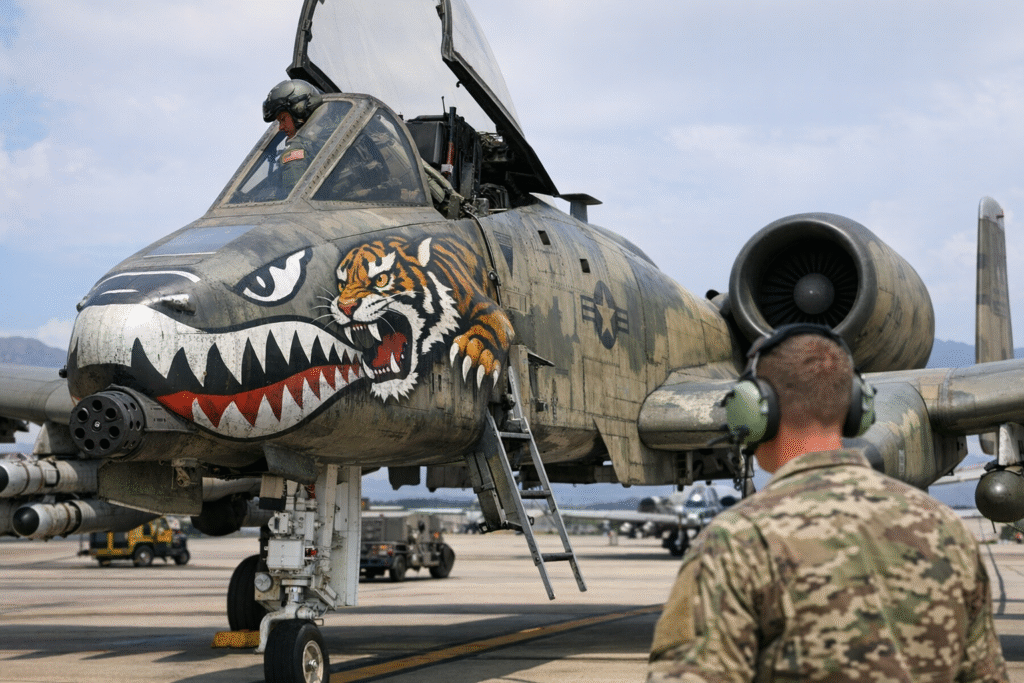
A recent Air Force initiative to commemorate the legacy of the World War II–era Flying Tigers underscores how historical symbolism continues to shape modern military identity. As reported in the article “Air Force crew honors WWII-era Flying Tigers with A-10 paint job,” published by Military Times, a U.S. Air Force crew has revived the iconic shark-mouth nose art on an A-10 Thunderbolt II, paying tribute to the famed American Volunteer Group that operated in China during the early 1940s.
The newly painted aircraft echoes one of the most recognizable visual markers in military aviation history. The original Flying Tigers, composed of American pilots serving under Claire Lee Chennault, became known not only for their combat effectiveness against Japanese forces but also for the distinctive shark-face designs emblazoned on their P-40 Warhawks. That imagery, intended both as psychological warfare and morale booster, has remained a powerful symbol within the Air Force.
According to Military Times, the modern paint job was carried out by maintenance personnel who approached the project with both artistic care and historical sensitivity. Rather than applying a superficial homage, the crew worked to replicate the design in a way that remains faithful to its wartime origins while adapting it to the contours of the A-10, an aircraft with its own long-standing reputation for ruggedness and close-air support capability.
The effort reflects a broader institutional emphasis on heritage within the Air Force. Units frequently look to past conflicts and storied predecessors to reinforce esprit de corps and continuity across generations. In this case, the choice of the A-10 is notable: like the P-40, it is an aircraft closely associated with frontline operations and pilot identity, reinforcing the connection between past and present combat roles.
The project also highlights the often-overlooked contributions of maintenance crews, whose work extends beyond technical upkeep into the cultural life of the service. By executing the paint scheme with precision, the team played a direct role in preserving and communicating Air Force history in a highly visible way.
While largely symbolic, such initiatives can carry practical implications for morale and public engagement. Aircraft adorned with heritage markings frequently draw attention at airshows and operational deployments, serving as mobile reminders of the service’s history. They also provide an opportunity for education, connecting newer generations of service members and civilians to lesser-known chapters of military history.
The Flying Tigers’ legacy remains particularly resonant given their unique status as volunteers operating before the United States’ formal entry into World War II. Their story has come to represent adaptability, international cooperation, and the early assertion of American airpower in the Pacific theater.
By bringing that legacy onto a modern aircraft, the Air Force not only honors its past but also reinforces a narrative of continuity that spans decades of technological and strategic change. As Military Times reports, the result is more than a cosmetic update; it is a deliberate act of remembrance embedded within an operational platform, ensuring that history remains visible in the skies as well as in the archives.