Israel Tests Pilot Plan to Relocate Gaza Civilians to Areas Outside Hamas Control
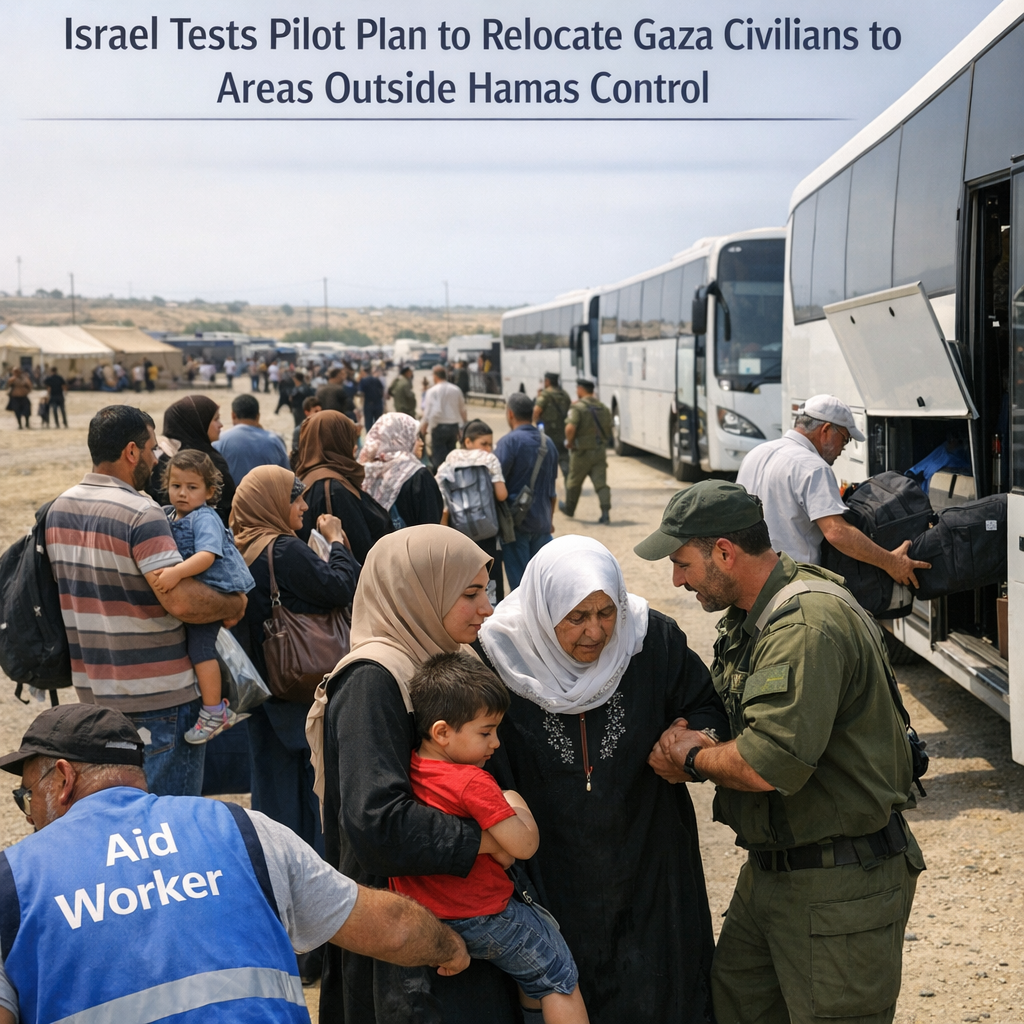
A pilot initiative aimed at relocating civilians within the Gaza Strip to areas beyond Hamas control is drawing attention as Israel continues to explore new approaches to governance and humanitarian management in the enclave, according to reporting by i24NEWS in its article “Gaza: A pilot project aims to relocate residents to an area outside Hamas control.”
The proposal, described as a limited trial rather than a comprehensive plan, is intended to test whether designated zones free of Hamas influence can function as viable civilian spaces. Such areas would, in theory, provide residents with improved access to humanitarian aid and basic services while weakening the militant group’s administrative grip on the population.
According to i24NEWS, the pilot project envisions a controlled framework in which Palestinian civilians could voluntarily move to specific parts of Gaza that have been cleared of Hamas presence. Israeli officials and planners reportedly view the concept as a potential building block for a broader post-war arrangement, though its feasibility remains uncertain.
The idea reflects a growing debate within Israeli policy circles about how to manage Gaza once large-scale military operations wind down. While Israel has said it does not intend to permanently reoccupy the territory or govern its civilian population, it has also insisted that Hamas cannot remain in power. This has left a vacuum in discussions about what governing structure might replace it and how civilians can be shielded from ongoing conflict.
Critics of relocation proposals have raised concerns about the humanitarian, legal, and logistical implications. Any movement of civilians within a conflict zone risks being seen as coerced, even if framed as voluntary, particularly given the widespread destruction, limited infrastructure, and ongoing insecurity in Gaza. Human Rights Watch and other organizations have emphasized that population transfers in conflict settings must meet strict standards under international humanitarian law to avoid violations.
Supporters of the pilot concept argue that localized experiments may offer a pragmatic way to stabilize parts of Gaza without committing to a single overarching solution. By establishing areas where aid distribution can be monitored and security enforced without Hamas interference, planners hope to both alleviate civilian suffering and create proof of concept for alternative governance mechanisms. Humanitarian groups such as the UN Relief and Works Agency (UNRWA) have repeatedly stressed the importance of safe and reliable aid delivery systems in Gaza.
However, significant obstacles remain. Ensuring that such zones are genuinely free of militant activity would require sustained security oversight. Establishing reliable supply lines for food, water, and medical care in a devastated environment poses further challenges, as noted in broader reporting on the humanitarian crisis. Additionally, any perception among Palestinians that relocation serves broader political or territorial objectives could undermine participation and fuel further instability.
International actors are also likely to scrutinize the initiative closely. Efforts to reorganize civilian life in Gaza will inevitably intersect with diplomatic considerations, including the role of the Palestinian Authority, regional stakeholders, and humanitarian agencies on the ground, including oversight bodies such as the UN Office for the Coordination of Humanitarian Affairs (OCHA).
As reported by i24NEWS, Israeli officials are treating the project as an exploratory step rather than a finalized policy. Whether it evolves into a larger framework or remains a limited trial may depend on conditions on the ground and the reactions of both the local population and the international community.
The proposal underscores the absence of a clear consensus on Gaza’s future and highlights the experimental nature of emerging strategies. For now, the pilot effort represents an attempt to test new mechanisms under highly constrained and volatile circumstances, with outcomes that remain difficult to predict.