Air Force Deploys C-5M Super Galaxy to Transport and Destroy $5 Billion in Seized Narcotics
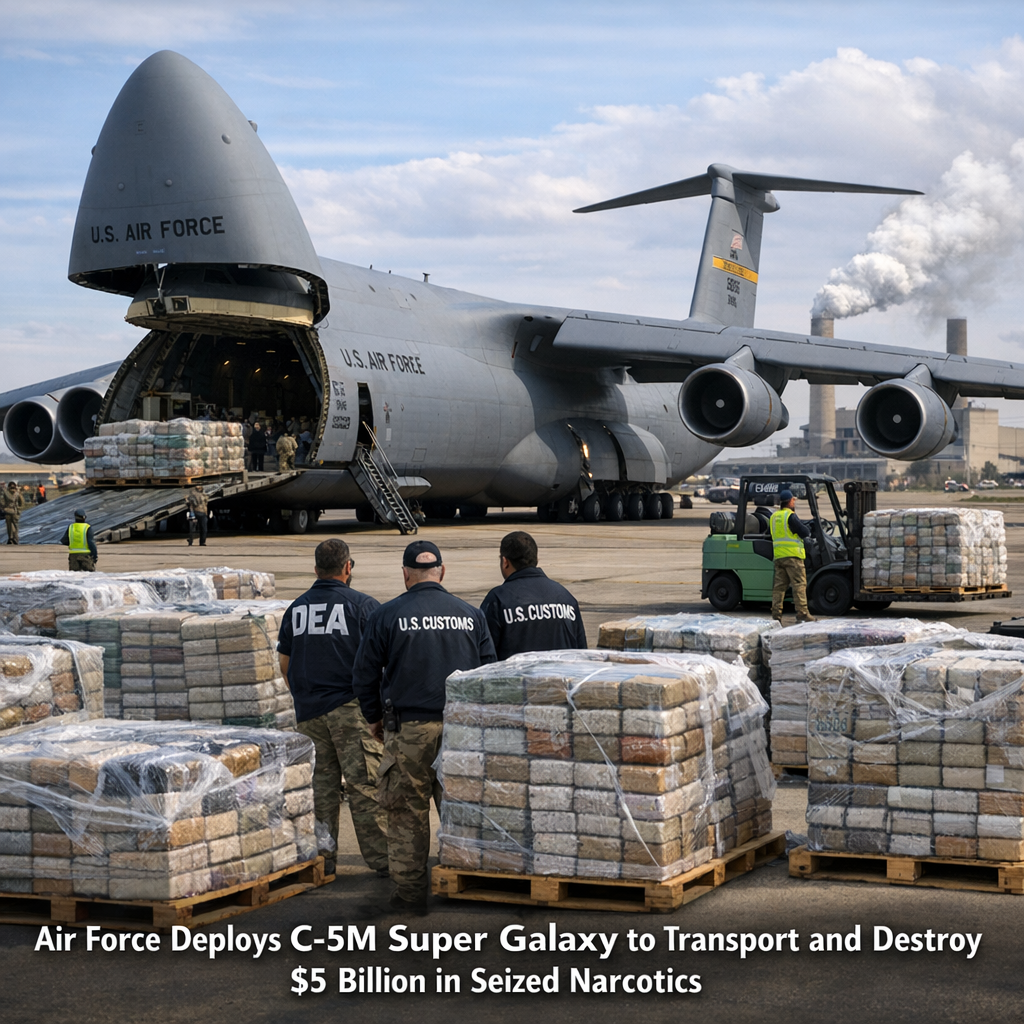
The U.S. Air Force has played a significant logistical role in the disposal of billions of dollars’ worth of illegal narcotics, underscoring the military’s expanding support role in counter-drug operations. According to a report by Military Times titled “Air Force’s C-5M Super Galaxy aids in removal, destruction of $5 billion worth of illegal drugs,” the service deployed one of its largest cargo aircraft to transport seized drugs for destruction, highlighting the scale and complexity of such missions.
The operation centered on the C-5M Super Galaxy, a strategic airlift aircraft designed to carry oversized and heavy payloads across long distances. Its use in this case reflects the sheer volume of narcotics involved, estimated at approximately $5 billion in street value. Authorities required an aircraft capable of efficiently relocating vast quantities of contraband from storage sites to secure destruction facilities, a task beyond the scope of smaller transport options.
The mission illustrates how military assets are periodically tasked with supporting domestic and international law enforcement agencies. While counter-narcotics efforts are typically led by civilian authorities such as the Drug Enforcement Administration, the Department of Defense provides specialized capabilities, including transportation, surveillance, and logistical coordination. The involvement of the C-5M highlights how these collaborations leverage military infrastructure to handle large-scale operations that would otherwise strain civilian capacity.
Officials emphasized that the destruction of the drugs was a critical step in ensuring they could not re-enter illicit markets. Such operations often involve coordination among multiple agencies and strict chain-of-custody protocols to maintain accountability from seizure to destruction. The need for secure and verifiable disposal becomes especially pressing when dealing with quantities of narcotics of this magnitude, both to protect public safety and to maintain confidence in enforcement processes.
The use of a high-profile military aircraft for this purpose also reflects broader strategic messaging. By visibly committing significant resources to the eradication of illegal drugs, authorities aim to reinforce deterrence and demonstrate institutional resolve against trafficking networks. However, it also brings attention to the persistent scale of the global drug trade, as noted by organizations like the United Nations Office on Drugs and Crime, since the destruction of even billions of dollars’ worth of narcotics represents only a fraction of the overall market.
The Military Times report situates this operation within a continuing pattern of military support to law enforcement, particularly in situations requiring rapid movement of high-volume or sensitive cargo. As trafficking organizations evolve and expand, such cross-agency cooperation is likely to remain a key component of efforts to disrupt supply chains.
While the C-5M Super Galaxy is typically associated with transporting troops, equipment, and humanitarian aid, its role in this mission demonstrates the flexibility of military logistics in addressing nontraditional security challenges. The operation stands as a reminder that combating the narcotics trade often requires not only investigative work and interdiction, but also the capacity to manage its aftermath on an industrial scale.