Iran Ghost Fleet Uses Sea Transfers to Evade Sanctions
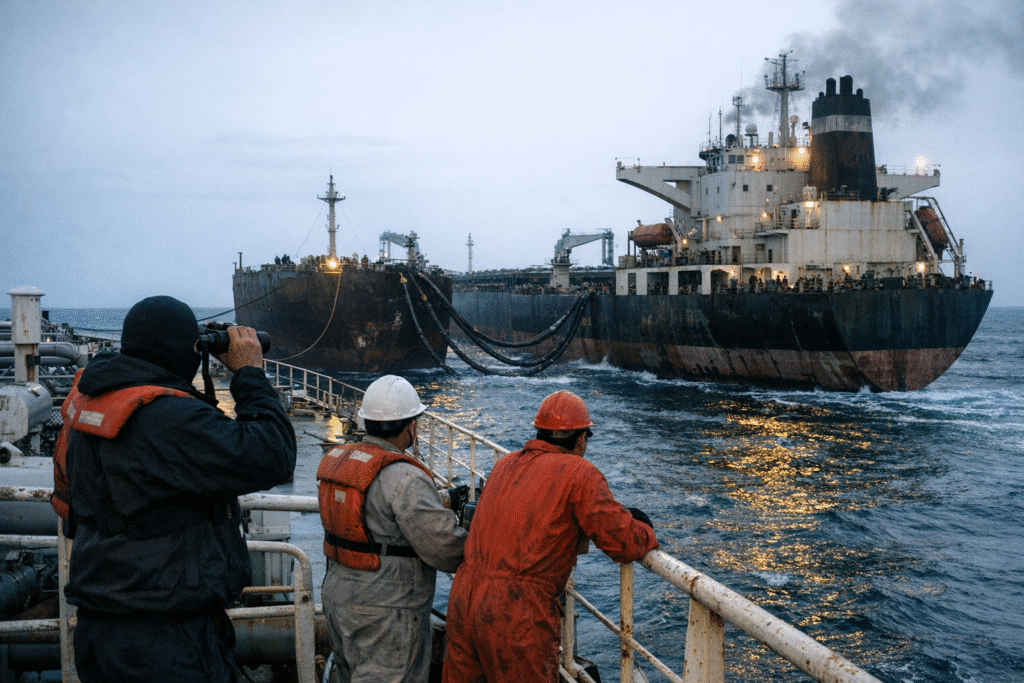
A new investigation by The Wall Street Journal sheds light on the expanding sophistication of Iran’s efforts to evade international sanctions on its oil exports, revealing a covert maritime network designed to obscure both the origin and destination of crude shipments. The report, titled “We Tracked Iran’s Secret ‘Ghost Ships’ Transferring Oil at Sea,” documents how aging tankers, often operating under opaque ownership structures and with transponders switched off, are used to quietly transfer oil between vessels in international waters.
According to the findings, these ship-to-ship transfers typically occur at night and in regions with limited monitoring, allowing cargo to change hands without appearing in official shipping records. Once transferred, the oil is frequently relabeled or blended, complicating efforts to trace it back to Iran. The Wall Street Journal’s analysis draws on satellite imagery, shipping data, and maritime tracking tools to reconstruct routes that would otherwise remain concealed.
This so-called “ghost fleet” has grown as Tehran has adapted to years of economic pressure from U.S. sanctions, which aim to curtail its oil revenues. By masking maritime activity and exploiting regulatory gaps, Iran appears to have maintained a significant level of exports despite restrictions. The vessels involved often sail under flags of convenience or use shell companies registered in jurisdictions with limited transparency, further obscuring accountability.
The investigation highlights the challenges faced by regulators and governments attempting to enforce sanctions in a global shipping system that remains fragmented and, in many cases, reliant on self-reporting. Tankers can disable Automatic Identification System (AIS) transponders—devices designed to broadcast a ship’s location—effectively vanishing from standard tracking systems. While such actions can raise suspicion, policing them across vast ocean areas remains difficult.
The Wall Street Journal reports that some of these transfers take place near busy shipping lanes in Asia and the Middle East, enabling vessels to blend into dense maritime traffic. Once the oil reaches its final destination, often in countries willing to purchase discounted crude, its origins are difficult to verify.
Analysts say the persistence and scale of these operations point to a highly coordinated logistical network that has evolved in response to enforcement efforts. It also underscores the limitations of sanctions regimes that depend heavily on monitoring financial systems and formal trade channels, while physical commodities can still move through less visible routes.
The findings come at a time of continued geopolitical tension surrounding Iran’s energy sector and broader regional security concerns. As the global demand for oil fluctuates and enforcement priorities shift, the tactics described in The Wall Street Journal’s investigation suggest that covert maritime trade will remain a central feature of sanction evasion strategies.
By exposing the mechanics of these hidden transfers, the report provides rare insight into a system that operates largely out of public view, raising questions about how effectively international sanctions can be enforced when faced with increasingly adaptive methods of circumvention.