NATO Expands Strategic Communications Training to Strengthen Ukraine’s Public Affairs Capabilities
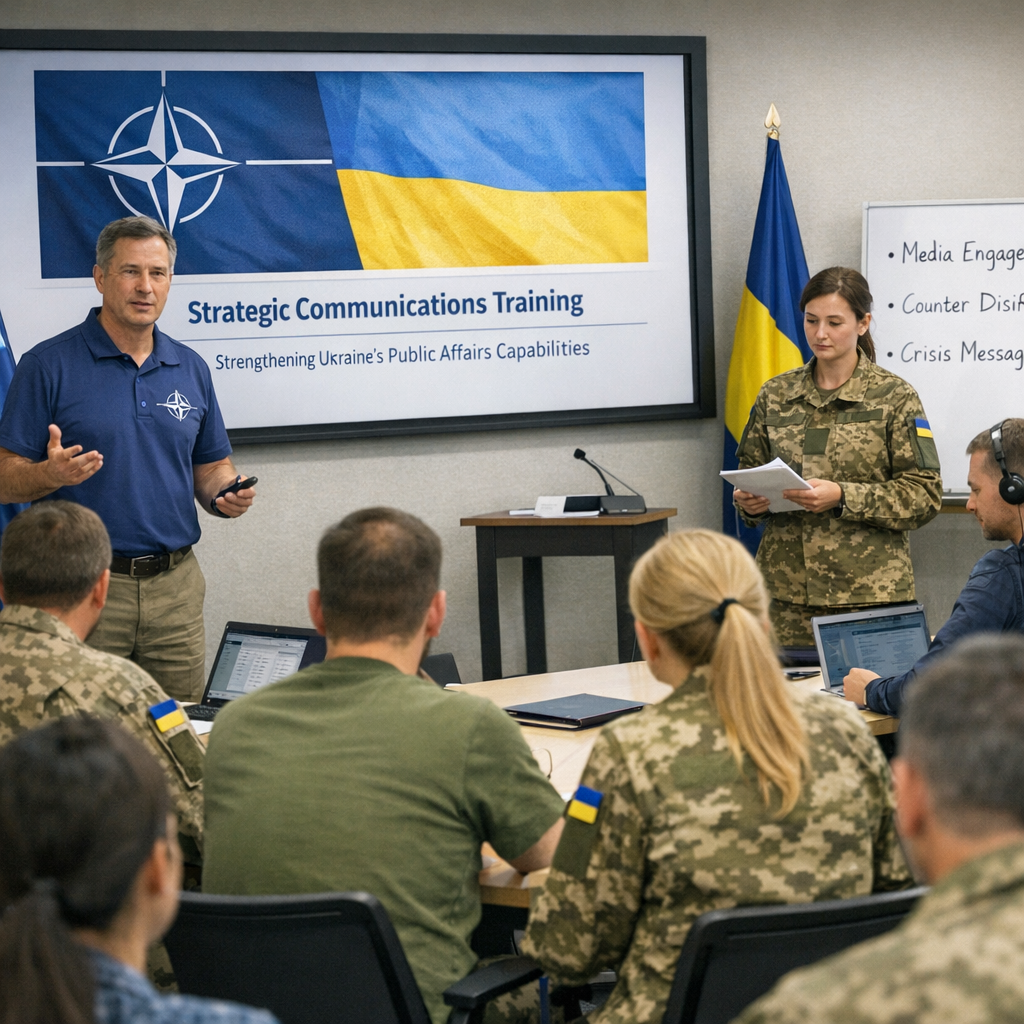
NATO has expanded its support for Ukraine’s strategic communications capacity with a new round of training aimed at strengthening the country’s public affairs capabilities, according to a report published by NATO titled “NATO delivers training for Ukraine’s public affairs teams” on its official website.
The initiative, delivered under NATO’s broader assistance framework for Ukraine, focuses on equipping public affairs personnel from Ukraine’s security and defence institutions with tools to communicate more effectively in a complex information environment shaped by ongoing conflict. The training brought together Ukrainian participants for a programme combining practical exercises, scenario-based learning, and guidance from NATO communications experts.
According to NATO, the sessions were designed to improve crisis communication, media engagement, and strategic messaging, particularly in high-pressure situations. Participants were introduced to best practices for handling disinformation, coordinating messaging across institutions, and maintaining transparency with both domestic and international audiences, building on approaches similar to those outlined by the NATO Strategic Communications Centre of Excellence.
Officials cited in the NATO report emphasized that effective public communication has become a central component of modern defence and security efforts, especially as Russia’s war against Ukraine continues to unfold alongside aggressive information campaigns documented by platforms such as EUvsDisinfo. Strengthening Ukraine’s ability to respond quickly and credibly to evolving narratives was presented as a key objective of the training.
The programme also reflects NATO’s longer-term effort to help Ukraine build institutional resilience. By investing in professional development for public affairs teams, the alliance aims to support more consistent, accurate, and timely communication from Ukrainian authorities, which NATO views as essential for maintaining public trust and international support, echoing broader governance principles promoted by the Organization for Security and Co-operation in Europe (OSCE).
Ukrainian participants highlighted the value of the training in refining their ability to operate in a high-stakes media landscape, where information can shape both battlefield outcomes and diplomatic dynamics. The exchange with NATO experts also provided an opportunity to align Ukraine’s communication practices more closely with those of allied countries and institutions such as NATO’s public diplomacy efforts.
The training forms part of NATO’s wider package of non-lethal assistance to Ukraine, which includes advisory support, capacity-building initiatives, and programmes designed to enhance democratic governance in the security sector, complementing international support tracked by organizations like the World Bank’s Ukraine programme. While NATO is not a direct participant in the conflict, it has continued to deepen its partnership with Ukraine through such initiatives.
As noted in the NATO article, the alliance plans to sustain these efforts, with further training and cooperation expected as Ukraine continues to adapt to the demands of prolonged conflict and an evolving information environment.