Marine Corps Eyes Robots to Build Airfields Fast
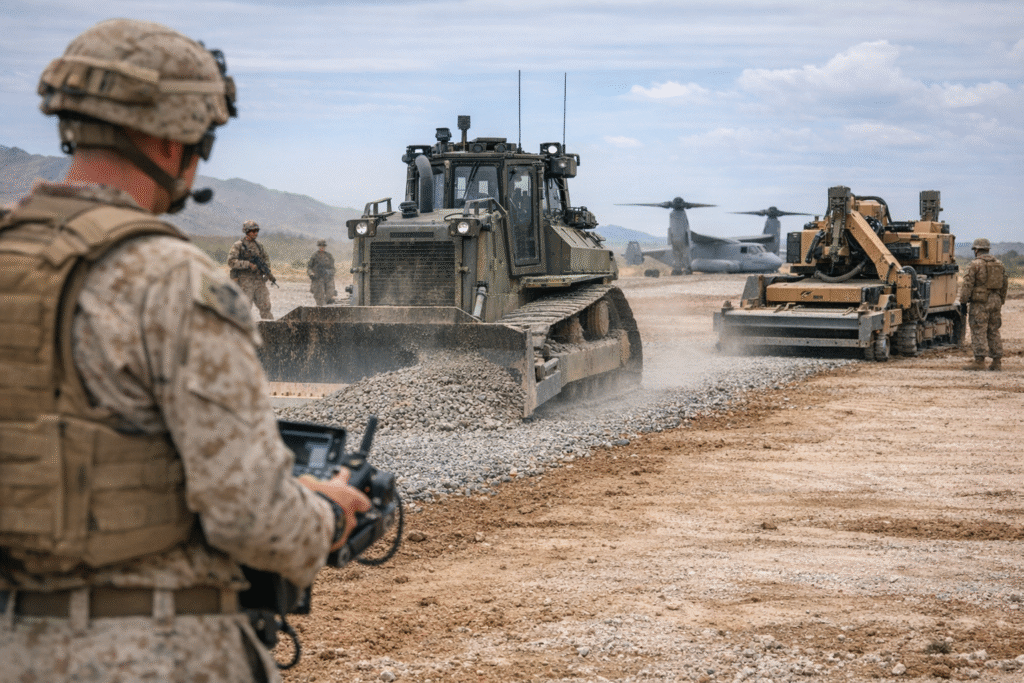
The U.S. Marine Corps is exploring the use of autonomous and robotic systems to construct expeditionary airfields, reflecting a broader shift toward automation in military logistics and engineering. The initiative, detailed in the Military Times article “The US Marine Corps is looking for a few good robots to build airfields,” underscores the service’s effort to maintain operational flexibility in contested environments while reducing risk to personnel.
According to the report published by Military Times, the Marine Corps is seeking innovative solutions that would enable rapid airfield construction with minimal human presence. These systems would be expected to perform tasks such as clearing terrain, leveling surfaces, and laying materials necessary for aircraft operations, all while operating in conditions that may be hazardous or under threat from adversaries.
The effort aligns with the Marine Corps’ evolving doctrine, particularly its emphasis on distributed operations and the need to establish temporary, austere bases across wide geographic areas. In such scenarios, traditional construction methods can be slow, manpower-intensive, and vulnerable to disruption. Autonomous systems could significantly accelerate timelines and allow Marines to focus on other mission-critical tasks.
Military planners have increasingly highlighted the vulnerability of large, centralized bases in potential conflicts with technologically advanced adversaries. Smaller, rapidly deployable airstrips are seen as a way to complicate enemy targeting and sustain air operations closer to the point of need. However, building such infrastructure quickly and safely remains a persistent challenge.
The concept of robotic construction is not entirely new, but advances in artificial intelligence, machine learning, and autonomous navigation have made more sophisticated applications feasible. The Marine Corps’ interest reflects a wider Department of Defense push to integrate unmanned systems into both combat and support roles.
Still, significant technical and operational hurdles remain. Robotic systems must be capable of functioning in unpredictable environments, handling complex construction tasks, and coordinating with other machines and human operators. Reliability, cybersecurity, and logistical support are also key concerns that could influence how quickly such technologies are adopted.
Industry partners are expected to play a central role in developing these capabilities, as the Marine Corps looks to tap into commercial innovation while tailoring solutions to military requirements. The initiative may involve prototyping, testing, and iterative development before any systems are fielded at scale.
If successful, the use of robotic builders could reshape how the Marine Corps prepares for future conflicts, offering a means to expand operational reach while minimizing exposure to risk. The effort illustrates how automation is increasingly viewed as a force multiplier, not only in combat but in the fundamental tasks that enable military operations.