Army tests rocket-armed resupply drone concept
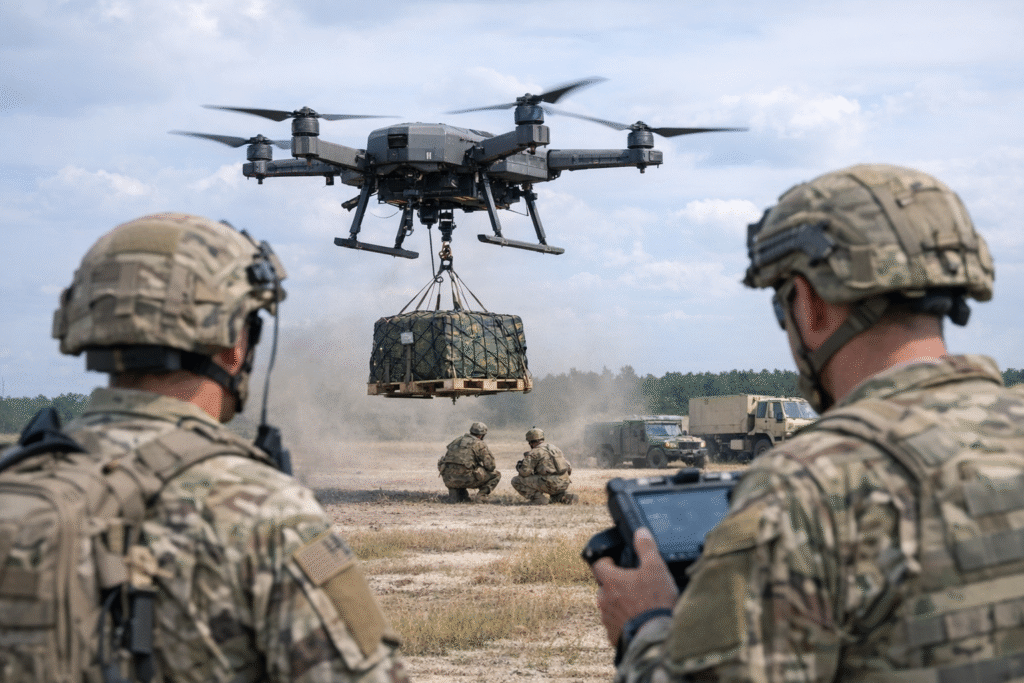
The U.S. Army is accelerating its exploration of low-cost, adaptable battlefield technologies, as demonstrated in a recent experiment that converted a resupply drone into a rocket-launching platform. The test, detailed in the Defense News article “Army turns resupply drone into rocket launcher in new test,” reflects a broader shift toward improvised yet scalable systems shaped by lessons from contemporary conflicts.
According to Defense News, the Army modified an existing logistics drone—originally designed to carry supplies to troops in contested areas—by integrating a launcher capable of firing 70mm rockets. The demonstration, conducted as part of an ongoing series of field experiments, highlights how rapidly adaptable commercial and near-commercial systems are reshaping military thinking about both logistics and combat roles.
Officials involved in the effort emphasized that the project is not about replacing traditional weapons platforms, but about expanding the range of options available to commanders. By using relatively inexpensive drones that can be quickly configured for different missions, units may gain access to capabilities that were previously limited to more costly or specialized systems. The ability to pivot a platform from resupply to strike functions, even in a limited capacity, underscores the Army’s interest in flexibility over rigid specialization.
The test also reflects the influence of recent battlefield developments, particularly in Ukraine, where both state and non-state actors have repurposed commercial drones for surveillance and attack missions with notable effectiveness. The Army has been closely studying these trends, seeking to institutionalize some of the improvisational tactics seen in those conflicts while maintaining safety, reliability, and command oversight.
One of the key challenges identified in the Defense News report is ensuring that such systems can operate effectively in contested electromagnetic environments. Drones that rely on commercial navigation or communication links are vulnerable to jamming and disruption, raising questions about how they would perform against a technologically sophisticated adversary. Army developers are therefore examining ways to harden these systems or provide alternative control methods.
There are also broader doctrinal considerations. Integrating multi-role drones into existing force structures requires rethinking how units are organized, trained, and equipped. A logistics drone that can double as a weapon introduces new questions about rules of engagement, accountability, and coordination with other assets on the battlefield.
Despite these challenges, the Army appears committed to continuing its experimentation. The emphasis, as described in the Defense News coverage, is on rapid prototyping and iterative testing rather than long development cycles. This approach allows the service to quickly assess what works, discard what does not, and refine promising concepts.
The transformation of a resupply drone into a rocket launcher may not, in itself, represent a निर्णtive technological breakthrough. However, it signals a broader evolution in military thinking—one that prioritizes adaptability, affordability, and speed in responding to emerging threats. As the Army continues to explore such concepts, the line between support systems and combat platforms may become increasingly blurred, reshaping expectations of what even the simplest equipment can do in modern warfare.