Army Pushes Quieter Deadlier Special Ops Helos
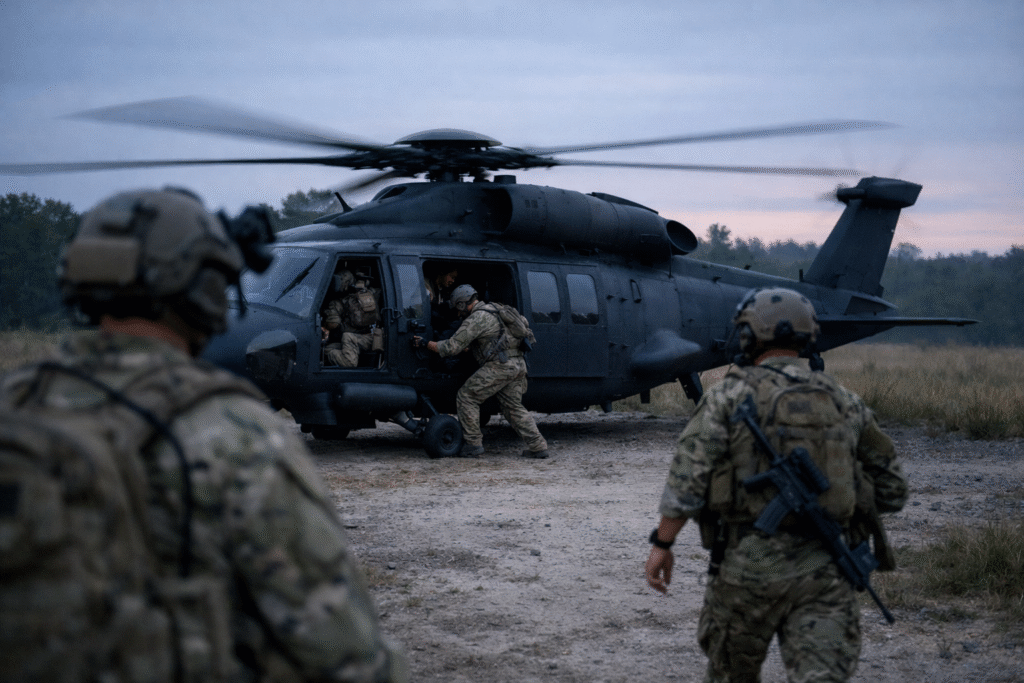
U.S. Army aviation officials are signaling an urgent need to modernize rotary-wing aircraft used in special operations, emphasizing that future missions will demand quieter, more efficient platforms capable of achieving greater effects with fewer aircraft. The push reflects both evolving battlefield threats and the logistical realities of deploying forces in increasingly contested environments.
According to reporting by Breaking Defense in its article “Helos need upgrades to perform special ops quieter, with fewer aircraft: PEO Rotary Wing,” Army leaders responsible for rotary-wing acquisition are reassessing how helicopters support elite units conducting high-risk, low-visibility missions. The emphasis is shifting from sheer aircraft numbers to precision, survivability, and acoustic signature reduction.
Brig. Gen. David Phillips, Program Executive Officer for Army Aviation’s Rotary Wing portfolio, indicated that future operations will require helicopters that are harder to detect, both visually and audibly, while also carrying more capability per sortie. This reflects hard lessons learned from recent conflicts and anticipates adversaries equipped with increasingly sophisticated detection systems.
Reducing noise signatures has emerged as a central priority. Traditional helicopters, while versatile, generate significant acoustic signatures that can compromise surprise during infiltration or exfiltration missions. Officials are now examining how design improvements, advanced rotor technologies, and integration of new propulsion concepts might mitigate those vulnerabilities. Even incremental reductions in detectability could have outsized operational impact in sensitive missions.
At the same time, the Army is confronting the reality that it may need to accomplish the same or greater mission outcomes with fewer aircraft. This is partly driven by cost pressures and partly by the growing risks associated with operating large formations in contested airspace. As a result, there is increasing emphasis on platforms that can carry heavier payloads, operate at longer ranges, and integrate more seamlessly with unmanned systems and digital command networks.
The modernization effort is not limited to entirely new aircraft programs. Current platforms may also receive upgrades aimed at extending their relevance, including improvements in avionics, survivability systems, and mission equipment. Such enhancements are seen as a near-term bridge while the Army continues to develop next-generation vertical lift capabilities.
Special operations forces, which often operate at the edge of technological and tactical innovation, are expected to play a key role in shaping these requirements. Their need for stealth, flexibility, and rapid response makes them a natural driver of aviation modernization priorities. The ability to conduct operations with fewer aircraft not only reduces exposure but also simplifies coordination in complex environments.
The urgency behind these efforts reflects broader strategic concerns. Potential adversaries are investing heavily in integrated air defense systems, electronic warfare, and surveillance technologies that could challenge legacy aviation platforms. In this context, maintaining a qualitative edge in rotary-wing capabilities is seen as essential.
As outlined in Breaking Defense’s reporting, the Army’s approach suggests a shift away from incremental improvements alone toward a more comprehensive rethink of how helicopters are designed and employed in special operations. The goal is not just to upgrade existing capabilities, but to redefine how rotary-wing aircraft contribute to mission success in an era of heightened competition and constrained resources.