Lockheed Expands THAAD Interceptor Production
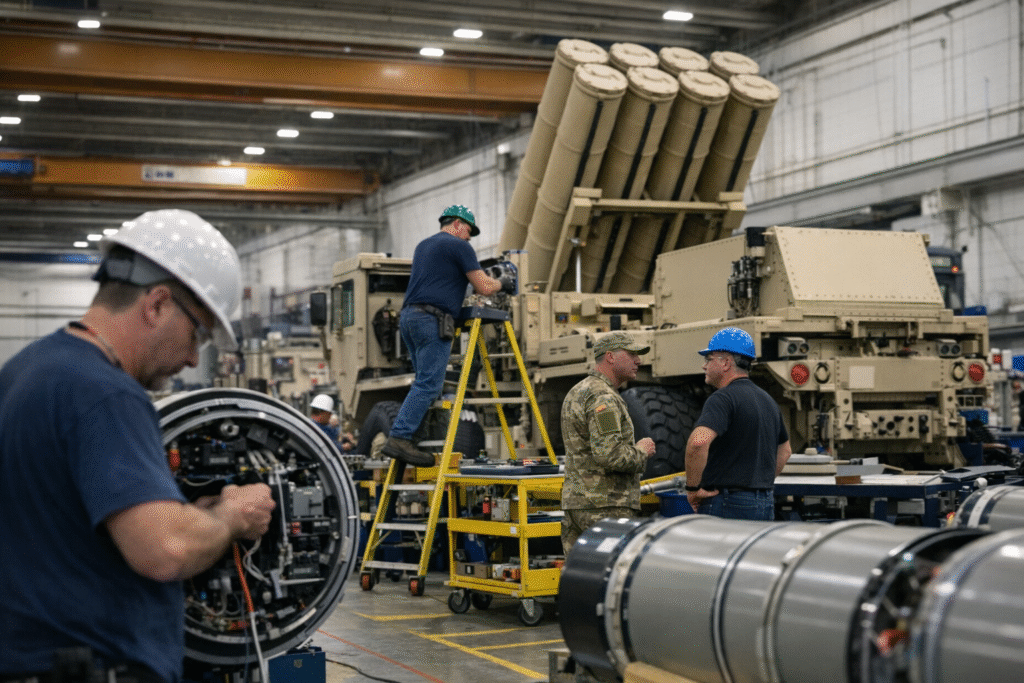
Lockheed Martin has begun construction on a new facility dedicated to producing interceptors for the Terminal High Altitude Area Defense (THAAD) system, marking a significant expansion of U.S. missile defense manufacturing at a time when the Pentagon is pressing industry to increase output of critical weapons.
The development, first reported by Breaking Defense in its article “Lockheed breaks ground on new THAAD interceptor plant as Pentagon pushes for more weapons production,” reflects a broader shift in U.S. defense policy toward rebuilding industrial capacity amid rising global demand for air and missile defense systems. The new plant is expected to enhance Lockheed Martin’s ability to produce THAAD interceptors more rapidly and at greater scale, addressing both U.S. military needs and those of allied nations.
THAAD has become a centerpiece of U.S. and allied missile defense architectures, designed to intercept short-, medium-, and intermediate-range ballistic missiles during their terminal phase of flight. Demand for the system has increased in recent years as tensions have escalated in regions such as the Indo-Pacific and the Middle East, placing pressure on existing production lines.
Pentagon officials have repeatedly emphasized the need for defense contractors to expand manufacturing capacity, citing lessons learned from the war in Ukraine and concerns over the pace at which the United States could sustain operations in a prolonged high-intensity conflict. Interceptor systems like THAAD, along with Patriot and other missile defense platforms, are considered particularly critical given the proliferation of missile threats worldwide.
The new facility is part of Lockheed Martin’s broader effort to modernize and scale its production infrastructure. By investing in additional manufacturing capacity, the company aims to reduce bottlenecks and shorten delivery timelines, which have become a central concern for both military planners and policymakers. The expansion also aligns with ongoing Pentagon initiatives to strengthen the defense industrial base through public-private collaboration, multiyear procurement strategies, and targeted investments in key munitions sectors.
Industry analysts note that missile interceptors present unique production challenges compared to other weapons systems, involving complex guidance systems, advanced materials, and rigorous testing requirements. Scaling up output without compromising quality or reliability is therefore a significant undertaking, requiring both capital investment and workforce development.
The Pentagon’s push for increased weapons production extends beyond missile defense to include artillery munitions, long-range precision fires, and naval systems. However, missile defense has taken on particular urgency as adversaries continue to expand and modernize their missile arsenals, including hypersonic and maneuverable systems that complicate interception efforts.
Lockheed Martin’s new THAAD interceptor plant signals that industry is beginning to respond to these strategic pressures. Whether such efforts will be sufficient to meet growing demand remains an open question, as supply chain constraints, workforce shortages, and budget uncertainties continue to pose challenges.
Still, the groundbreaking represents a concrete step in a broader effort to adapt the U.S. defense industrial base to a more contested and rapidly evolving security environment—one in which production capacity is increasingly viewed as a core element of national defense.