Naval Academy’s New Hair Rule for Incoming Women Sparks Debate Over Uniformity and Tradition
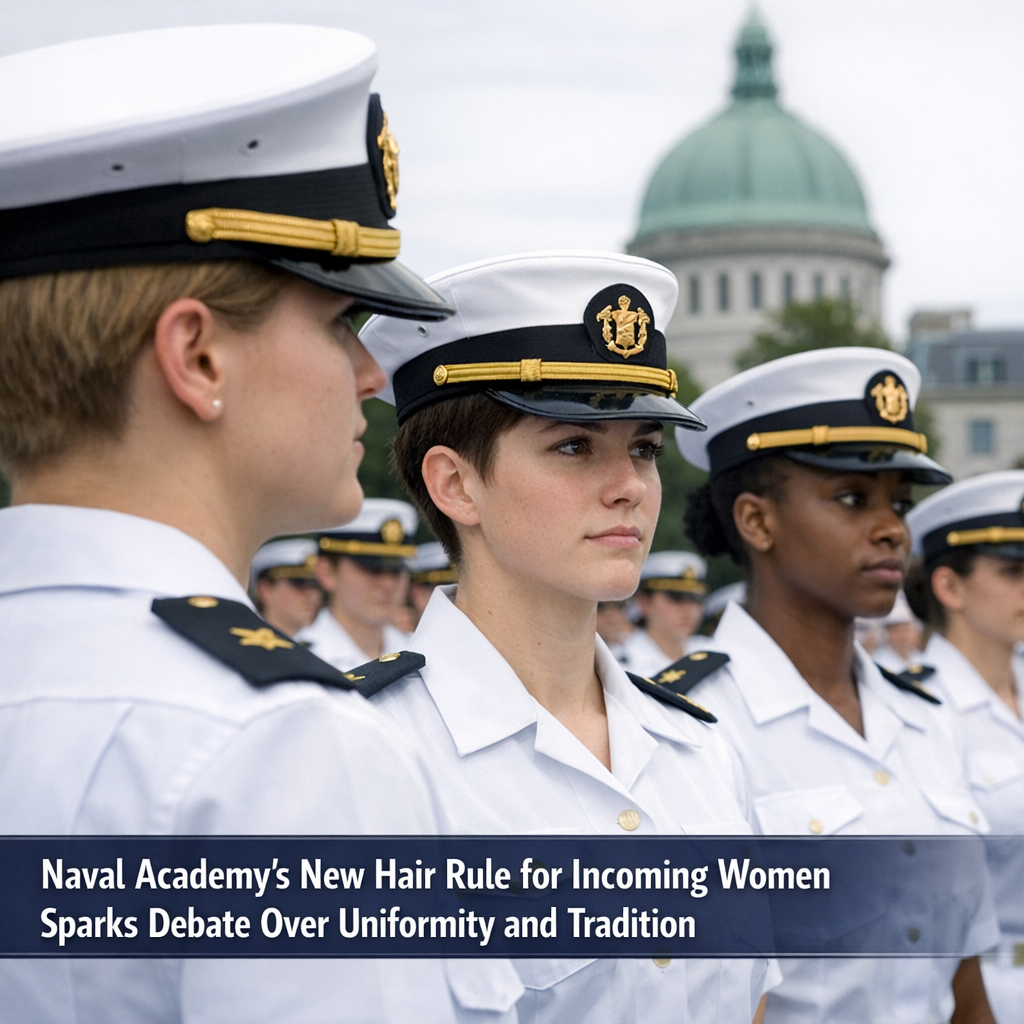
A new directive affecting incoming female midshipmen at the U.S. Naval Academy has drawn attention to the institution’s evolving standards on appearance and uniformity, prompting debate over tradition, discipline, and gender norms in military training environments.
According to reporting by Military Times in its article “Incoming female students at US Naval Academy must cut hair below chin”, the academy will now require newly admitted female students to maintain hair that does not extend below the chin upon arrival, aligning their grooming standards more closely with those long imposed on male midshipmen. The policy takes effect for the incoming class and is intended to streamline basic training requirements during the initial induction period.
Naval Academy officials have framed the change as a practical measure designed to simplify uniformity during the physically demanding early weeks of training, when recruits are introduced to military discipline, close-order drills, and strict inspections. By limiting hair length from the outset, administrators aim to reduce the need for time-consuming grooming adjustments and ensure consistency across the incoming class.
Historically, female midshipmen at the academy have been permitted to wear longer hair, provided it is styled in a manner that meets regulations once the academic year begins. However, during the initial Plebe Summer training phase, maintaining those standards can require additional time and resources. Officials indicated that the updated rule removes that complication and places all incoming students under a more uniform baseline.
The decision reflects a broader trend within the U.S. military toward revisiting gender-specific policies. In recent years, the armed forces have adjusted various grooming and appearance standards, sometimes relaxing restrictions to accommodate religious practices or personal health needs, while at other times tightening rules to emphasize cohesion and operational efficiency. Relevant guidance can be found in official Navy administrative messages and Department of Defense policy updates.
Reactions to the new academy policy have been mixed. Supporters argue that the change reinforces the principle that all midshipmen should begin training under the same expectations, reducing distinctions that could undermine unit cohesion. Critics contend that the requirement places an unequal burden on female candidates and may be seen as a symbolic rollback of accommodations that recognized differences without compromising performance.
Some observers also note that grooming standards have long played a symbolic role in military culture, serving as visible markers of discipline and conformity. Alterations to those standards, even when narrowly targeted, can carry broader implications about institutional priorities and the balance between individuality and uniformity, as outlined in the Navy’s uniform regulations.
The Naval Academy has not indicated whether the rule could be revisited or modified in future training cycles, but officials emphasized that the requirement applies only to incoming students during the initial training phase. After this period, female midshipmen will again be permitted to follow existing Navy grooming standards, which allow for longer hair if properly secured.
As the academy prepares to welcome its next class, the policy underscores the continued tension between modernization and tradition in one of the nation’s most prominent military institutions.