House Approves $1.15 Trillion Defense Bill with Military Pay Raises and Housing Allowance Reforms
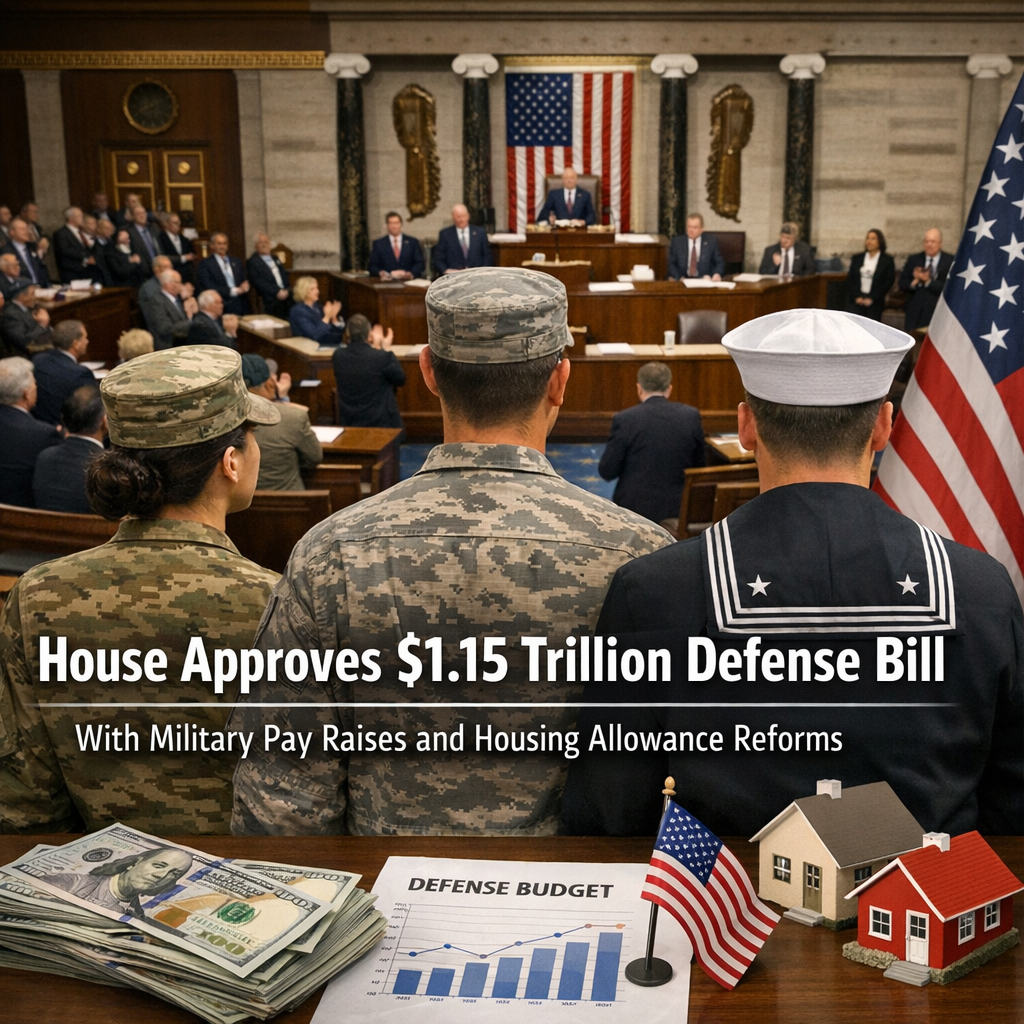
The U.S. House of Representatives has approved a sweeping $1.15 trillion defense budget bill that includes pay raises for service members and adjustments to housing allowances, measures aimed at addressing ongoing concerns about military compensation and cost-of-living pressures. The legislation, detailed in a Military Times report titled “Military pay raises, changes to housing allowance included in House-passed $1.15 trillion defense budget,” (original source) reflects congressional efforts to balance recruitment, retention, and fiscal constraints amid evolving national security demands.
At the center of the proposal is a pay increase for military personnel, continuing a recent trend of annual raises intended to keep pace with private-sector wage growth and inflation. Lawmakers have increasingly emphasized that competitive compensation is critical to sustaining an all-volunteer force, particularly as the services struggle with recruiting shortfalls in several branches, an issue documented by the Government Accountability Office.
In addition to basic pay adjustments, the bill introduces changes to the Basic Allowance for Housing, a key benefit designed to offset service members’ living expenses. Rising housing costs in many parts of the United States, tracked by the Bureau of Labor Statistics Consumer Price Index, have eroded the effectiveness of current allowances, prompting calls from military advocates and some defense officials for reform. The House measure seeks to recalibrate how these allowances are calculated, with the goal of reducing out-of-pocket costs for troops and their families, building on guidance from the Department of Defense on housing allowances.
The legislation reflects broader concerns within Congress that compensation packages have not kept up with economic realities, especially in high-cost regions where many service members are stationed. While the proposed changes stop short of fully restoring previous housing cost coverage levels, they represent a partial shift toward greater financial support.
The defense budget also includes a wide range of funding priorities beyond personnel compensation, encompassing modernization programs, readiness initiatives, and ongoing global operations, consistent with broader outlines in recent National Defense Authorization Act proposals. However, pay and benefits have emerged as a focal point in this year’s debate, underscoring bipartisan recognition of the strain faced by military families.
Despite its passage in the House, the bill faces further negotiation in the Senate, where lawmakers may propose revisions to both spending levels and compensation provisions. Differences between the chambers could shape the final outcome, particularly as fiscal pressures and competing domestic priorities complicate budget discussions, a dynamic often analyzed by the Congressional Budget Office.
The Military Times report highlights that while the House bill signals a commitment to improving service member pay and housing support, the extent of those improvements will ultimately depend on the legislative process ahead. For now, the proposal stands as a significant, if incremental, effort to address the financial challenges confronting military personnel in an increasingly expensive economic environment.