Europe Pushes New Hormuz Maritime Security Plan
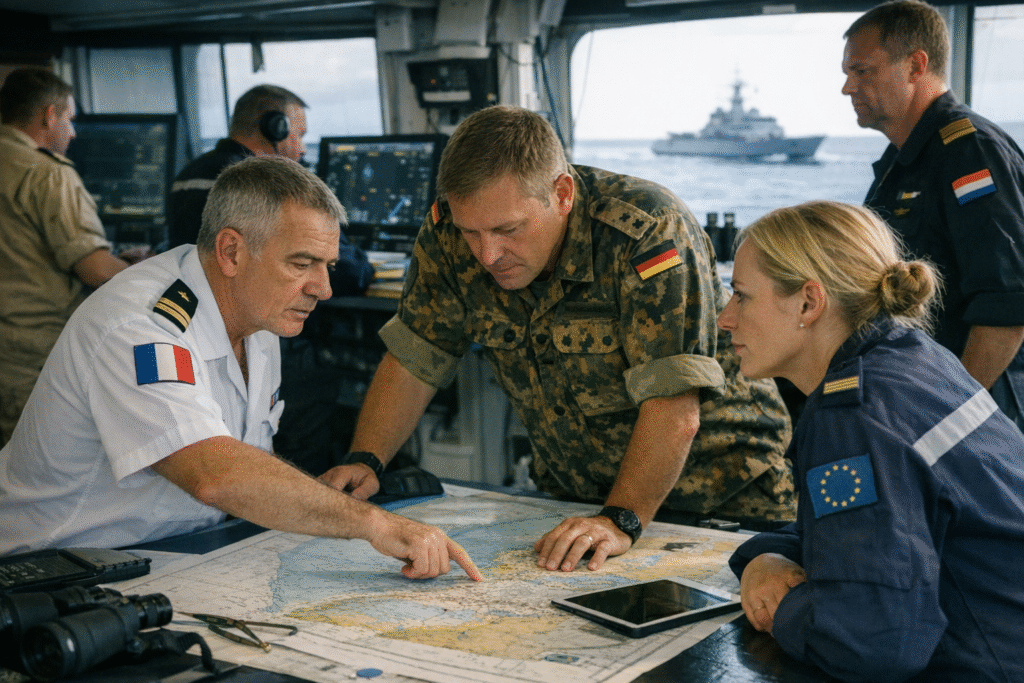
European governments are advancing plans for a coordinated maritime security effort in and around the Strait of Hormuz, reflecting mounting concern over the vulnerability of one of the world’s most critical energy chokepoints. The initiative, described in the Breaking Defense article “From destroyers to drones: How a Europe-led coalition aims to open the Strait of Hormuz,” highlights a shift toward a more flexible, technology-driven approach to safeguarding commercial shipping amid persistent regional tensions.
According to Breaking Defense, the proposed coalition would combine traditional naval capabilities with a growing array of unmanned systems, including aerial and surface drones, to monitor and deter threats in the narrow waterway. The Strait of Hormuz handles a significant portion of global oil shipments, making any disruption there a matter of international economic concern, particularly for European economies still navigating energy security challenges.
European officials and defense planners are increasingly wary that reliance on large naval platforms alone is insufficient in an environment where asymmetric tactics—Iran-backed militia activity, mine deployment, and fast-attack craft—pose persistent risks. The model under consideration blends destroyers and frigates with dispersed sensor networks and autonomous systems capable of maintaining near-constant surveillance. This layered presence is intended not only to improve early warning but also to reduce the operational strain on high-value warships.
The effort marks a notable evolution in Europe’s strategic posture in the Gulf. While European states have participated in past maritime security missions in the region, leadership has often rested with the United States. The new initiative suggests a more prominent European role, both operationally and politically, amid broader debates about burden sharing and strategic autonomy within NATO.
Breaking Defense reports that planners envision a coalition structured to allow contributions from multiple nations with varying capabilities. Smaller states could provide drones, surveillance assets, or logistical support, while larger navies would continue to supply escort vessels and command infrastructure. That modular approach reflects lessons drawn from recent conflicts, particularly in the Red Sea, where the proliferation of low-cost drones and missiles has complicated traditional naval defense.
At the same time, the initiative faces practical and political challenges. Coordinating rules of engagement among diverse participants, ensuring interoperability between manned and unmanned systems, and securing sustained funding commitments remain unresolved questions. There is also the broader regional dynamic: any expanded foreign naval presence in the Strait risks escalating tensions with Iran, which has historically viewed such deployments with suspicion.
Energy security concerns are likely to keep the issue at the forefront of European policymaking. Even limited disruptions in the Strait of Hormuz can ripple through global markets, affecting prices and supply chains far beyond the Middle East. For Europe, which has been recalibrating its energy imports in recent years, maintaining open sea lanes is increasingly tied to economic stability.
The concept outlined in the Breaking Defense report underscores a larger transformation in maritime security thinking. Rather than concentrating power in a few large assets, the emerging model emphasizes distribution, persistence, and technological integration. If implemented, the Europe-led coalition could become a test case for how middle and major powers adapt naval strategy to an era defined by both high-tech competition and diffuse, irregular threats.
Whether the effort ultimately succeeds will depend not only on technological adoption but also on political cohesion among participating states. As planning progresses, the Strait of Hormuz may once again serve as a proving ground for how alliances respond to evolving risks at sea.