Eighty-Two Years After D-Day, Normandy’s Lessons Shape Modern Deterrence and Alliance Strategy
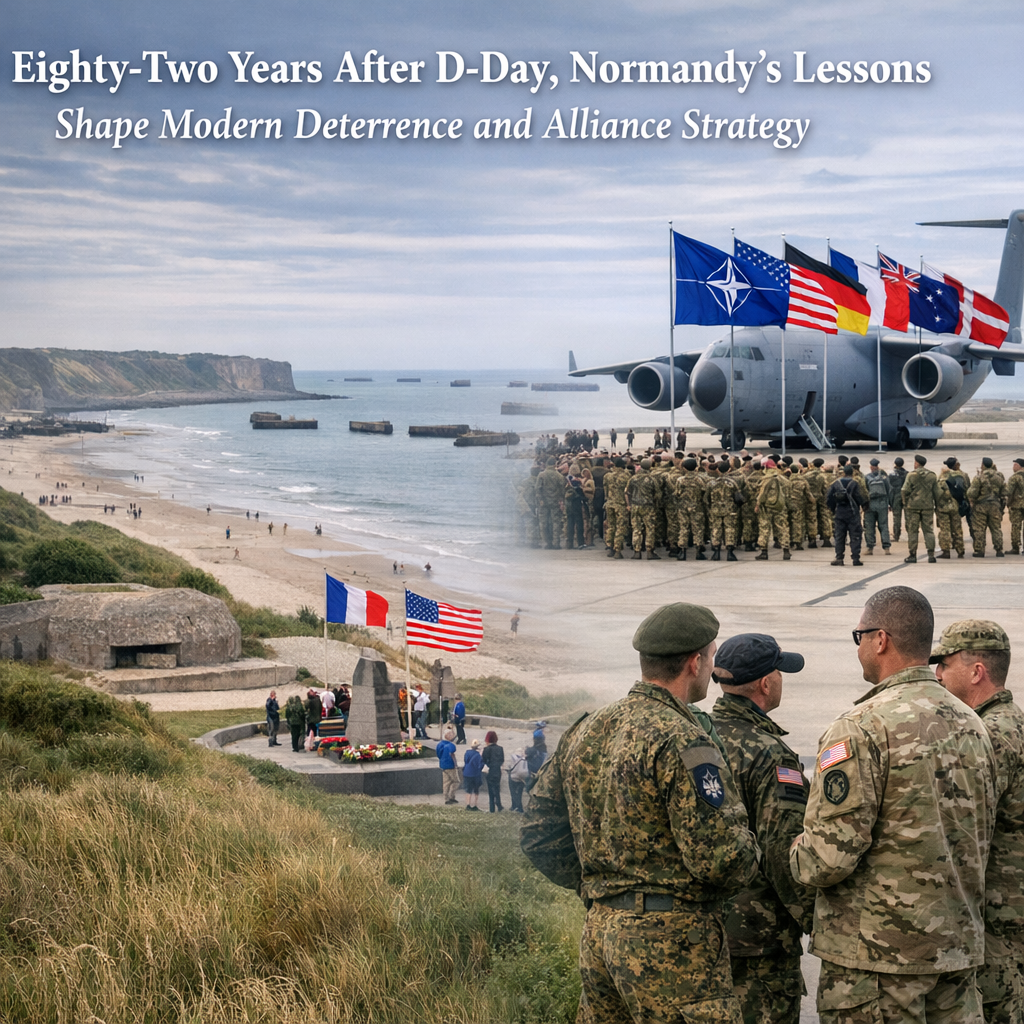
In its article “A message from Normandy, 82 years later”, Breaking Defense reflects on the enduring strategic and moral lessons of the D-Day landings, drawing connections between the Allied invasion of 1944 and today’s evolving security environment. The piece situates the anniversary not merely as a moment of remembrance, but as a call to reassess how democratic nations prepare for, deter, and, if necessary, fight large-scale conflict.
Eighty-two years after Allied forces stormed the beaches of Normandy, the article emphasizes that the operation’s success was neither inevitable nor purely the result of numerical superiority. Instead, it highlights the interplay of industrial capacity, alliance cohesion, deception, and technological adaptation. Breaking Defense underscores that these factors remain relevant as Western nations confront renewed great-power competition, particularly in Europe.
The article points to the war in Ukraine as a stark reminder that high-intensity conflict on the continent is no longer theoretical. In this context, Normandy is framed as a historical analogue that underscores the importance of logistics, interoperability among allies, and sustained political will. The scale of the D-Day invasion required immense coordination across nations and services—an element that defense analysts warn cannot be improvised in a crisis.
Breaking Defense also draws attention to the role of innovation in 1944, noting that success depended on both established capabilities and rapid adaptation to battlefield challenges. From specialized landing craft to deception campaigns like Operation Fortitude, the Allied approach blended planning with flexibility. The article suggests that modern militaries face a similar imperative as they integrate emerging technologies such as autonomous systems, cyber capabilities, and advanced surveillance into cohesive operational concepts.
At the same time, the piece cautions against overly deterministic readings of history. While Normandy demonstrates what can be achieved with unity and preparation, it also reflects the immense human cost of large-scale war. The article argues that deterrence—grounded in credible capability and alliance solidarity—is the most effective way to avoid repeating such sacrifices.
A central theme in Breaking Defense’s analysis is the importance of industrial readiness. The Allies’ ability to sustain operations after the initial landings depended on robust supply chains and manufacturing capacity. Today, defense planners are increasingly concerned that Western industrial bases may struggle to meet the demands of prolonged conflict, particularly when compared with potential adversaries that have mobilized their economies for sustained competition, such as China’s defense industrial base.
The article also stresses the enduring value of alliances, particularly NATO. Just as the success of D-Day depended on coordination among multiple nations, contemporary security challenges require shared investment and burden-sharing. Breaking Defense suggests that political cohesion, as much as military capability, will determine whether alliances can respond effectively to future crises.
Ultimately, “A message from Normandy, 82 years later,” presents the anniversary as more than historical commemoration. It is a strategic reminder that preparedness, unity, and adaptability are not abstract virtues but practical necessities. As geopolitical tensions mount, the lessons of Normandy, the article argues, remain a guide for policymakers seeking to navigate an increasingly uncertain security landscape.