Israeli Startup Unveils Rapid-Response Laser Defense System to Counter Rising Drone Threats
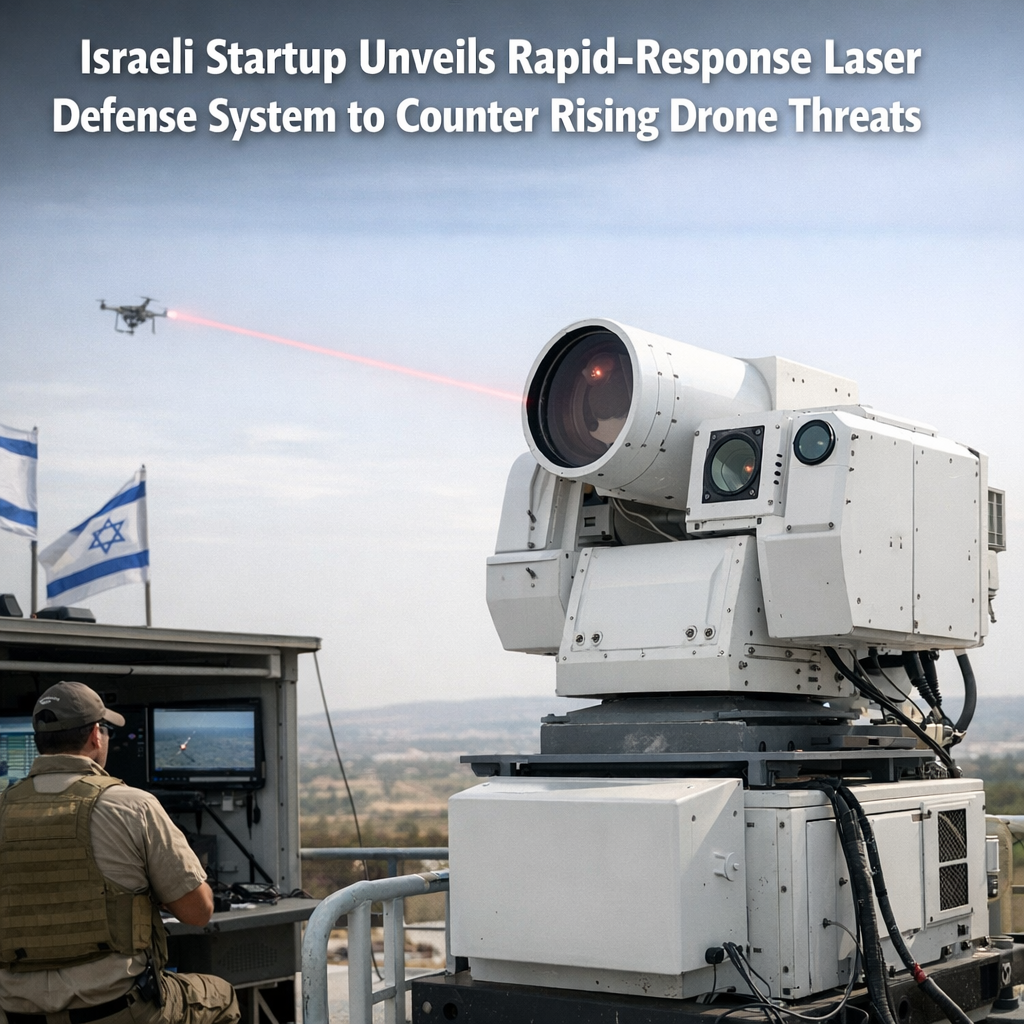
An Israeli defense startup has publicly introduced a new laser-based air defense system it claims can disable or destroy hostile drones within seconds, underscoring intensifying efforts to counter the rapid proliferation of unmanned aerial threats on modern battlefields.
According to a report by Breaking Defense, titled “Israeli startup unveils laser system it says can kill drones in seconds,” the company presented its system as a compact, high-energy laser designed to engage small airborne targets quickly and at relatively low cost per interception. The unveiling comes amid growing global demand for effective counter-drone technologies as both state and non-state actors increasingly deploy inexpensive unmanned systems in surveillance and attack roles. (See original report.)
The startup said its laser weapon is engineered to track and neutralize drones almost instantaneously once locked on, emphasizing speed and precision as key advantages over traditional interceptors. Unlike missile-based air defenses, which can be costly and limited in supply, laser systems rely primarily on electrical power, potentially enabling sustained operation with minimal logistical burden. Similar concepts are being explored in programs such as the U.S. Army’s Directed Energy M-SHORAD initiative.
Developers highlighted that the system is intended to integrate with existing air defense networks, suggesting it could serve as a complementary layer alongside radar-guided missiles and electronic warfare tools. By focusing on short-range threats such as small drones and loitering munitions, the technology aims to fill a critical gap that has been exposed in recent conflicts. NATO has also emphasized the urgency of counter-drone capabilities in its counter-UAS strategy.
The Breaking Defense report notes that the company’s claims remain subject to verification under operational conditions, a common hurdle for emerging directed-energy weapons. While laser systems have advanced significantly in recent years, questions persist about their performance in adverse weather, including dust, fog, and rain, which can degrade beam effectiveness. Research from organizations like RAND Corporation has highlighted these environmental limitations.
Even so, defense analysts increasingly view such systems as a necessary evolution in air defense architecture. The relatively low cost of deploying drones has challenged conventional military economics, where expensive interceptors are often used against far cheaper threats. Directed-energy weapons promise a shift in that balance by lowering the cost per engagement, a concept also reflected in Israel’s development of systems like Iron Beam.
Israel has been a leading developer of missile defense systems, and it has also invested heavily in laser technologies as a next-generation solution. The unveiling of this startup’s system reflects a broader national push to expand layered air defenses beyond kinetic interceptors, complementing systems such as Rafael’s air defense portfolio.
If the system performs as described, it could offer militaries a scalable means of protecting infrastructure, bases, and civilian areas from the growing threat posed by small, agile unmanned aircraft. However, as with many emerging defense technologies, its ultimate impact will depend on rigorous testing, operational integration, and real-world performance under contested conditions.