Germany Pairs P-8 Poseidon Fleet with MQ-9 Reapers to Boost Tracking of Russian Submarines
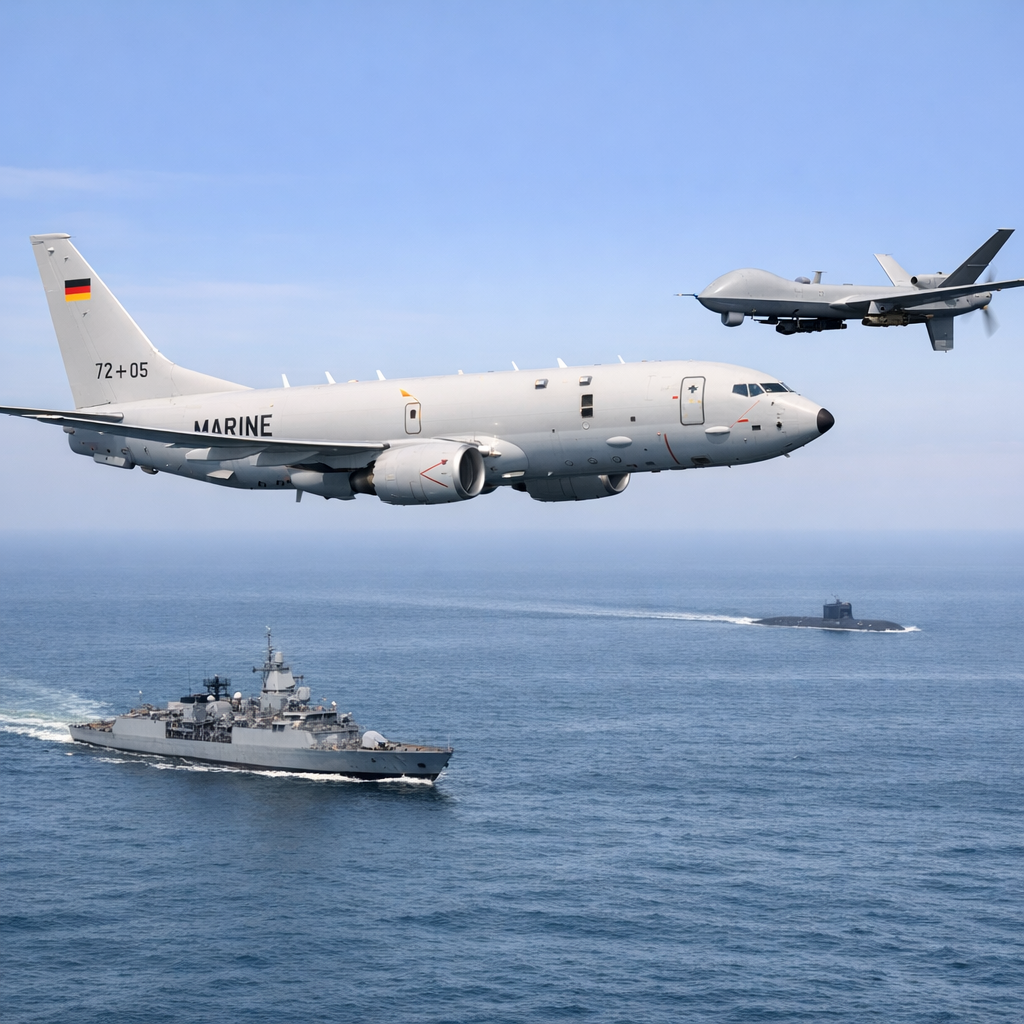
Germany is moving to strengthen its maritime surveillance capabilities by pairing its incoming fleet of Boeing P-8A Poseidon maritime patrol aircraft with MQ-9 Reaper drones, a shift aimed at improving its ability to monitor Russian submarine activity in European waters. The development was detailed in the Breaking Defense article “The threat is there: Germany to pair P-8s with MQ-9 drones to keep an eye on Russian subs”, which underscores Berlin’s growing concern about undersea threats in the Baltic and North Atlantic regions.
German defense officials have framed the initiative as a response to an increasingly active Russian navy, particularly its submarine force, which NATO planners view as a critical component of Moscow’s deterrence and power-projection strategy. The integration of crewed and uncrewed systems reflects a broader NATO trend toward layered surveillance, where persistent drone coverage complements the more advanced sensor suites and rapid response capabilities of manned aircraft.
The P-8A Poseidon, already in service with several NATO allies, is designed for anti-submarine warfare, anti-surface warfare, and intelligence, surveillance, and reconnaissance missions. Equipped with advanced sonar buoys, radar systems, and weapons including torpedoes, the aircraft is capable of detecting and, if necessary, engaging hostile submarines. Germany’s acquisition of the platform marks a significant upgrade from its aging P-3C Orion fleet, aligning its capabilities more closely with those of the United States and the United Kingdom.
The MQ-9 Reaper, by contrast, offers endurance rather than firepower. Able to remain airborne for extended periods, it provides persistent surveillance over large maritime areas, feeding real-time intelligence back to operators and supporting cueing for other assets. While traditionally associated with counterterrorism operations over land, the MQ-9’s maritime surveillance role has expanded in recent years, with sensor packages adapted for tracking surface vessels and contributing to anti-submarine operations.
The operational concept emerging from Berlin envisions the drones acting as an initial detection layer, scanning broad swaths of ocean and identifying anomalies or contacts of interest. Once a potential submarine presence is detected, P-8 aircraft can be deployed to investigate more closely, using their specialized equipment to localize and track targets. This division of labor is intended to maximize efficiency while reducing the strain on more costly and resource-intensive crewed platforms.
German officials cited in the Breaking Defense report emphasized that the move is driven by a clear assessment of the current security environment. Russian submarine patrols have become more frequent and more capable, and NATO planners have raised concerns about the vulnerability of undersea infrastructure, including data cables and energy pipelines. The Baltic Sea, in particular, has emerged as a focal point following a series of unexplained incidents affecting critical infrastructure in recent years.
The initiative also reflects Germany’s broader effort to assume a more active role within NATO’s collective defense framework. Long criticized for underinvestment in its military, Berlin has begun to reorient its defense posture following Russia’s full-scale invasion of Ukraine in 2022. Investments in maritime patrol aviation and unmanned systems are seen as a way to contribute meaningfully to alliance priorities, particularly in the northern European theater.
Integrating the P-8 and MQ-9 will present technical and organizational challenges, including data-sharing architectures and coordination between service branches. However, defense planners increasingly view such integration as essential to modern warfare, where speed of information and the ability to fuse data from multiple platforms can determine operational success.
As Breaking Defense noted in its reporting, German officials are under no illusion about the stakes. The emphasis on surveillance and early detection reflects a recognition that maritime competition with Russia is intensifying, even as much of Europe’s attention remains focused on land operations in Ukraine. By investing in a combined crewed-uncrewed capability, Germany is signaling that it intends to play a more assertive role in monitoring and securing NATO’s northern maritime flank.