Exurbs Lead America’s Population Boom
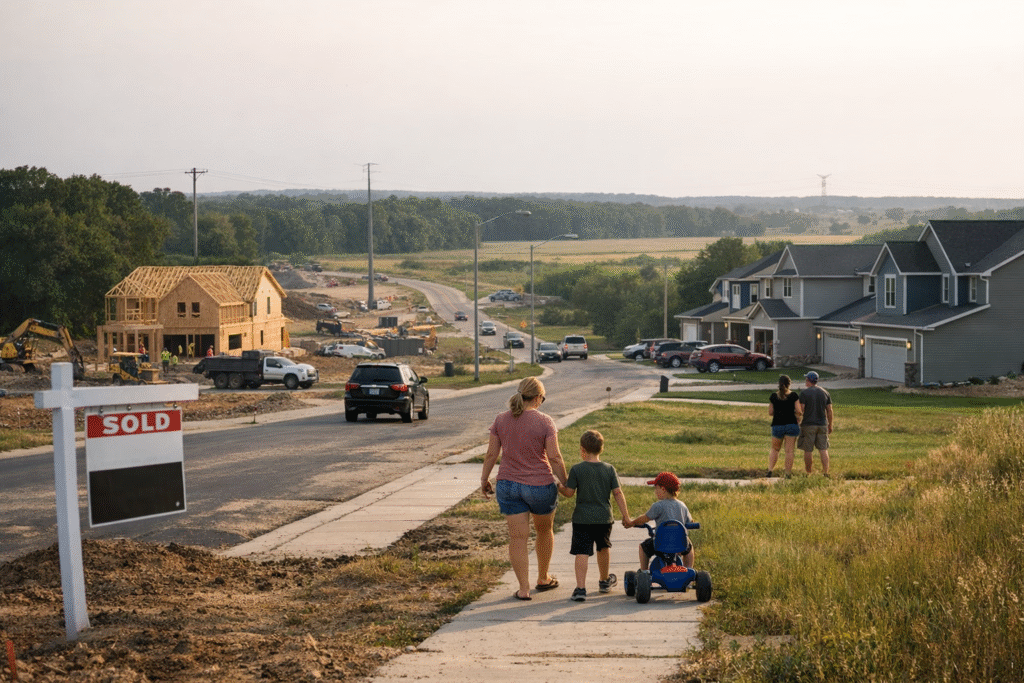
A recent Wall Street Journal report titled “America’s Fastest-Growing Cities Are in the Exurbs” highlights a striking shift in U.S. population patterns, as growth increasingly concentrates on the far outer edges of metropolitan areas rather than in urban cores or close-in suburbs. The trend reflects a complex convergence of housing affordability pressures, remote and hybrid work arrangements, and changing household preferences that have accelerated in the years following the pandemic.
According to the Wall Street Journal, many of the country’s fastest-growing communities are located well beyond traditional suburban rings, in areas once considered too distant for daily commuting. These exurban locales, often defined by lower housing costs and greater availability of land, are drawing a steady influx of residents from high-cost metropolitan centers. In places across Texas, Florida, and the Mountain West, small towns and previously underdeveloped areas are rapidly transforming into bustling residential hubs.
Housing affordability remains a primary driver of this migration. Sharp increases in home prices and rents in major cities have pushed many households to look further afield for attainable options. In exurban areas, larger homes with more space—both indoors and outdoors—are often available at significantly lower prices. For families in particular, the trade-off between commute distance and housing value has shifted decisively, especially as remote work reduces the need for daily travel into city centers.
The normalization of remote and hybrid work has played a central role in enabling this shift. Employers’ increasing tolerance for flexible work arrangements has untethered many workers from geographic proximity to offices. As a result, households are recalibrating what constitutes a practical distance from employment hubs. In some cases, workers are willing to accept occasional long commutes in exchange for more affordable living conditions and perceived quality-of-life improvements.
At the same time, local governments and developers in exurban regions are working to accommodate rapid population growth. Residential construction has surged, accompanied by investment in infrastructure such as roads, schools, and utilities. However, the pace of expansion has raised concerns about whether these areas can sustain growth without straining public services or diminishing the very qualities that attracted residents in the first place.
The Wall Street Journal notes that while exurbs are benefiting from the current migration wave, the trend carries broader implications for urban planning and economic development. Central cities, which experienced population losses during the early stages of the pandemic, have begun to stabilize in some regions, but the longer-term balance between urban, suburban, and exurban growth remains uncertain. Policymakers face the challenge of managing uneven growth patterns while addressing housing shortages and infrastructure needs across different types of communities.
Environmental considerations also loom large. Increased development in outlying areas can lead to greater car dependency, longer travel distances, and expanded land use, all of which carry sustainability concerns. Planners and analysts warn that without careful oversight, the expansion of exurbs could exacerbate traffic congestion and environmental pressures, even as it alleviates housing shortages elsewhere.
Despite these challenges, the surge in exurban growth underscores a broader redefinition of American living patterns. As the Wall Street Journal’s reporting suggests, the evolving relationship between work, housing, and geography continues to reshape where and how people choose to live. Whether this shift proves durable will depend on economic conditions, employer policies, and the ability of rapidly growing communities to adapt to their newfound prominence.