MLB Owners Push Salary Cap Ahead of Labor Talks
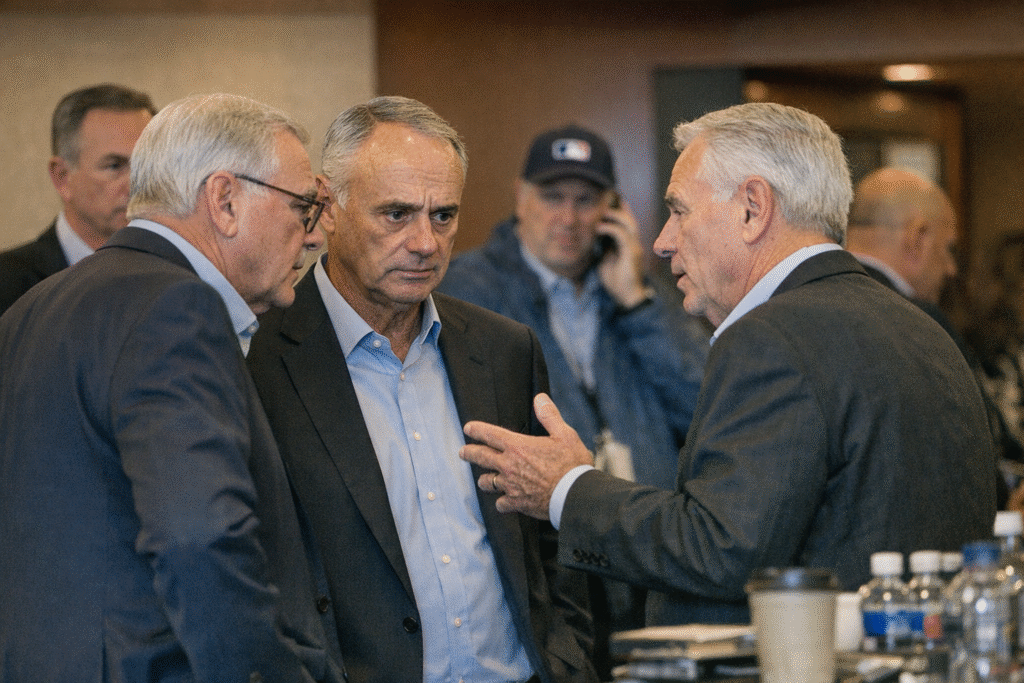
Major League Baseball owners are increasingly consolidating their position around the idea of implementing a salary cap, a shift that could set the stage for a significant confrontation with players as the sport edges toward its next round of labor negotiations.
According to the Wall Street Journal article titled “MLB Owners Eye Salary Cap,” team executives have grown more vocal about concerns over widening payroll disparities, arguing that the current system—anchored by a competitive balance tax rather than a hard spending limit—has failed to ensure sufficient parity across the league. Smaller-market franchises in particular contend that escalating player salaries and aggressive spending by top-revenue clubs are putting them at a competitive disadvantage that revenue sharing alone cannot fully address.
The issue, long considered a third rail in baseball labor relations, is expected to loom large ahead of the expiration of the current collective bargaining agreement in December 2026. MLB has not operated under a salary cap, unlike the NFL, NBA, and NHL, and the players’ union has historically opposed any proposal that would explicitly limit earning potential. That resistance remains firm, with union leadership continuing to frame a cap as a nonstarter that would suppress wages and undermine the open-market system players have fought to preserve for decades.
Owners, however, appear increasingly emboldened by broader concerns about the sport’s economic structure. Some argue that a cap system, potentially paired with a salary floor, could create more balanced competition and improve the financial stability of franchises that struggle to keep pace with high-spending rivals. The discussion has also been influenced by recent local media disruptions and declining regional sports network revenues, which have exposed vulnerabilities in the league’s financial ecosystem.
While there is no formal proposal on the table, the growing alignment among owners suggests that the conversation is moving from theoretical to strategic. Any attempt to introduce a salary cap would almost certainly lead to a contentious negotiation, raising the possibility of another work stoppage in a sport that has already experienced multiple labor disputes over the past half-century.
The league’s current system, which penalizes teams for exceeding certain payroll thresholds rather than outright restricting spending, was designed as a compromise to avoid precisely this kind of impasse. Yet critics within ownership circles argue that the tax has lost its intended deterrent effect, as wealthier clubs routinely surpass the thresholds and absorb the financial penalties.
For players, the stakes are equally high. The absence of a cap has allowed elite talent to command record-breaking contracts and has contributed to steady overall salary growth, even as concerns persist about stagnation among mid-tier and younger players. Union officials are likely to frame any salary cap proposal as an existential threat to those gains.
As the next labor negotiation cycle approaches, both sides appear to be positioning themselves for a broader philosophical debate about the structure of the game’s economy. Whether the idea of a salary cap evolves into a concrete proposal—or remains a bargaining chip in a complex negotiation—will depend largely on how much consensus owners can build and how strongly players are willing to resist.
What is increasingly clear is that the question is no longer hypothetical. It is becoming central to baseball’s future.