Arcade War Art Sparks Debate at DC Memorial
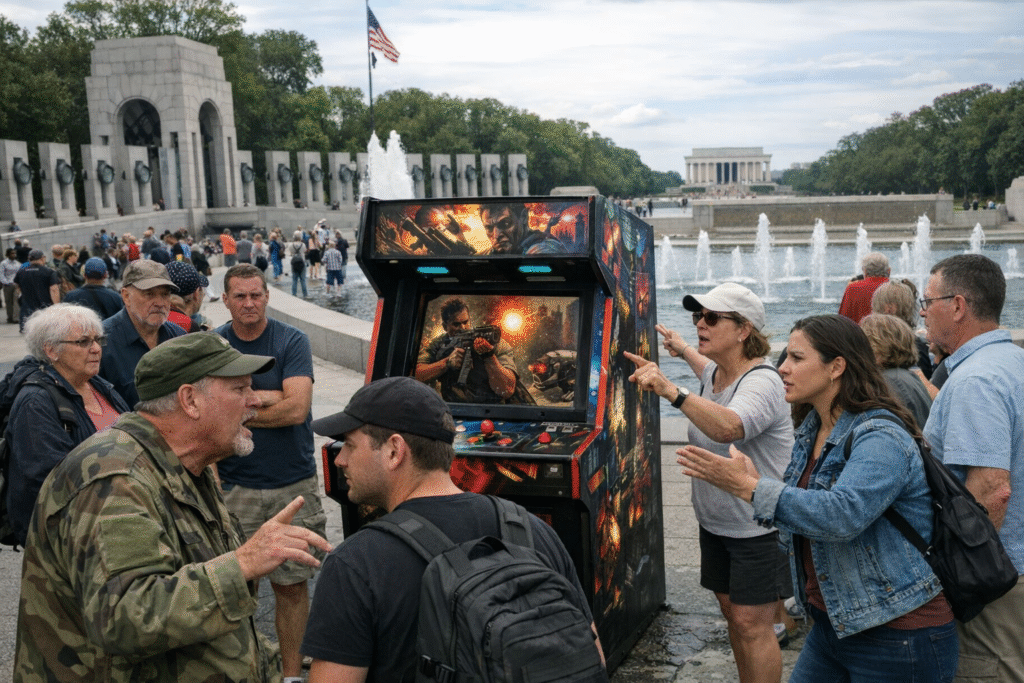
A set of provocative arcade-style installations appearing near a prominent Washington, D.C., war memorial has stirred debate among veterans, policymakers, and passersby, highlighting tensions between artistic expression and the solemnity of military remembrance.
According to Military Times, in its article “Arcade games satirizing Iran war appear at DC war memorial,” the displays mimic retro video games while depicting hypothetical combat scenarios involving Iran. The machines, set up in the vicinity of a memorial honoring U.S. service members, allow users to “play” through stylized military engagements, complete with pixelated explosions and scorekeeping systems.
The juxtaposition of such imagery with a site intended for reflection and commemoration has drawn sharp reactions. Some veterans expressed concern that the installations trivialize the realities of war, reducing complex geopolitical conflicts and human costs to entertainment. For them, the location amplifies the perceived insensitivity, as memorials serve as spaces for mourning and respect rather than satire.
Others, however, have interpreted the project as a form of political commentary. By presenting war as a literal game, the creators appear to critique what they view as the abstraction and detachment often present in public discourse about military intervention. In this reading, the installations are meant to challenge viewers to reconsider how easily discussions of conflict can slip into strategic or gamified thinking, far removed from lived consequences.
Officials have not indicated that the displays pose any security concern, but their presence has prompted questions about permitting, public space usage, and the boundaries of protest art in highly symbolic locations. Washington’s memorials, while open to the public, exist within a careful balance of accessibility and reverence, and interventions like this can test that balance.
The episode also underscores a broader cultural moment in which military issues are increasingly filtered through digital and interactive media. Video games have long been a site of both recruitment messaging and critique, and the emergence of physical “arcade” installations in civic spaces suggests an evolving form of public engagement—one that blurs lines between art, activism, and spectacle.
As Military Times reported, reactions continue to unfold among those who encounter the installations firsthand. Whether viewed as disrespectful or thought-provoking, the displays have succeeded in drawing attention, prompting a renewed conversation about how war is represented, remembered, and debated in public life.