Weighing Restraint, Limited Strikes, and War in U.S. Policy Toward Iran
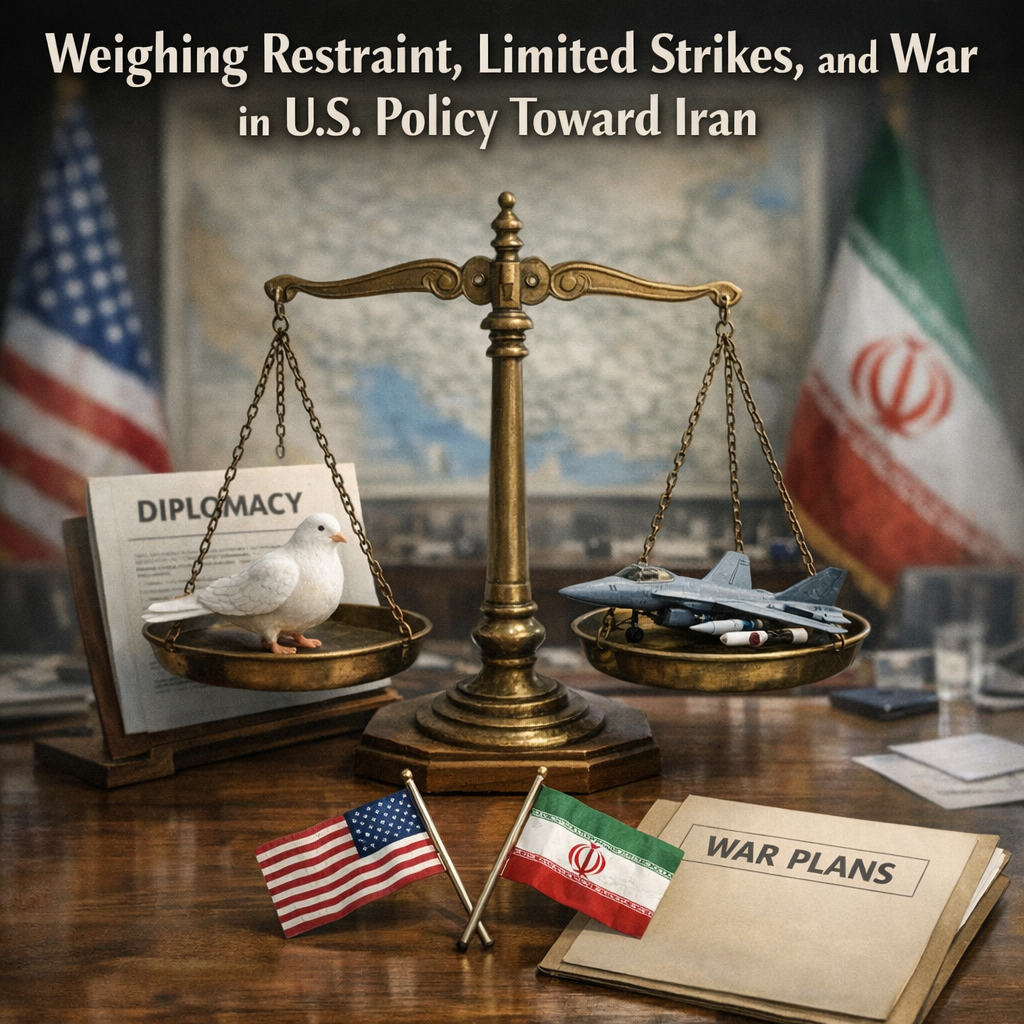
An opinion article published by Fox News, titled “Three choices define Trump’s Iran war cost,” lays out a stark framework for evaluating the potential consequences of U.S. military action against Iran. While framed around decisions facing former President Donald Trump, the analysis broadly reflects enduring dilemmas in American foreign policy: whether to exercise restraint, pursue limited military action, or commit to a larger-scale conflict, each with distinct and far-reaching costs.
The piece argues that the first option—strategic restraint—offers the lowest immediate risk but carries longer-term uncertainties. Avoiding direct confrontation with Iran could reduce the likelihood of rapid escalation and limit immediate financial and human costs. However, critics of restraint often contend that it may embolden adversaries or allow destabilizing activities to continue unchecked in the region, concerns frequently raised in analyses by institutions like the Brookings Institution’s Middle East program. The Fox News article presents this path as one that prioritizes caution while acknowledging that inaction can carry its own strategic consequences.
A second path outlined is limited military engagement, such as targeted strikes aimed at deterring specific actions or degrading certain capabilities. This option is framed as a middle ground, attempting to demonstrate resolve without committing to a prolonged war. Yet the analysis highlights the inherent unpredictability of such actions, a risk often discussed in reports by the Council on Foreign Relations. Even carefully calibrated strikes risk miscalculation, retaliation, and escalation, particularly in a region as volatile as the Middle East. The article underscores that limited actions, while politically appealing as a show of strength, can quickly expand beyond their initial scope.
The third and most consequential option described is a broader military campaign. According to the Fox News commentary, a full-scale confrontation with Iran would likely entail significant economic costs, extended military involvement, and substantial geopolitical repercussions. Iran’s capacity to respond asymmetrically—through regional proxies, cyber operations, or disruptions to global energy markets—has been widely analyzed, including by the Center for Strategic and International Studies. These dynamics raise the stakes considerably. The article suggests that any move toward large-scale war would demand sustained public support and a clear strategic objective, both of which can be difficult to maintain over time, as highlighted in historical assessments by the RAND Corporation.
Throughout, the Fox News opinion piece emphasizes that these choices are not merely tactical decisions but reflections of broader strategic priorities. Each path involves trade-offs between deterrence and escalation, immediate security concerns and long-term stability, as well as domestic political considerations and international alliances. These trade-offs are frequently debated in the context of U.S. grand strategy and defense planning, including within the U.S. Department of Defense.
The framing offered in “Three choices define Trump’s Iran war cost” ultimately serves as a reminder of the complexity inherent in decisions about military force. While the article is situated within a particular political moment, the underlying debate remains relevant: how to balance the risks of action versus inaction in an increasingly fragmented and volatile global landscape.