Unauthorized Drone Incursions Expose Growing Vulnerabilities in US Military Logistics Network
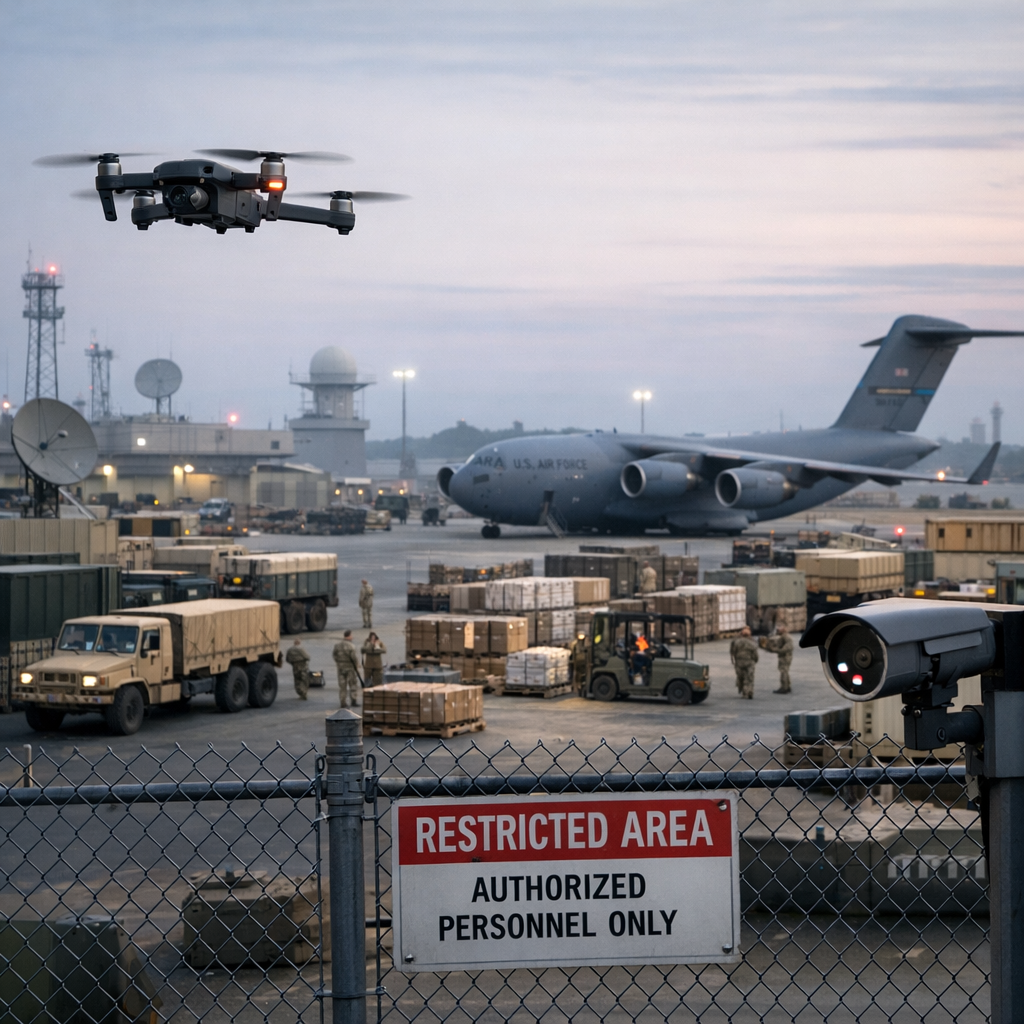
The growing frequency of unauthorized drone incursions near sensitive U.S. military logistics hubs is emerging as a significant operational risk for U.S. Transportation Command (USTRANSCOM), raising concerns about surveillance, disruption, and the broader vulnerability of critical mobility infrastructure. A recent DefenseScoop report, titled “Why unauthorized drone incursions are a clear and present issue for US Transportation Command,” underscores how low-cost, commercially available unmanned aerial systems are complicating the command’s mission to move troops and materiel around the globe.
USTRANSCOM, which oversees the Defense Department’s global airlift, sealift, and land transportation operations, depends on a network of installations and commercial partners to sustain military readiness. According to DefenseScoop, officials are increasingly alarmed by the ease with which adversaries—or even unsophisticated actors—can deploy drones near airfields, ports, and logistics staging areas. These incursions can expose sensitive operational details, including troop movements and cargo manifests, or interfere directly with flight operations.
The concern is not hypothetical. Military leaders have reported a steady uptick in drone sightings near installations in recent years, reflecting a broader global trend noted by agencies like the Federal Aviation Administration. Small drones can evade traditional radar systems, are difficult to attribute, and can be operated at minimal cost. This combination presents a uniquely asymmetric challenge, allowing actors with limited resources to probe highly sensitive military environments.
DefenseScoop’s reporting highlights that USTRANSCOM’s role makes it particularly vulnerable. Unlike combatant commands focused on warfighting in contested environments, USTRANSCOM operates heavily within or adjacent to civilian infrastructure. Many of its key nodes are located at or near commercial airports and seaports, where legal authorities to counter drone threats are often constrained. This creates a patchwork of jurisdictional responsibilities among military, federal, state, and local authorities, complicating rapid response.
Officials have emphasized that the risk extends beyond intelligence collection. Even a single drone intrusion could disrupt flight operations, delay missions, or force temporary shutdowns of critical facilities. In a high-tempo crisis or conflict, such disruptions could cascade into larger operational setbacks. The prospect of coordinated drone activity—whether for surveillance or active interference—adds another layer of concern.
DefenseScoop notes that existing counter-drone capabilities are unevenly distributed and often limited by policy restrictions. Technologies capable of detecting and neutralizing drones are available, but their deployment, especially in domestic settings, is governed by strict legal frameworks designed to protect privacy and civil liberties, as outlined by the Department of Homeland Security’s counter-UAS guidance. As a result, commanders may lack both the authority and the tools to respond decisively to incursions in real time.
The article points to ongoing efforts within the Defense Department to address these gaps, including investments in counter-unmanned aerial systems and closer coordination with interagency partners. However, progress has been incremental, and the pace of technological adoption by potential adversaries continues to outstrip defensive measures. The proliferation of drones, combined with their increasing sophistication, suggests that the problem will intensify, a trend also highlighted in analyses by organizations like the RAND Corporation.
Another complicating factor is attribution. Determining who is operating a drone—and with what intent—is often difficult in the moment. This ambiguity limits the range of immediate response options and raises the risk of either overreaction or insufficient action. For USTRANSCOM, whose operations are tightly scheduled and globally interconnected, uncertainty can translate into operational hesitation.
The broader strategic context also shapes the urgency of the issue. Defense planners have warned that near-peer competitors are actively studying U.S. logistics networks as potential points of vulnerability, an issue examined in reports by the Government Accountability Office. Drone incursions, even if not directly tied to foreign adversaries, could provide valuable insights into how U.S. forces mobilize and sustain operations. This intelligence could be exploited in future conflicts.
DefenseScoop’s reporting suggests that addressing the threat will require a combination of technological, legal, and organizational changes. Expanding the authorities of military commanders to counter drones in domestic airspace is one option under discussion, though it remains politically sensitive. Enhancing detection systems, improving data sharing among agencies, and integrating counter-drone measures into routine base security are also seen as necessary steps.
Ultimately, the issue reflects a broader shift in the threat landscape, where relatively simple technologies can create disproportionate challenges for complex, highly optimized systems like U.S. military logistics. As USTRANSCOM continues to adapt to evolving risks, unauthorized drone incursions are likely to remain a persistent concern—one that tests not only technical defenses but also the agility of policy and coordination frameworks designed for a different era.