Israel Advances Layered Air Defense by Integrating Iron Dome with Iron Beam Laser System
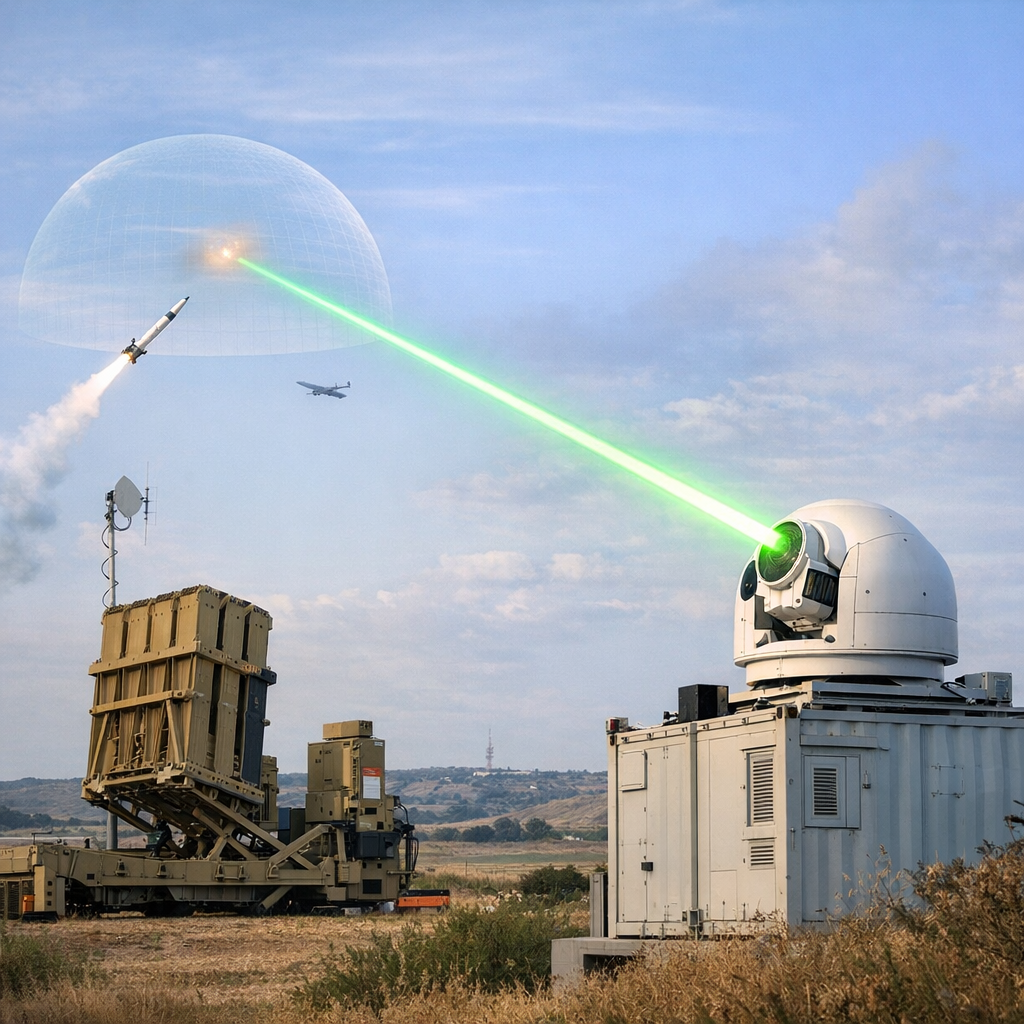
Israel has conducted a new round of testing that integrates its long-standing Iron Dome missile defense system with the emerging Iron Beam laser platform, signaling a significant step toward a layered air defense architecture that combines kinetic interceptors with directed-energy weapons.
According to the Defense News report titled “Israel tests Iron Dome with Iron Beam pairing missiles with laser pulses for air defense”, the trials explored how the two systems can operate in tandem against a range of aerial threats, including rockets and drones. The effort reflects Israel’s broader strategy to offset the high costs and logistical constraints associated with interceptor missiles by introducing a lower-cost, high-volume defensive option in the form of laser technology.
Iron Dome, developed by Rafael Advanced Defense Systems, has been a central pillar of Israel’s air defense since it became operational in 2011, designed to intercept short-range rockets and artillery shells. However, each intercept carries a significant financial cost, often far exceeding that of the incoming projectile it is designed to destroy. The Iron Beam system, also developed by Rafael, aims to address this imbalance by using high-energy laser pulses that can be fired repeatedly at a fraction of the cost per engagement.
The integration tested in recent exercises appears to focus on assigning each system roles based on operational efficiency. Laser intercepts would be prioritized for lower-altitude, short-range threats and mass barrages, while Iron Dome missiles would remain available for more complex or higher-altitude targets where laser effectiveness may be reduced due to weather conditions or range limitations.
Officials cited in the Defense News report indicated that one of the primary challenges has been ensuring seamless coordination between the systems’ sensors, targeting algorithms, and command-and-control networks. Effective pairing requires real-time decision-making that determines whether a laser pulse or a missile is the most appropriate response to a given threat. This level of integration marks a shift from standalone defensive units toward a more unified, networked defense ecosystem.
The development comes amid evolving threat landscapes in the region, including the increasing use of low-cost drones and saturation attacks designed to overwhelm traditional missile defenses. By incorporating a laser-based layer, Israel aims to improve both sustainability and responsiveness, particularly during prolonged engagements when interceptor stockpiles may be strained.
Analysts view the pairing as part of a broader global trend toward directed-energy weapons, which are being pursued by multiple countries as a complement to conventional systems. While lasers offer clear advantages in terms of cost per shot and virtually unlimited ammunition, they remain dependent on environmental conditions and power availability, making them most effective when integrated into a broader defensive network rather than deployed alone.
Israeli officials have suggested that continued testing will focus on expanding operational scenarios and refining system coordination, with the long-term goal of deploying the combined capability in active defense environments. If successful, the integration of Iron Beam with Iron Dome could represent a meaningful evolution in air defense doctrine, blending traditional missile interception with emerging laser technologies to create a more adaptable and economically sustainable shield against modern aerial threats.