U.S. Military Accelerates Push for Cost-Effective Counter-Drone Defenses as Aerial Threats Proliferate
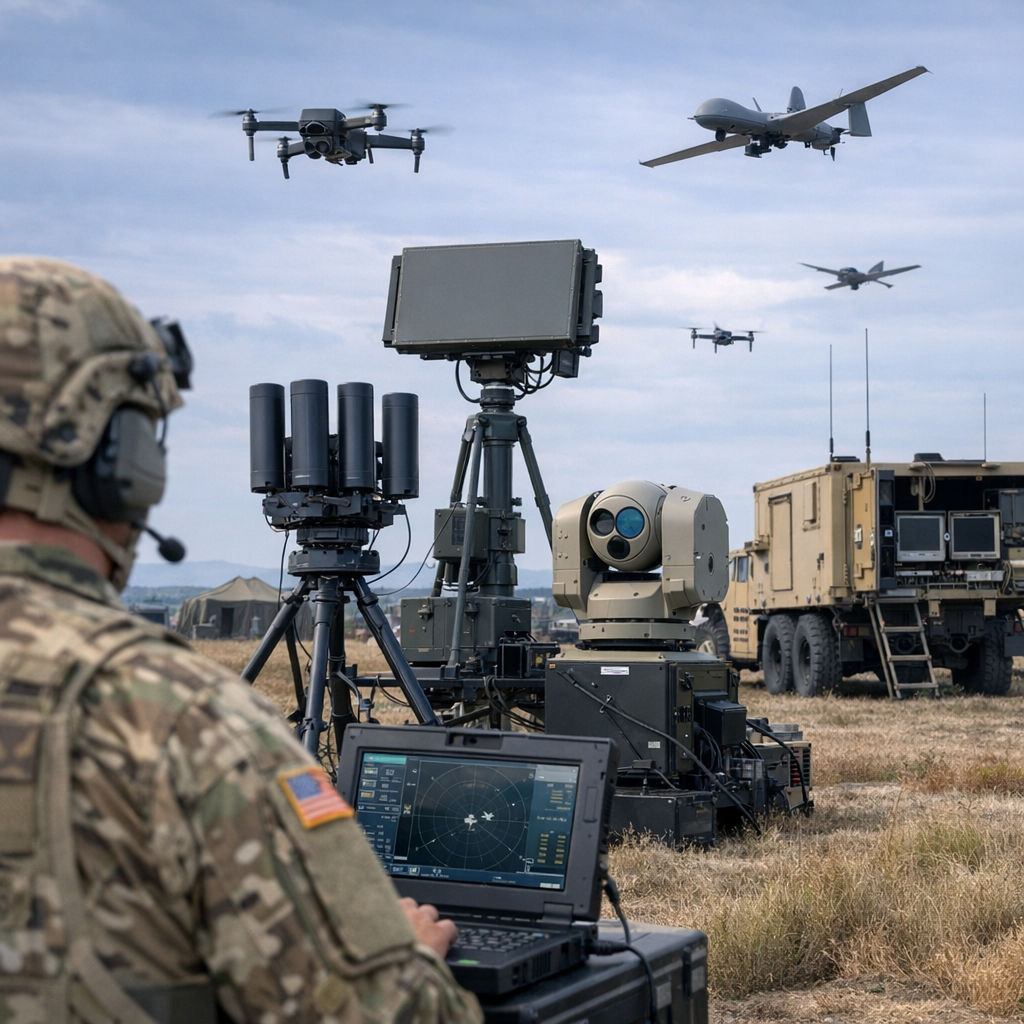
Demand for counter-drone systems across the U.S. military is accelerating as low-cost aerial threats proliferate, according to industry officials, underscoring a shift in how armed forces are preparing for future conflicts.
In the article “Israel’s Smart Shooter sees C-UAS demand grow across US military: exec,” published by Breaking Defense, a senior executive from Israeli defense firm Smart Shooter described a marked increase in interest from multiple branches of the U.S. military in technologies designed to counter unmanned aerial systems (UAS). The company, known for its fire-control systems that enhance the accuracy of small arms against aerial targets, has positioned itself to meet what it sees as a rapidly expanding operational requirement. The full report can be found here: Breaking Defense article.
The growing urgency reflects lessons drawn from recent conflicts, particularly in Ukraine and the Middle East, where relatively inexpensive drones have been used to significant tactical effect, as documented by the Center for Strategic and International Studies. These systems, ranging from commercially modified quadcopters to more sophisticated loitering munitions, have challenged traditional air defense architectures by presenting small, agile, and often swarm-based threats that are difficult to detect and intercept using conventional methods.
Smart Shooter’s core technology centers on attaching advanced targeting systems to standard infantry weapons, allowing soldiers to engage drones more effectively. The system uses sensors and computer vision—fields widely studied by organizations like DARPA—to track targets and ensure that a shot is only released when a hit is statistically likely, reducing ammunition waste and improving hit probability against fast-moving aerial threats.
According to the Breaking Defense report, the company’s executive said that interest is not confined to a single service branch. The Army, Marine Corps, and Special Operations forces have all explored or adopted variants of such systems, reflecting a broader Department of Defense effort to create layered, cost-effective counter-UAS defenses, as outlined by the DoD Counter-Small UAS Strategy. Rather than relying solely on expensive missile interceptors or electronic warfare systems, military planners are increasingly emphasizing distributed solutions that can be deployed at the squad level.
This shift is partly driven by cost asymmetry. Traditional air defense missiles can cost hundreds of thousands or even millions of dollars per interceptor, while many drones cost only a few thousand dollars or less—a disparity highlighted in analyses from the RAND Corporation. This imbalance has forced militaries to reconsider engagement strategies, prioritizing solutions that are economically sustainable in high-volume threat environments.
The executive also noted that training and ease of integration are critical factors in adoption. Systems that can be quickly mounted on existing rifles and used by soldiers with minimal additional instruction are more likely to see widespread deployment. This aligns with broader Pentagon priorities to accelerate fielding timelines and adapt rapidly to emerging threats, as emphasized in U.S. Army modernization initiatives.
At the same time, challenges remain. Countering drones effectively often requires a combination of detection, tracking, and engagement capabilities, and no single solution can address all scenarios. Small arms-based systems are typically limited by range and environmental conditions, while electronic warfare approaches can be constrained by spectrum management and adversary countermeasures.
Still, the increasing interest highlighted in the Breaking Defense article reflects a clear trend: counter-UAS capabilities are becoming a baseline requirement rather than a niche capability. As adversaries continue to innovate and expand their use of unmanned systems, the U.S. military is under pressure to ensure that even its smallest units can defend themselves against threats from above.
The result is a growing market for technologies like those developed by Smart Shooter, as well as a broader reevaluation of how air defense is structured at the tactical edge.