Space Force Expands MUOS Network with Boeing to Strengthen Secure Military Communications
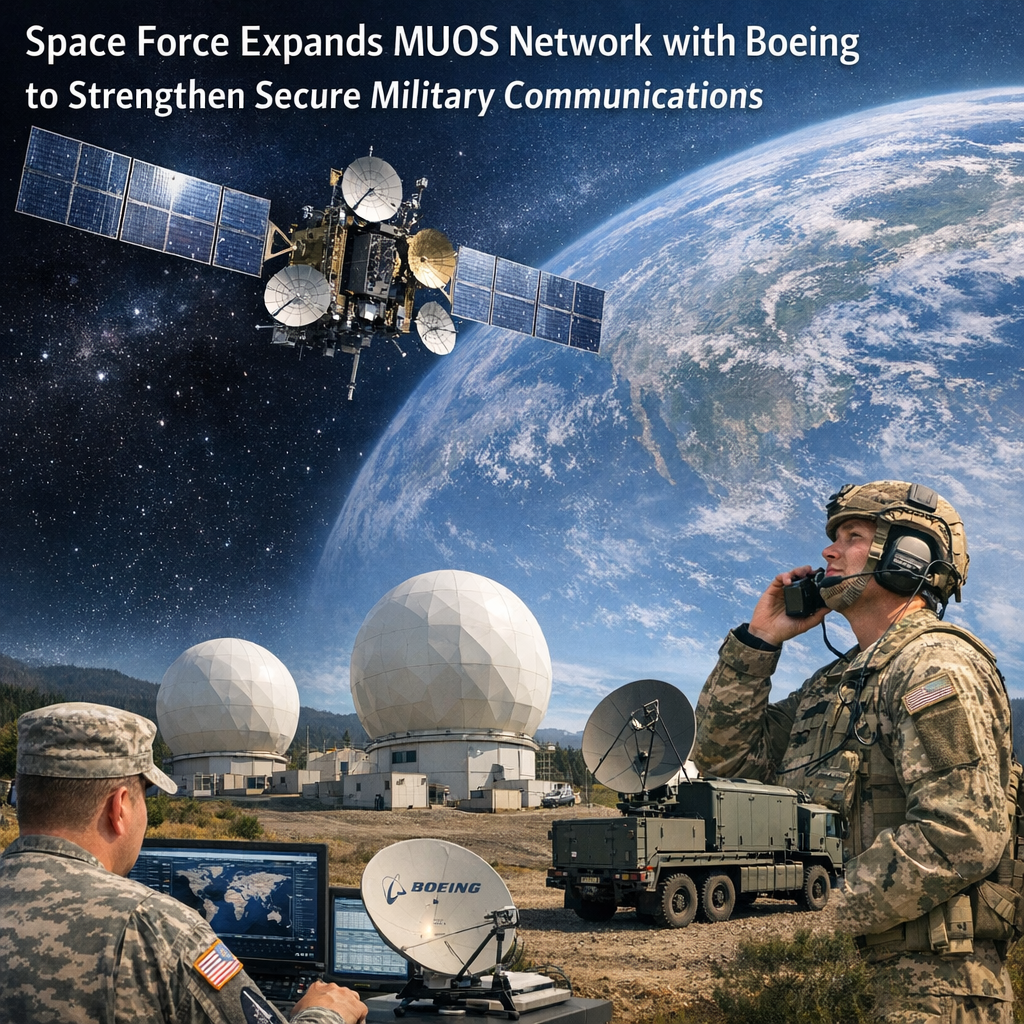
The U.S. Space Force has selected Boeing to develop additional Mobile User Objective System satellites, extending a key military communications architecture that supports secure, beyond-line-of-sight connectivity for forces worldwide. The award, reported in “Boeing awarded Space Force contract for MUOS satellites” by DefenseScoop, underscores the Pentagon’s continued investment in resilient satellite communications amid growing operational demands and contested space environments.
The contract advances the next phase of the Mobile User Objective System (MUOS) program, a narrowband communications system designed to provide mobile troops with reliable voice, video, and data links using handheld devices. Since its inception, MUOS has been a cornerstone capability for the Department of Defense, particularly for operations in remote or infrastructure-limited regions. Boeing’s role will focus on building additional satellites that are expected to enhance capacity, extend coverage, and improve system resilience.
Officials have increasingly emphasized the importance of redundant, survivable communications as adversaries develop capabilities to disrupt or degrade space-based assets. The expansion of MUOS reflects a broader strategic effort by the U.S. Space Force to harden its satellite constellations while maintaining compatibility with existing user equipment across the services.
While financial details and precise delivery timelines were not fully disclosed, the award signals confidence in Boeing’s space systems division and its previous involvement in similar programs. The company is expected to leverage established production lines and technical expertise to meet the Space Force’s requirements, potentially reducing development risk and accelerating deployment.
The MUOS system, initially developed to replace legacy Ultra High Frequency Follow-On satellites, has already transformed tactical communications by enabling 3G-like connectivity for deployed forces. However, as operational needs evolve and threats to space infrastructure intensify, defense planners have sought to add capacity and ensure continuity of service even in degraded conditions.
The Space Force’s decision also reflects a measured approach to balancing modernization with sustainment. Rather than abandoning established architectures, the military continues to build on proven systems while exploring next-generation solutions. This incremental strategy is seen by some analysts as a pragmatic way to maintain readiness without introducing unnecessary technical or programmatic risk.
As competition in space accelerates, contracts such as this highlight the central role of satellite communications in future conflict scenarios. Ensuring that troops can communicate securely and reliably, even in contested environments, remains a top priority for U.S. defense leaders.