US Air Force Advances Drone Wingman Program with General Atomics and Anduril Production Contracts
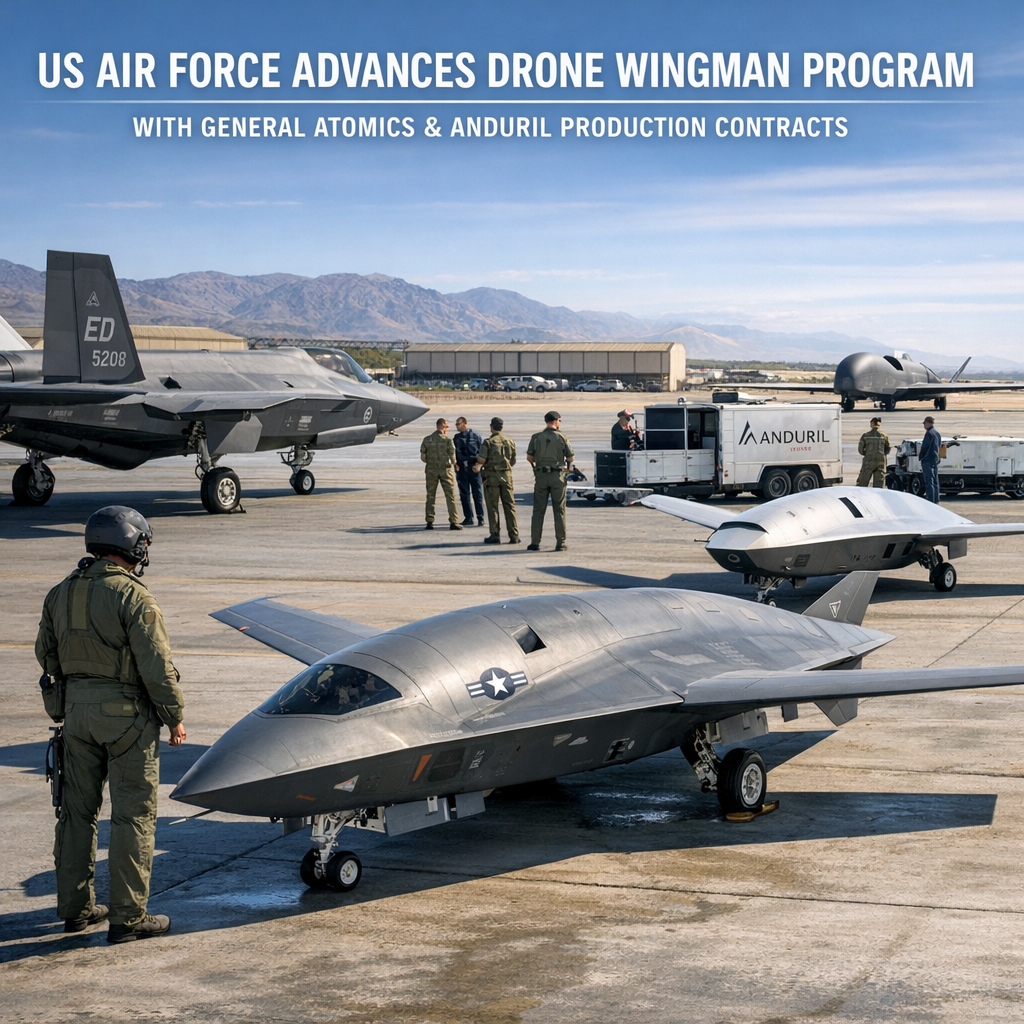
The U.S. Air Force has selected General Atomics and Anduril Industries to move forward with production contracts for its emerging class of autonomous “drone wingmen,” a step that underscores the Pentagon’s accelerating investment in collaborative combat aircraft and next-generation airpower.
According to the Military Times report, the decision marks a pivotal transition from experimentation to operational capability. The program, often referred to as Collaborative Combat Aircraft (CCA), is designed to pair uncrewed systems with piloted fighter jets, expanding combat reach while reducing risk to human pilots.
Both companies have been at the forefront of developing autonomous or semi-autonomous air systems. General Atomics Aeronautical Systems, long known for its MQ-9 Reaper drone, brings decades of experience in long-endurance unmanned aircraft. Anduril Industries, a newer but rapidly influential defense technology firm, has distinguished itself with software-driven autonomous platforms and rapid prototyping approaches. Their selection signals a blend of established defense manufacturing and newer, software-centric innovation.
The U.S. Air Force envisions these drone wingmen as force multipliers that can carry sensors, electronic warfare payloads, or weapons, operating alongside aircraft such as the F-35 and the forthcoming Next Generation Air Dominance (NGAD) fighter. By distributing capabilities across multiple platforms, the service aims to complicate adversaries’ targeting and enhance survivability in contested environments.
Officials have framed the effort not simply as a technological upgrade, but as a doctrinal shift. Rather than relying solely on exquisitely expensive crewed aircraft, the Air Force is pursuing a more flexible and scalable force structure in which autonomous systems can be produced in larger numbers and adapted quickly to evolving threats.
Cost and speed are central considerations. The Pentagon has repeatedly emphasized the need to field capabilities faster in response to pacing challenges from China and other competitors. Programs like CCA are intended to shorten development cycles and introduce more iterative upgrades, in contrast to traditional acquisition timelines that can stretch over decades.
The Military Times report highlights that this production phase follows earlier design and prototyping efforts, suggesting that the Air Force is gaining confidence in the maturity of the technology. However, significant questions remain about how these systems will be integrated operationally, how much autonomy they will be granted in combat scenarios, and how they will be sustained at scale.
There are also broader implications for the defense industrial base. By awarding major roles to both a legacy contractor and a newer entrant, the Air Force appears to be encouraging competition and diversification, potentially reshaping the landscape of military aviation suppliers.
As the program advances, its success will likely hinge on balancing rapid innovation with reliability and ethical considerations surrounding autonomous systems. For now, the selection of General Atomics and Anduril marks a concrete step toward a future in which human pilots and autonomous aircraft operate side by side in increasingly complex battlespaces.