General Atomics Wins Army Contract to Push Limits of Long-Range Artillery Capability
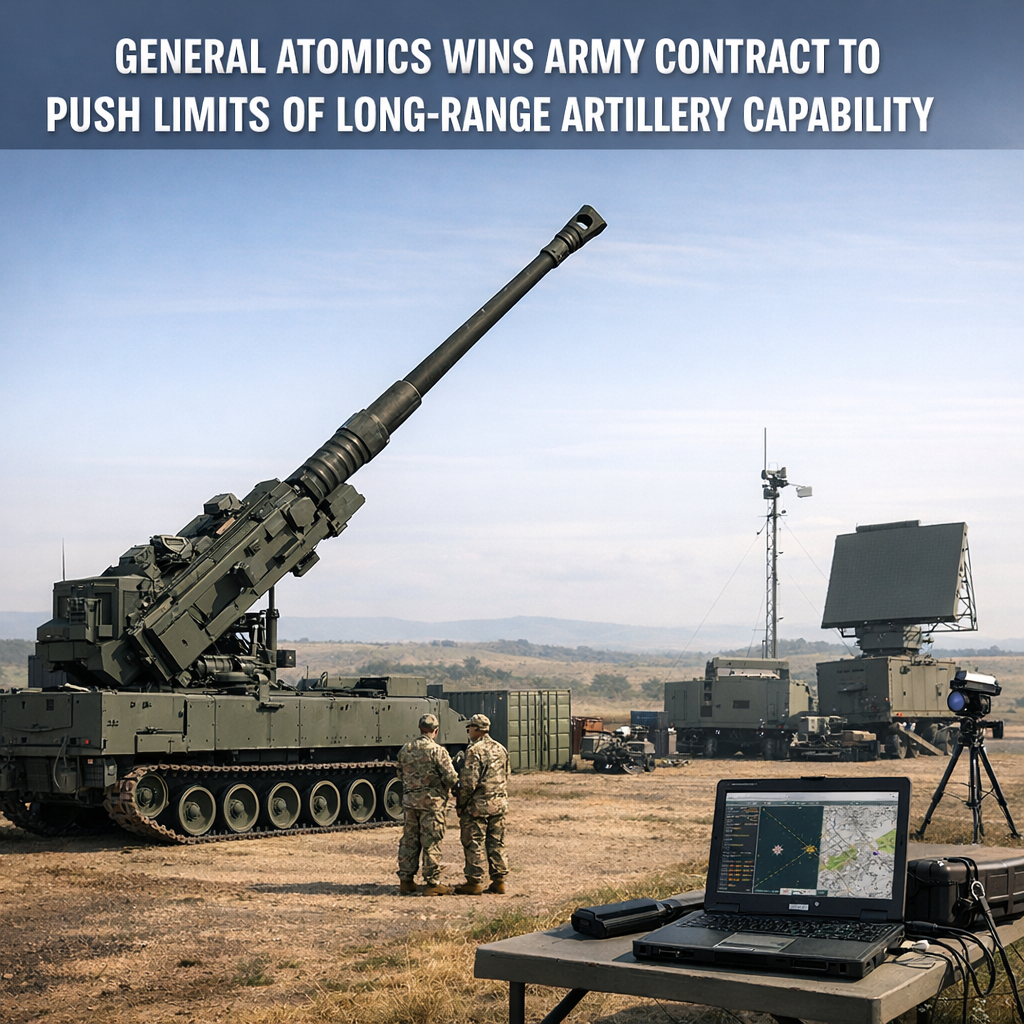
General Atomics has secured a new contract with the U.S. Army to advance extended-range artillery capabilities, underscoring the Pentagon’s broader push to modernize long-range precision fires amid evolving global threats.
According to reporting by Military Times in the article “General Atomics awarded US Army contract for extended-range artillery,” the defense contractor will work on developing a next-generation system designed to significantly increase the reach and effectiveness of ground-based artillery. The effort is part of the Army’s ongoing modernization priorities, which emphasize enhancing strike capabilities against distant and well-defended targets, including initiatives outlined in Congressional Research Service reporting on Long-Range Precision Fires.
The contract focuses on technologies that could extend the range of traditional artillery systems well beyond current limits, potentially offering commanders greater operational flexibility in both conventional and contested environments. While specific technical details remain closely held, the initiative is expected to incorporate advanced propulsion, guidance, and targeting systems intended to improve both accuracy and survivability, similar to concepts explored in programs like the Extended Range Cannon Artillery (ERCA) effort.
The Army has made long-range fires a central pillar of its modernization strategy, driven in part by concerns over near-peer adversaries with sophisticated anti-access and area denial (A2/AD) capabilities. By extending the reach of its artillery, the service aims to reduce reliance on forward-deployed forces and shorten response times in high-intensity conflicts, a priority overseen by organizations like Army Futures Command.
General Atomics, known for its work on unmanned systems and advanced defense technologies, is positioning itself as a key player in this evolving space (see company overview). The company’s involvement suggests an emphasis on integrating innovative approaches, potentially including autonomous or semi-autonomous elements, into traditional artillery frameworks.
Military analysts note that extended-range artillery could alter battlefield dynamics by allowing U.S. and allied forces to strike targets from safer distances while maintaining precision. However, the development of such systems also raises questions about cost, logistical complexity, and integration with existing platforms.
The Army has not disclosed a detailed timeline for deployment, but the contract marks another step in a series of investments aimed at maintaining technological superiority in long-range strike capabilities. As the program progresses, its success will likely depend on balancing ambitious performance goals with practical considerations around deployment and sustainment.
The award to General Atomics reflects a broader trend of increased collaboration between the military and private industry as the U.S. seeks to accelerate innovation in critical defense technologies.