Report Raises Questions About Newsom Donation Linked to Chinese Firm Later Flagged by Pentagon
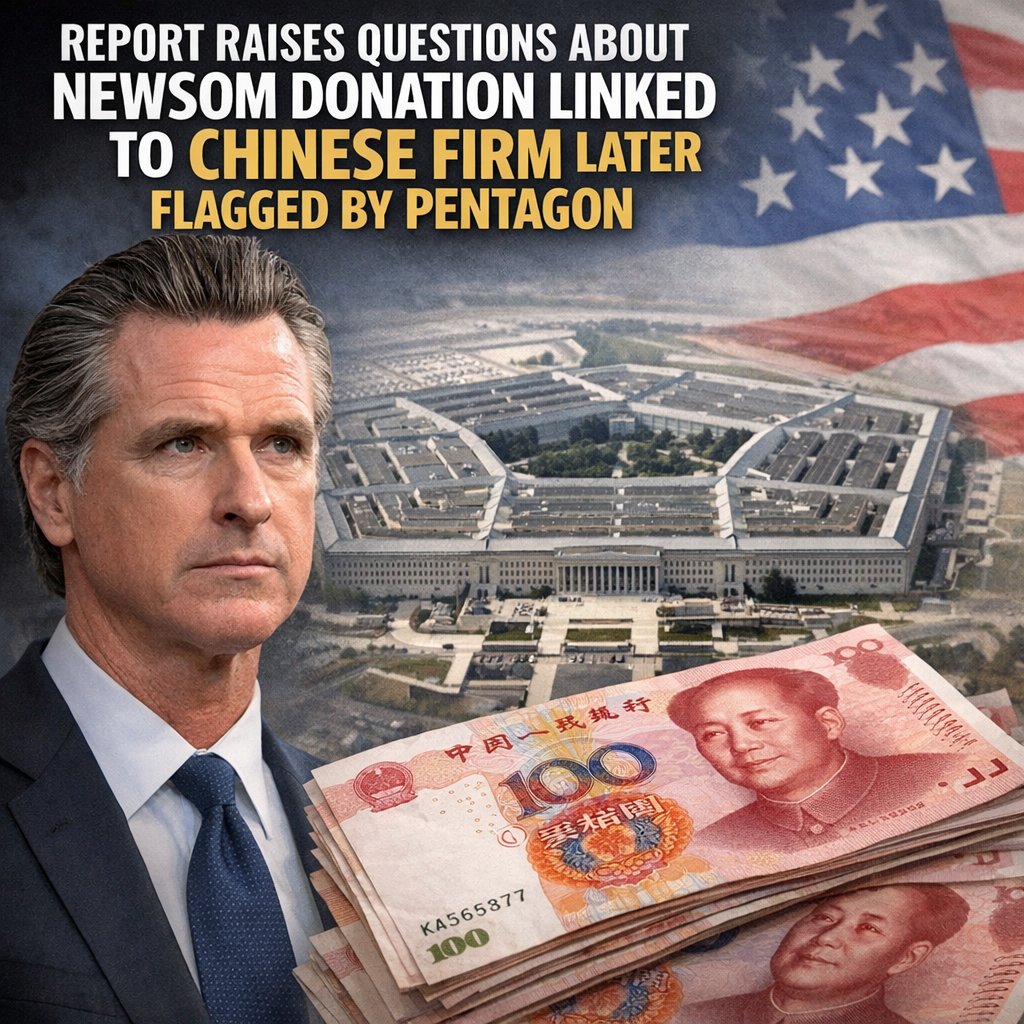
A recent report from the Washington Free Beacon has drawn renewed attention to political donations received by California Gov. Gavin Newsom, raising questions about the intersection of state leadership, campaign finance, and national security concerns.
In the article titled “Weak Link: Gavin Newsom Took $50K From Chinese EV Exec of Now-Blacklisted Chinese Military Company, According to New Pentagon Classification”, the publication reports that Newsom accepted a $50,000 political contribution from an executive associated with a Chinese electric vehicle company that has since been designated by the U.S. Department of Defense as having ties to the Chinese military.
According to the Free Beacon, the executive in question is linked to BYD, a major Chinese electric vehicle and battery manufacturer. The Pentagon recently added BYD to a list of companies it alleges are connected to China’s military-industrial complex, a designation that can carry significant implications for U.S. policy and investment scrutiny. The report frames the contribution as part of a broader concern about potential vulnerabilities in political funding streams involving foreign-linked entities.
The article notes that the donation was made during Newsom’s earlier political career and was permissible under campaign finance laws at the time it was received. There is no indication in the report that the contribution violated any legal requirements. However, the Pentagon’s updated classification of the company has retrospectively raised questions among critics about the optics and potential risks associated with such financial ties.
Newsom’s office has not publicly indicated that the contribution was improper, and the Free Beacon article does not suggest any direct influence on policy decisions stemming from the donation. Nevertheless, the report situates the issue within a broader national debate over economic and technological competition with China, particularly in sectors such as electric vehicles and clean energy, where Chinese firms hold significant global market share.
The Pentagon’s list, referenced in the article, is part of an ongoing U.S. government effort to identify and monitor Chinese companies believed to support military objectives; see related reporting from Reuters on defense blacklist updates. Inclusion on the list can affect how American companies and investors engage with those entities, though it does not automatically result in sanctions.
The Free Beacon article also places the donation in the context of California’s leadership in promoting electric vehicle adoption initiatives and climate policy, areas in which Chinese companies like BYD have been active competitors and potential partners. This overlap between policy priorities and international business relationships has heightened scrutiny of political figures’ past financial connections.
As tensions between Washington and Beijing continue to shape economic and security policy, such reports underscore the challenges of navigating globalized industries while maintaining safeguards against foreign influence. The scrutiny surrounding Newsom’s campaign donation reflects a broader concern among policymakers and analysts about how historical financial relationships are reassessed in light of evolving national security frameworks.