Strategy in War Linking Politics and Power
A recent essay titled “What Is Strategy in War?” published on Spencer Guard’s Substack examines a deceptively simple question that has long challenged military thinkers, policymakers, and historians alike. The piece argues that while the term “strategy” is frequently invoked in discussions of conflict, it is often misunderstood, diluted, or conflated with related concepts such as tactics, operations, or long-term planning.
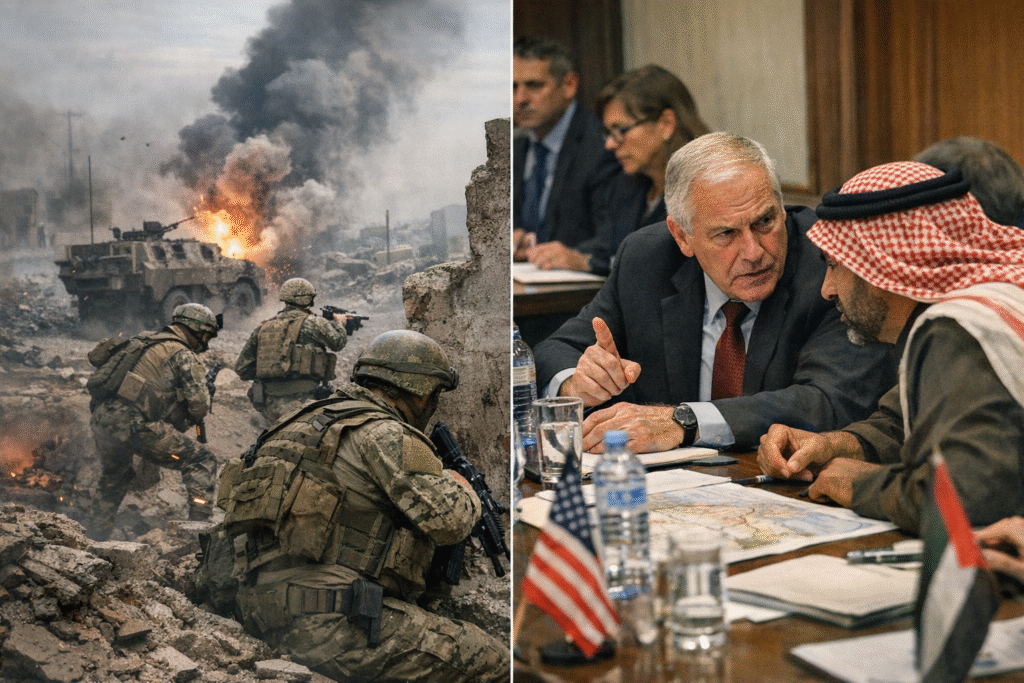
The essay situates its analysis within a broader historical and intellectual tradition, tracing how definitions of strategy have evolved from classical theorists to modern military doctrine. It emphasizes that strategy is not merely a plan or a set of objectives, but a dynamic process that links political goals with the use of organized force. In this framing, strategy operates as a bridge between ends and means, translating abstract national interests into concrete actions on the battlefield and beyond.
Central to the article’s argument is the idea that strategy must remain firmly anchored in political purpose. Drawing on the enduring influence of Carl von Clausewitz, the piece underscores that war is never autonomous; it is an extension of politics by other means. When strategy becomes detached from political objectives, it risks becoming directionless or internally contradictory. The author suggests that many modern conflicts reveal this disconnect, where military efforts continue without a coherent or achievable political end state.
The essay also addresses the common tendency to equate strategy with planning alone. It contends that strategy cannot be reduced to a static blueprint devised before conflict begins. Instead, it unfolds over time, shaped by uncertainty, adaptation, and interaction with an adversary. In this sense, strategy is as much about decision-making under pressure as it is about initial design. The author highlights that effective strategy requires continuous reassessment, as well as an ability to reconcile shifting realities with overarching goals.
Another key theme is the distinction between strategy and other levels of war. While tactics concern the conduct of individual engagements and operations involve the coordination of battles, strategy encompasses the broader alignment of military activity with political objectives. The essay argues that confusion among these levels can lead to misplaced priorities, where success in tactical engagements is mistaken for strategic progress. This misalignment, the author suggests, has been evident in several recent conflicts where battlefield achievements failed to translate into durable political outcomes.
The article further explores the role of constraints in shaping strategy. Far from being purely about maximizing power, strategy often involves navigating limitations, whether political, economic, or moral. The author emphasizes that effective strategists must account for these constraints rather than ignore them, as overextension or miscalculation can undermine even the most carefully constructed plans.
Throughout, the essay maintains a critical perspective on contemporary discourse surrounding war. It notes that strategy is often invoked rhetorically, serving as a catchall term that obscures rather than clarifies. By contrast, the author advocates for a more precise and disciplined understanding, one that recognizes strategy as a rigorous, context-dependent practice rather than a vague abstraction.
In its conclusion, “What Is Strategy in War?” argues that clarifying the concept is not merely an academic exercise, but a practical necessity. Misunderstandings about strategy can have profound consequences, shaping how conflicts are initiated, conducted, and ultimately resolved. By revisiting foundational principles and emphasizing the enduring link between political purpose and military action, the essay seeks to restore analytical clarity to a term that is too often taken for granted.