Germany Firms Team Up on Counter-Drone Shield
Germany’s two industrial heavyweights are moving deeper into the rapidly expanding market for counter-drone technology, underscoring Europe’s growing urgency to protect critical infrastructure as aerial threats evolve.
According to the Wall Street Journal article “Germany’s Rheinmetall and Deutsche Telekom to Develop Drone-Defense Shield,” the defense contractor Rheinmetall and telecommunications giant Deutsche Telekom have entered a partnership to create an integrated system capable of detecting, tracking, and neutralizing unmanned aerial threats. The collaboration reflects a broader shift in Europe’s security posture following Russia’s war in Ukraine, which has highlighted the tactical and strategic significance of drones in modern conflict.
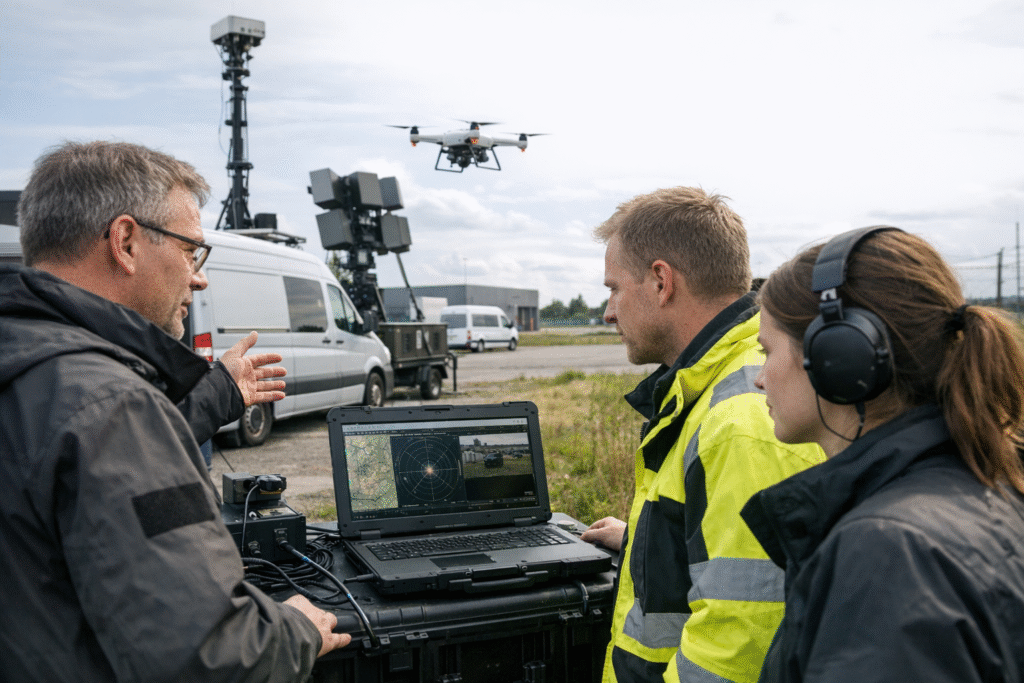
The proposed system is intended to combine Rheinmetall’s air-defense and weapons expertise with Deutsche Telekom’s digital infrastructure and connectivity capabilities. By leveraging mobile network data and advanced sensing technologies, the companies aim to build a layered defense network that can identify unauthorized drones in real time and respond quickly to potential threats. This approach is designed not only for military use but also for civilian applications, including the protection of airports, industrial sites, public events, and critical national infrastructure.
Industry analysts view the partnership as part of a wider convergence between defense and telecommunications sectors. As drones become more accessible and capable, traditional air-defense systems alone are no longer sufficient, particularly in urban or densely populated environments where low-flying devices can evade radar. Integrating communications networks into detection systems could significantly enhance situational awareness and response speeds.
The initiative also aligns with Germany’s broader effort to increase defense spending and modernize its military capabilities, a shift that has accelerated since 2022. Berlin has placed particular emphasis on air-defense systems, both for national security and as part of its contributions to NATO. At the same time, the involvement of a major telecom provider signals recognition that future defense solutions will rely heavily on civilian infrastructure and dual-use technologies.
For Deutsche Telekom, the project represents an expansion into security applications built on its 5G network and data platforms. Telecom companies across Europe have been exploring similar opportunities, seeking to apply their networks to areas such as surveillance, emergency response, and smart-city systems. For Rheinmetall, the collaboration offers a pathway to integrate digital capabilities into its existing defense portfolio, strengthening its position in a competitive global market.
The urgency behind such initiatives has been reinforced by recent incidents involving drones near military bases, airports, and energy facilities across Europe. These events have exposed vulnerabilities in existing defense frameworks and prompted calls for more comprehensive and technologically advanced solutions.
While the partnership is still in development, it illustrates how European companies are adapting to an increasingly complex threat environment. The blending of military hardware with civilian digital infrastructure may become a defining feature of next-generation defense systems, as countries seek to counter risks that are both technologically sophisticated and widely accessible.