Waltz Confronts Iran-Linked Envoy in Heated Clash Over U.S. Values and Foreign Influence
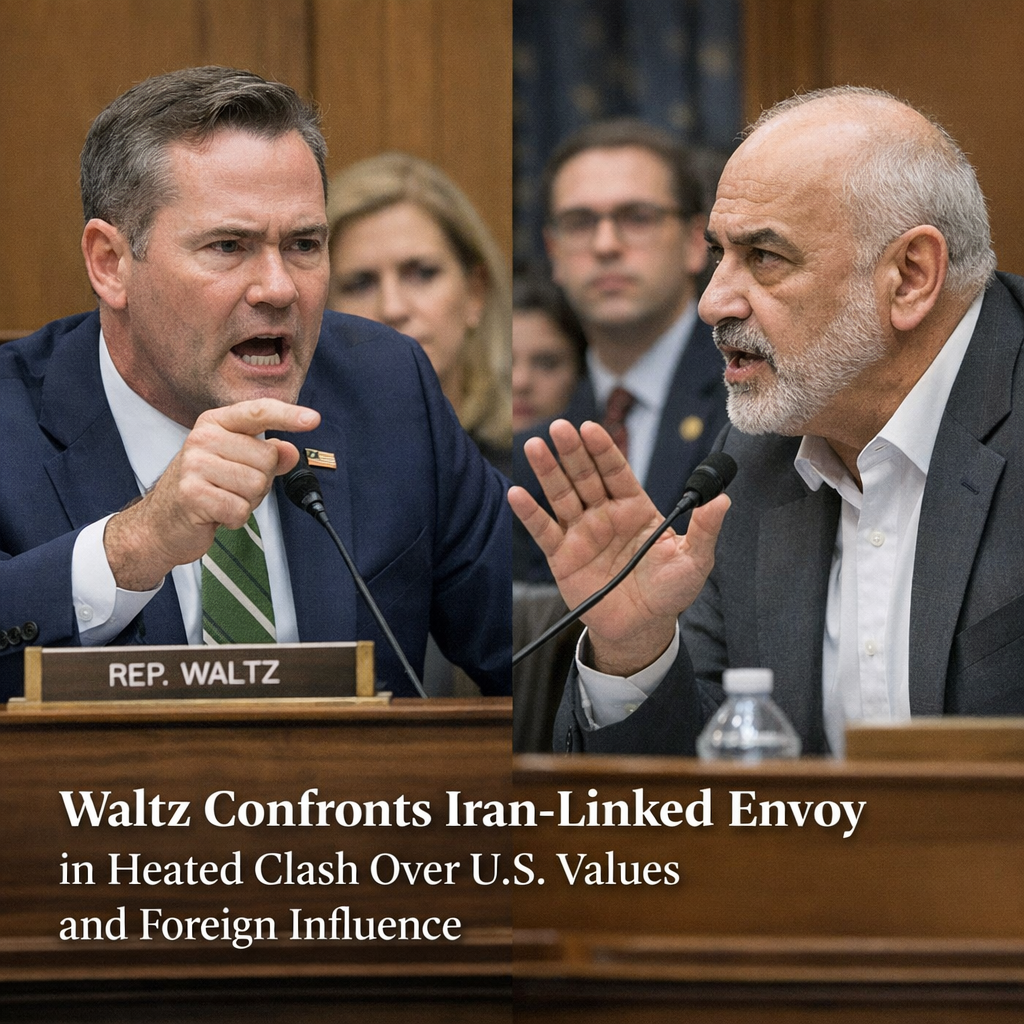
A recent report by The Daily Wire, titled “Waltz Blasts Iran Envoy: ‘This Is Not Tehran, This Is The United States Of America,’” highlights a sharp rebuke delivered by Rep. Mike Waltz during a congressional exchange that underscores deepening tensions over U.S. policy toward Iran and the conduct of diplomatic representatives on American soil.
According to The Daily Wire’s account, Waltz criticized an Iranian-affiliated envoy during a public forum, objecting to rhetoric and positions he viewed as incompatible with American values and national interests. His remarks, punctuated by the statement that “this is not Tehran,” were framed as a broader warning against what he characterized as attempts by foreign representatives to project influence or normalize positions aligned with the Iranian regime within U.S. institutions.
The confrontation comes at a time of renewed scrutiny over U.S.-Iran relations, particularly in the wake of ongoing disputes over nuclear development, regional proxy conflicts, and sanctions enforcement. Lawmakers across party lines have expressed varying degrees of concern about how the United States engages with Iranian officials and intermediaries, especially in academic or policy settings where formal diplomatic constraints may be less clearly defined.
Waltz’s comments, as described by The Daily Wire, reflect a more hardline perspective that prioritizes a strict boundary between engagement and endorsement. He argued that allowing rhetoric sympathetic to Tehran’s leadership to go unchallenged risks undermining U.S. credibility and could be interpreted as tacit acceptance of policies widely condemned by Washington, including Iran’s human rights record and its support for militant groups in the Middle East, a concern also detailed in analyses by the Council on Foreign Relations.
Critics of that approach, however, have long maintained that exposure to a range of viewpoints—even controversial ones—is a necessary component of open discourse in democratic societies. They argue that engagement does not necessarily equate to agreement and can, in some cases, serve as a tool for de-escalation or improved understanding, particularly in the context of nuclear diplomacy monitored by organizations such as the International Atomic Energy Agency.
The episode underscores the broader political divide in Washington over how to balance national security concerns with principles of free expression and diplomatic engagement. While some policymakers favor stricter limitations on platforms for representatives linked to adversarial governments, others caution that overly rigid restrictions could erode the openness that distinguishes U.S. political and academic institutions, a debate frequently explored in reports from the Congressional Research Service.
As tensions with Iran continue to shape U.S. foreign policy, moments like the one described in The Daily Wire’s reporting illustrate how those geopolitical conflicts increasingly play out not only abroad but within domestic forums, where questions of influence, legitimacy, and national identity are contested in real time.