Sheinbaum Balances Strategy for Trump Era
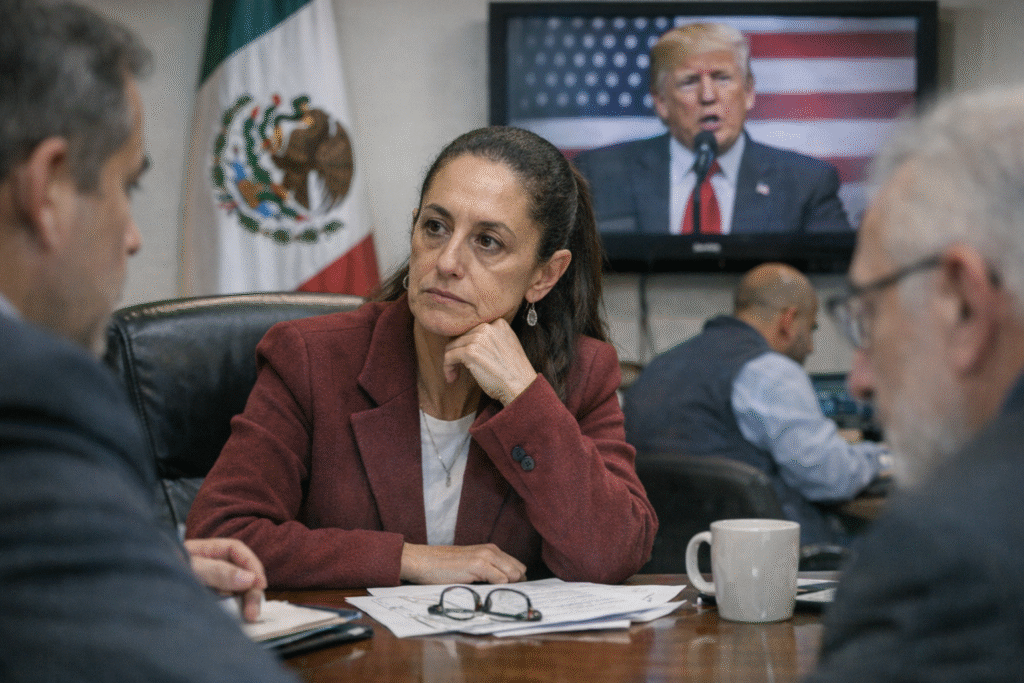
A recent Wall Street Journal article titled “Claudia Sheinbaum: Appeasing Trump” examines the early signals from Mexico’s incoming president and the implications of her approach toward a potential second Donald Trump presidency in the United States. The piece situates Sheinbaum’s emerging foreign policy posture within a broader, delicate recalibration of U.S.–Mexico relations at a moment of political uncertainty on both sides of the border.
According to the Wall Street Journal, Sheinbaum, a close ally of outgoing President Andrés Manuel López Obrador, is widely expected to maintain continuity with many elements of her predecessor’s domestic agenda. However, her stance toward Washington—particularly in the event of Trump returning to power—has drawn heightened scrutiny. The article argues that Sheinbaum appears to be signaling pragmatism, even accommodation, as she prepares to navigate a potentially more confrontational U.S. administration focused heavily on migration and trade.
The Journal highlights how migration remains the central pressure point in bilateral relations. During Trump’s previous presidency, Mexico faced intense pressure to curb migration flows, leading to controversial enforcement measures along its southern border. The article suggests that Sheinbaum may be inclined to adopt a similar strategy of cooperation to avoid economic retaliation or diplomatic escalation, particularly given Mexico’s deep integration with the U.S. economy.
Trade is another axis of concern. The United States-Mexico-Canada Agreement underpins the region’s economic framework, but its future could be tested by protectionist tendencies in Washington. The Wall Street Journal notes that Sheinbaum’s government may prioritize stability in trade ties, even if that requires concessions, in order to safeguard manufacturing investment and supply chains that are critical to Mexico’s growth.
At the same time, the article points to potential tensions between Sheinbaum’s political base and any perception of yielding to U.S. demands. López Obrador cultivated a nationalist image, regularly asserting Mexico’s sovereignty in the face of foreign pressure. Sheinbaum inherits that political legacy, and managing domestic expectations while engaging pragmatically with Washington could prove to be a difficult balancing act.
The Wall Street Journal frames Sheinbaum’s apparent approach as a calculated effort to avoid confrontation with a figure like Trump, whose previous tenure demonstrated a willingness to use economic and political leverage aggressively. Yet the article also raises questions about how sustainable such an approach would be if demands from the United States intensify, particularly on migration enforcement or security cooperation.
Ultimately, the analysis suggests that Sheinbaum’s early posture reflects both constraint and choice: constraint imposed by Mexico’s economic dependence on the U.S., and choice in opting for a strategy that emphasizes stability over ideological confrontation. As the political landscape in the United States evolves, her approach is likely to be tested, with significant implications for the bilateral relationship and the broader region.