Forterra Polaris Debut Autonomous Combat Vehicle
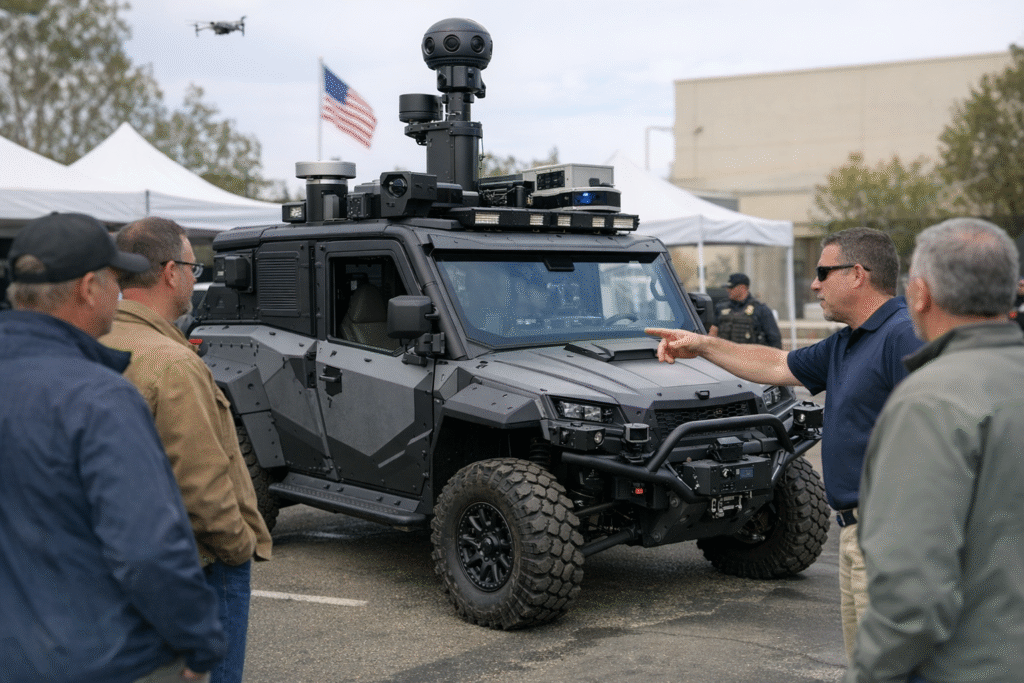
Forterra and Polaris have unveiled a new autonomous ground vehicle aimed at resupplying troops and evacuating casualties in contested environments, marking another step in the U.S. military’s push toward unmanned logistics. The development was detailed in the Breaking Defense article titled “Forterra, Polaris tout new autonomous vehicle for CASEVAC, logistics.”
The platform combines Polaris’ off-road vehicle design with Forterra’s autonomous driving software, producing a system intended to operate in difficult terrain without a human driver. Company executives say the vehicle is designed to handle casualty evacuation missions as well as routine supply delivery, potentially reducing the exposure of personnel to hostile fire.
The system reflects a broader effort within the Pentagon to automate battlefield support roles. While autonomous air and maritime systems have garnered significant attention, ground-based autonomy has proven more technically challenging due to uneven terrain, obstacles, and the unpredictability of combat zones. Forterra argues its software has reached a level of maturity that allows vehicles to navigate these environments with minimal oversight.
According to the Breaking Defense report, the vehicle can operate either remotely or in a supervised autonomous mode, allowing human operators to intervene if needed. This hybrid approach aligns with current military doctrine, which remains cautious about fully removing humans from operational decision-making loops, particularly in complex scenarios such as casualty evacuation.
The CASEVAC mission presents unique requirements, including the need for stability, reliability, and the ability to traverse under fire or through degraded infrastructure. The companies emphasize that the platform can be quickly adapted to carry stretchers or medical equipment, while maintaining enough mobility to reach austere locations.
The unveiling comes as the U.S. Army continues to explore autonomous truck convoys and robotic support vehicles under various experimentation programs. These initiatives are driven in part by lessons learned in recent conflicts, where logistics operations have been increasingly targeted and contested.
Despite advances, questions remain about how autonomous systems will perform in real-world combat conditions, where GPS signals may be disrupted and adversaries may attempt to interfere with communications. Forterra has indicated that its system incorporates multiple layers of sensing and navigation redundancy, though operational validation at scale is still ongoing.
If adopted, platforms like the one highlighted in “Forterra, Polaris tout new autonomous vehicle for CASEVAC, logistics” could reduce risk to personnel and improve the speed and efficiency of battlefield resupply. However, their ultimate impact will depend on how well they integrate into existing military structures and whether they can maintain reliability under the stresses of combat.