Israel Tests Next-Generation Iron Dome with Integrated High-Power Laser Defense System
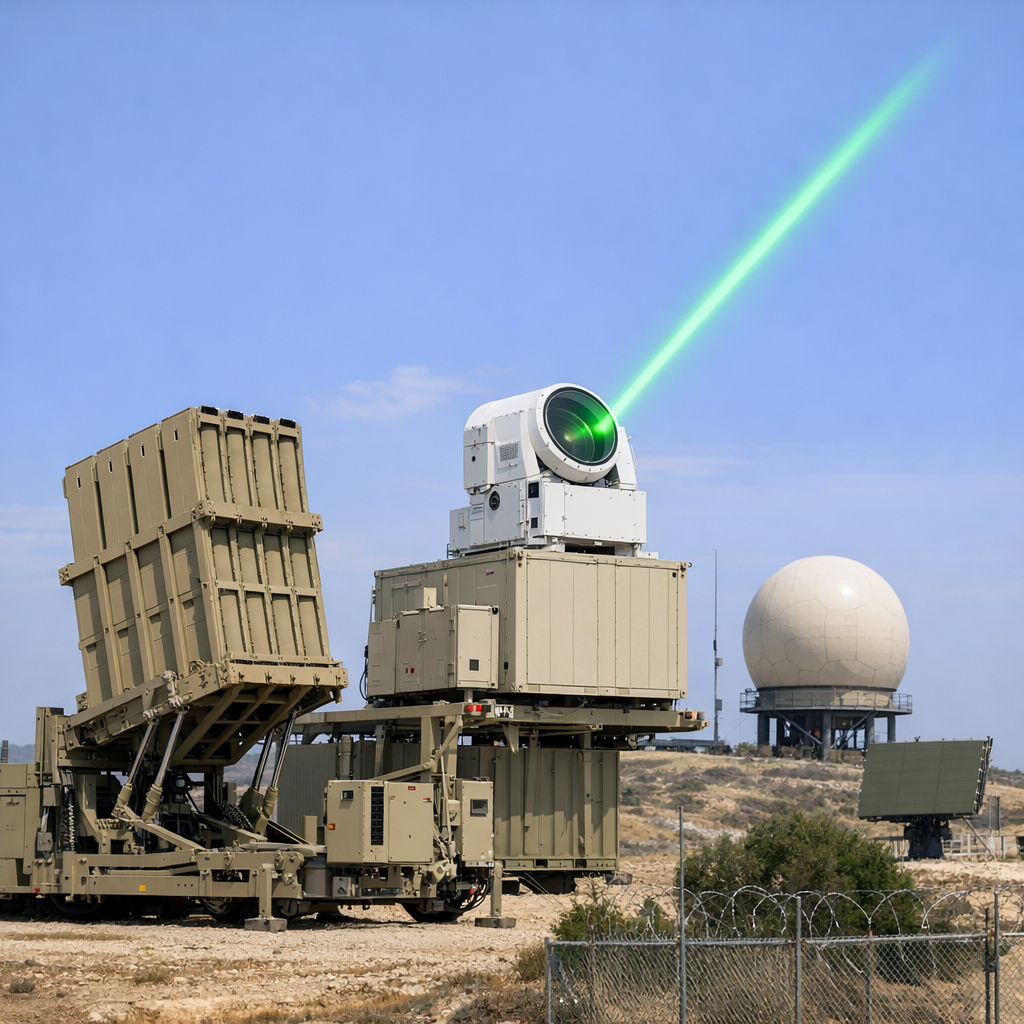
Israel has successfully carried out a series of advanced air defense trials integrating an upgraded Iron Dome system with high-power laser technology, according to a report published by i24NEWS titled “Israel successfully tests upgraded Iron Dome, integrates high-power laser in advanced air defense trials.”
The tests mark a notable step in Israel’s ongoing effort to modernize its multi-layered air defense architecture in response to evolving regional threats. The country’s existing system—widely regarded as one of the most effective missile defense networks in the world—relies heavily on the Iron Dome to intercept short-range rockets and artillery. The newly tested configuration expands this capability by incorporating directed-energy systems designed to complement traditional interceptors.
Israeli defense officials indicated that the integration of high-power laser technology aims to improve interception efficiency and reduce costs associated with conventional missile defense. While interceptor missiles such as those used by Iron Dome are highly effective, they can be expensive to deploy in large numbers, particularly during sustained barrages, as noted in coverage by Reuters. Laser-based systems, by contrast, offer the potential for near-instant engagement at a significantly lower cost per interception once operational.
The trial reportedly evaluated coordinated responses between kinetic interceptors and laser systems, demonstrating how the two could operate together under real-world combat scenarios. Officials suggested that layered use of both technologies could help address challenges posed by increasing quantities and sophistication of incoming threats, including drones, rockets, and possibly cruise missiles, an issue frequently analyzed by the Center for Strategic and International Studies Missile Defense Project.
The development reflects a broader shift within military defense towards integrating emerging technologies such as directed energy into existing frameworks rather than replacing them outright. Analysts note that while laser systems offer promising advantages, they are not without limitations, including sensitivity to atmospheric conditions and power requirements, as discussed in RAND Corporation research on directed energy weapons. As a result, a hybrid approach—combining lasers with proven missile interceptors—appears to be a practical pathway forward.
The i24NEWS report indicates that Israel’s defense establishment sees these advancements as part of a long-term strategy to maintain its qualitative military edge. Continued testing and refinement are expected before full operational deployment, but the recent trials underscore both the pace of technological innovation and the urgency driving it.
As regional tensions persist and adversaries expand their use of low-cost aerial threats, Israel’s evolving air defense systems are likely to play an increasingly central role in its security posture.