Cairo Ceasefire Talks Stall as Israel and Hamas Remain Divided Over Disarmament and Gaza’s Future
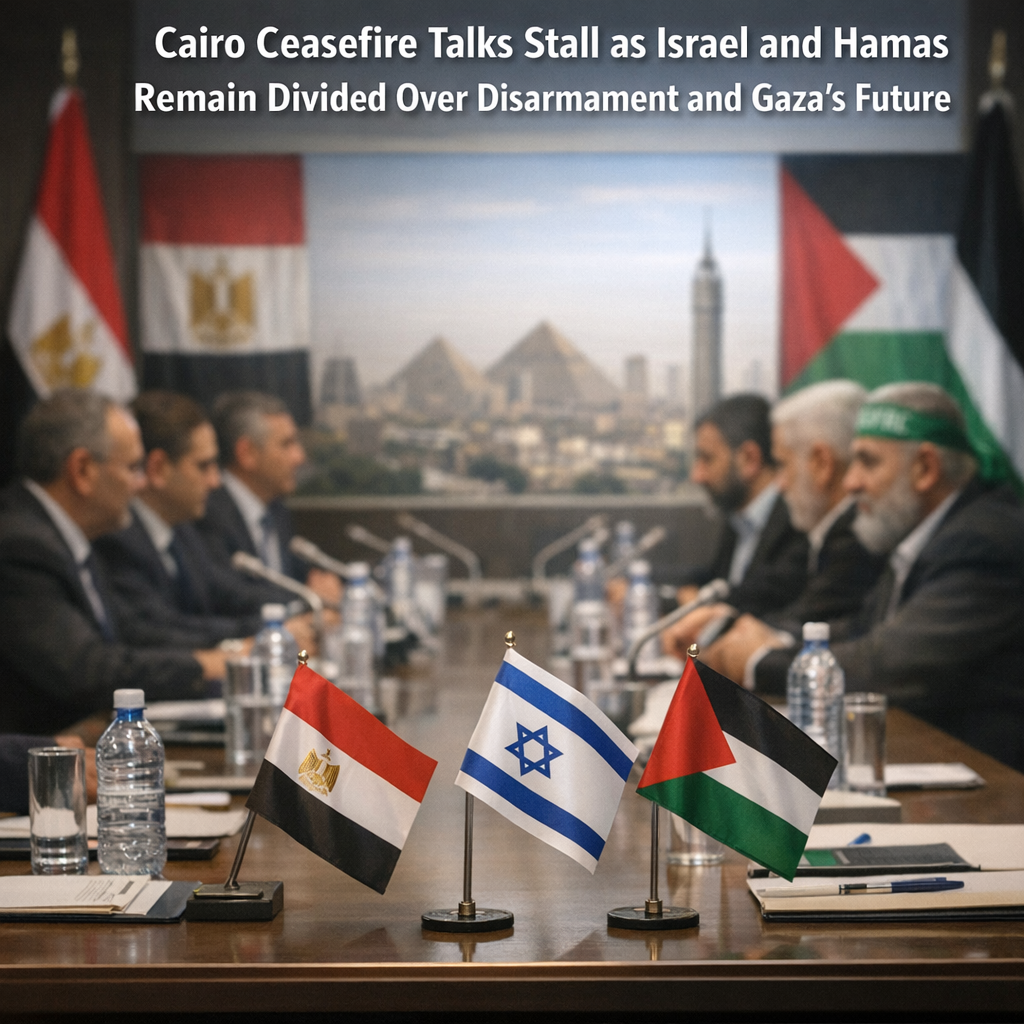
Negotiations aimed at securing a ceasefire in Gaza have faltered in Cairo, underscoring the persistent impasse between Israel and Hamas over core security demands and the future governance of the enclave. According to the article “Gaza ceasefire talks in Cairo stall over Hamas disarmament” published by i24NEWS, the central sticking point remains Israel’s insistence on the disarmament of Hamas, a condition the group has repeatedly rejected.
The Cairo talks, mediated by Egypt and supported by other regional and international actors, were intended to build on intermittent diplomatic efforts to halt the violence that has devastated Gaza and heightened regional tensions. However, the negotiations have again exposed the deep structural divide between Israel’s security priorities and Hamas’s political and military posture.
Israeli officials have maintained that any durable ceasefire must include mechanisms to prevent Hamas from rearming and carrying out future attacks. Disarmament, in Israel’s view, is not merely a bargaining position but a prerequisite for long-term stability. Without it, Israeli leaders argue, any pause in hostilities would amount to a temporary reprieve rather than a meaningful resolution.
Hamas, for its part, has refused to consider disarmament, framing its military wing as a “resistance” force and an essential guarantor of Palestinian leverage. The group has instead focused on demands related to humanitarian access and reconstruction in Gaza, as well as the lifting or easing of restrictions on the territory. Its negotiators have argued that relinquishing arms without concrete political concessions would leave Gaza vulnerable and weaken its negotiating power.
The failure to bridge this gap has complicated the role of mediators, particularly Egypt, which has long served as a key interlocutor between Israel and Palestinian factions. Cairo has sought to craft a formula that could satisfy Israel’s security concerns while offering Hamas incentives to commit to a sustained ceasefire. Yet, as the Reuters Middle East coverage also reflects in similar reporting, the disarmament issue has proven especially resistant to compromise.
The stalled talks come amid an increasingly dire humanitarian situation in Gaza, where infrastructure damage, displacement, and shortages of basic supplies continue to affect the civilian population. International aid organizations such as the International Committee of the Red Cross have warned that without a ceasefire and expanded access, conditions are likely to deteriorate further. These pressures have added urgency to diplomatic efforts, even as political realities limit the scope for agreement.
Wider regional dynamics also shape the negotiations. External actors, including the United States and Gulf states, have encouraged progress toward a ceasefire while balancing their own strategic priorities. Meanwhile, the internal Palestinian political landscape remains fragmented, complicating questions about who would ultimately govern Gaza in the event of a lasting agreement.
Despite the current deadlock, diplomatic channels remain open. Mediators are expected to continue shuttle diplomacy in hopes of finding incremental steps that could eventually lead to a broader arrangement. However, as highlighted in the i24NEWS coverage, the fundamental disagreement over Hamas’s military future suggests that a comprehensive deal remains elusive in the near term.
Absent a breakthrough, the risk is that the cycle of escalation and temporary truces will persist, with significant consequences for civilians on both sides. The Cairo talks, while ongoing in form, illustrate the enduring challenge of reconciling immediate humanitarian needs with deeper political and security disputes that have defined the conflict for years.