Belev Echad and the Expanding Role of Civil Society in Rehabilitating Israel’s Wounded Veterans
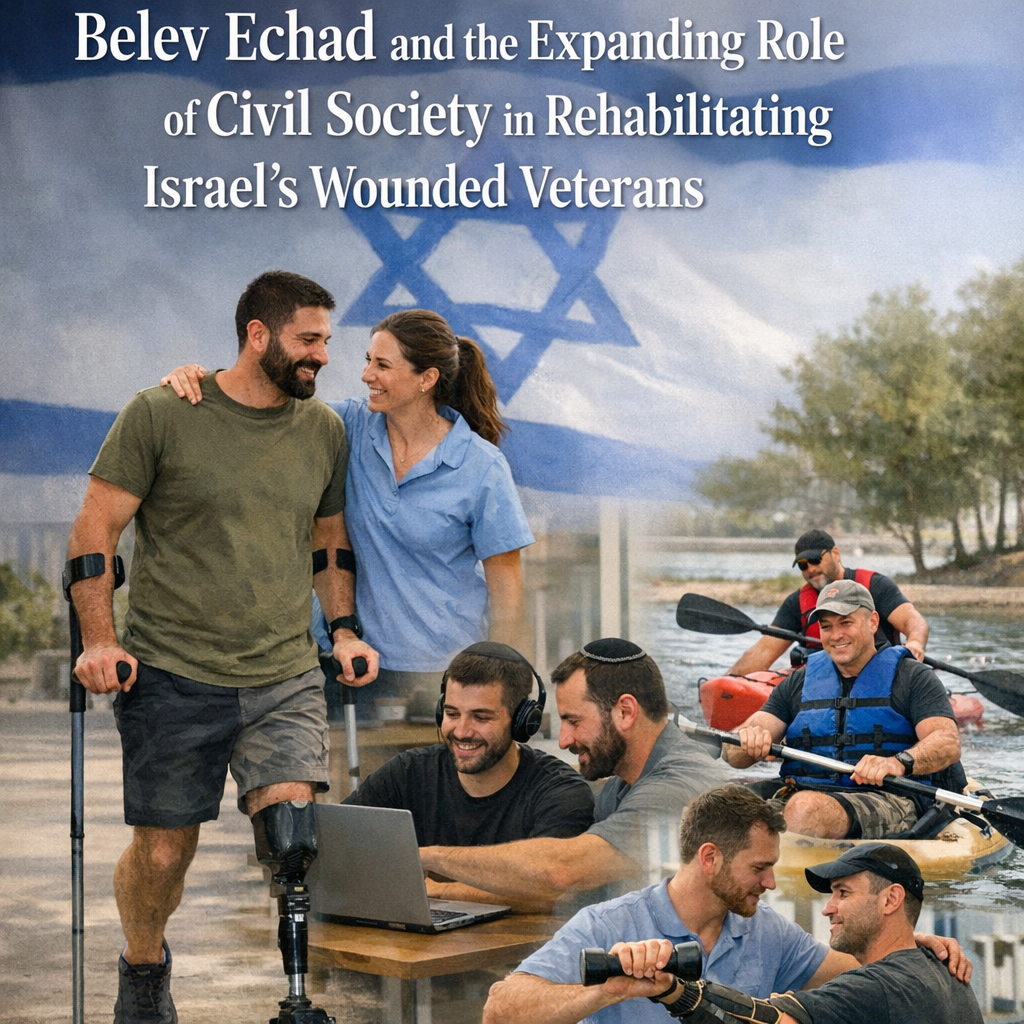
A recent report by i24NEWS, titled “A springboard for life’: How Belev Echad is helping Israel’s wounded veterans rebuild,” highlights the expanding role of civil society in addressing the long-term needs of soldiers injured in Israel’s ongoing conflicts (original article). The article underscores both the scale of the challenge and the increasingly structured response led by nonprofit organizations filling gaps left by formal rehabilitation systems.
Belev Echad, a nongovernmental organization founded in 2009, has emerged as one of the more prominent actors in this space (Belev Echad official website). Its model extends beyond immediate medical recovery, emphasizing sustained physical rehabilitation, psychological support, and social reintegration. According to the i24NEWS report, the organization works with hundreds of wounded veterans each year, many of whom face complex combinations of trauma, disability, and social isolation.
The needs Belev Echad addresses have intensified in the wake of recent escalations in violence, which have produced a new wave of injured servicemen and women. While Israel maintains a well-developed military medical infrastructure, long-term recovery often requires resources that extend into civilian life, including adaptive sports programs, therapy frameworks, and community-building initiatives (Israel Ministry of Defense Rehabilitation Department). The organization positions itself as a bridge between hospital discharge and reintegration into everyday life.
Central to its approach is a focus on restoring a sense of agency and purpose. Activities such as sports rehabilitation, group travel, and peer support networks are designed not only to improve physical outcomes but also to counter the psychological effects of trauma (WHO overview of PTSD). The emphasis on community among veterans appears to be a defining feature, creating informal systems of mentorship and shared experience that complement professional treatment.
The i24NEWS article points to personal testimonies as evidence of impact, with participants describing the organization as a “springboard” that allowed them to envision a future beyond injury. These accounts suggest that recovery, in this context, is not limited to clinical benchmarks but extends to identity reconstruction and renewed independence. Research has increasingly shown that structured physical activity can play a key role in rehabilitation outcomes (NIH study on exercise and rehabilitation).
At the same time, the growing reliance on nonprofits raises broader questions about the distribution of responsibility between state institutions and civil society. While organizations like Belev Echad can operate with flexibility and personalization, their expansion also reflects systemic pressures on public rehabilitation frameworks. The trend mirrors patterns seen in other countries, where veteran care increasingly involves partnerships between government agencies and private or charitable entities (OECD on civil society partnerships).
Financial sustainability remains an ongoing concern. Belev Echad relies heavily on donations, including from international supporters, to fund its programs. As demand rises, maintaining consistent funding streams will be critical to preserving the scope and quality of services.
The visibility of such initiatives has increased as Israeli society confronts the long-term human cost of repeated conflict. The narrative presented by i24NEWS situates Belev Echad not only as a service provider but as part of a broader cultural response, one that seeks to ensure that wounded veterans are not marginalized after their service ends.
In this context, the organization’s work reflects a shift toward more holistic understandings of recovery. Rather than treating rehabilitation as a finite process, it is framed as an evolving journey requiring sustained engagement, community support, and adaptive resources. The continued development of this model may influence how veteran care is approached both within Israel and in comparable settings internationally.