Thales’ €4.5 Billion Exail Acquisition Signals Europe’s Push Into Autonomous Subsea Warfare
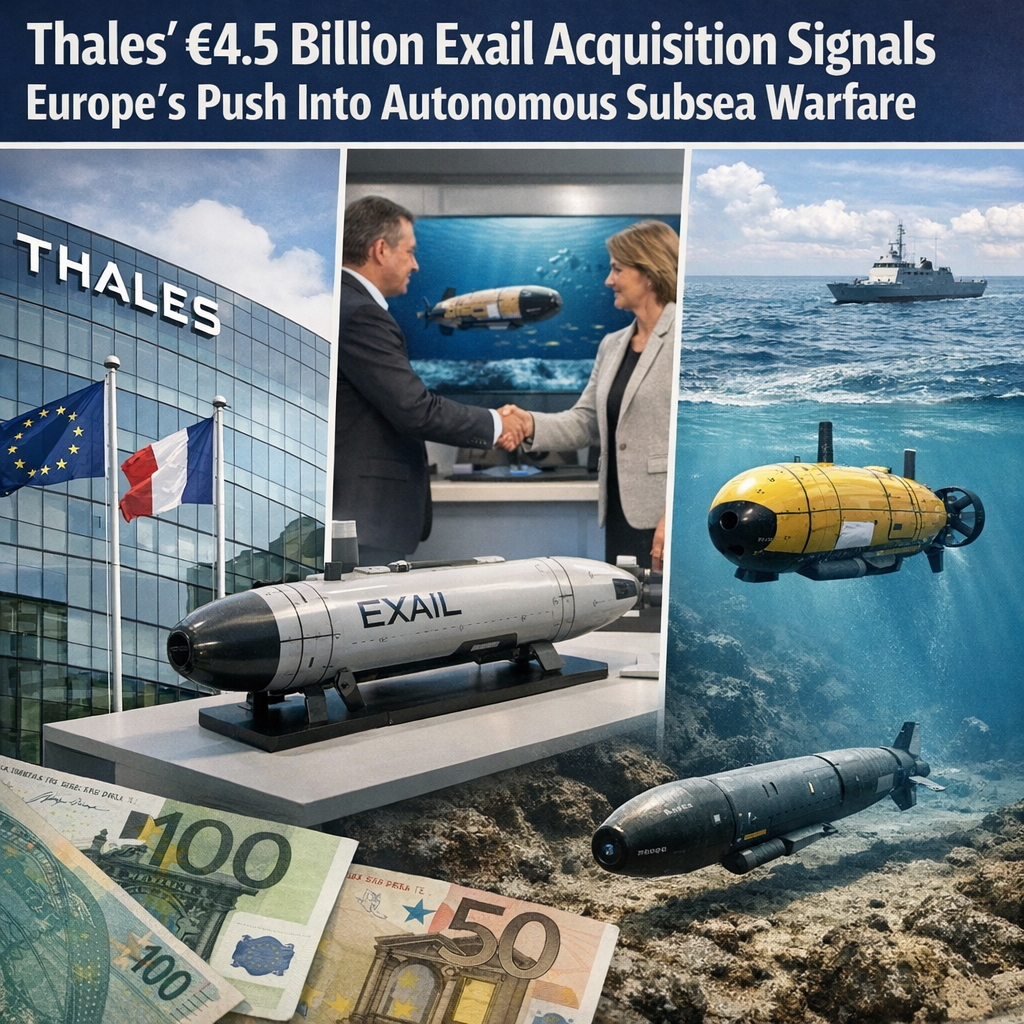
French defense electronics giant Thales has agreed to acquire underwater robotics specialist Exail in a transaction valued at approximately €4.5 billion, a move that underscores a broader shift in European defense priorities toward subsea capabilities and autonomous systems.
The deal, first reported in the Defense News article “Thales to buy French underwater drone maker Exail in €4.5 billion deal”, signals Thales’ intent to expand its footprint in a rapidly evolving segment of naval warfare and maritime security. Exail, a French company formed through the merger of ECA Group and iXblue, has established itself as a leading provider of autonomous underwater vehicles, navigation systems and mine countermeasure technologies.
Industry analysts view the acquisition as part of a wider consolidation trend within Europe’s defense sector, driven by rising geopolitical tensions and increased government spending on military modernization. With undersea infrastructure such as subsea communication cables and pipelines increasingly seen as strategic assets vulnerable to sabotage, demand for sophisticated detection and protection technologies has grown sharply.
By integrating Exail’s capabilities, Thales is positioning itself to offer more comprehensive solutions spanning sonar, unmanned systems and data integration. The company already has a significant presence in naval electronics and anti-submarine warfare, and the addition of Exail’s autonomous platforms is expected to enhance both its technological depth and its competitiveness in export markets.
Executives have framed the acquisition as a strategic step toward strengthening Europe’s industrial base in a domain often dominated by U.S. and, increasingly, Asian players. The consolidation may also align with European Union initiatives to boost defense autonomy and reduce dependency on external suppliers in critical technologies.
Financial details beyond the headline valuation remain limited, but the scale of the transaction suggests a long-term bet on sustained growth in maritime defense spending. Governments across NATO, particularly in Northern and Eastern Europe, have placed renewed emphasis on naval capabilities in response to heightened tensions and incidents involving subsea infrastructure in recent years.
The integration of Exail could also accelerate innovation in dual-use technologies. Many of the company’s systems, such as autonomous underwater vehicles, have applications beyond defense, including offshore energy, oceanographic research and commercial shipping. Thales has indicated that it intends to maintain these civilian market links while leveraging defense synergies.
However, the acquisition may face scrutiny from regulators concerned about market concentration in certain high-end segments, particularly mine countermeasure systems. It will also require careful integration of two technologically complex organizations with overlapping product lines and engineering cultures.
Still, the strategic logic appears clear. As naval warfare evolves toward greater reliance on unmanned and autonomous systems operating below the surface, control of subsea technology ecosystems is becoming a decisive factor. Thales’ move to absorb Exail reflects both an immediate response to security concerns and a broader effort to secure a leading role in what many defense planners see as the next frontier of military competition.