U.S. Marine Corps Invests $20 Million in First Autonomous Ground Vehicles to Transform Battlefield Logistics
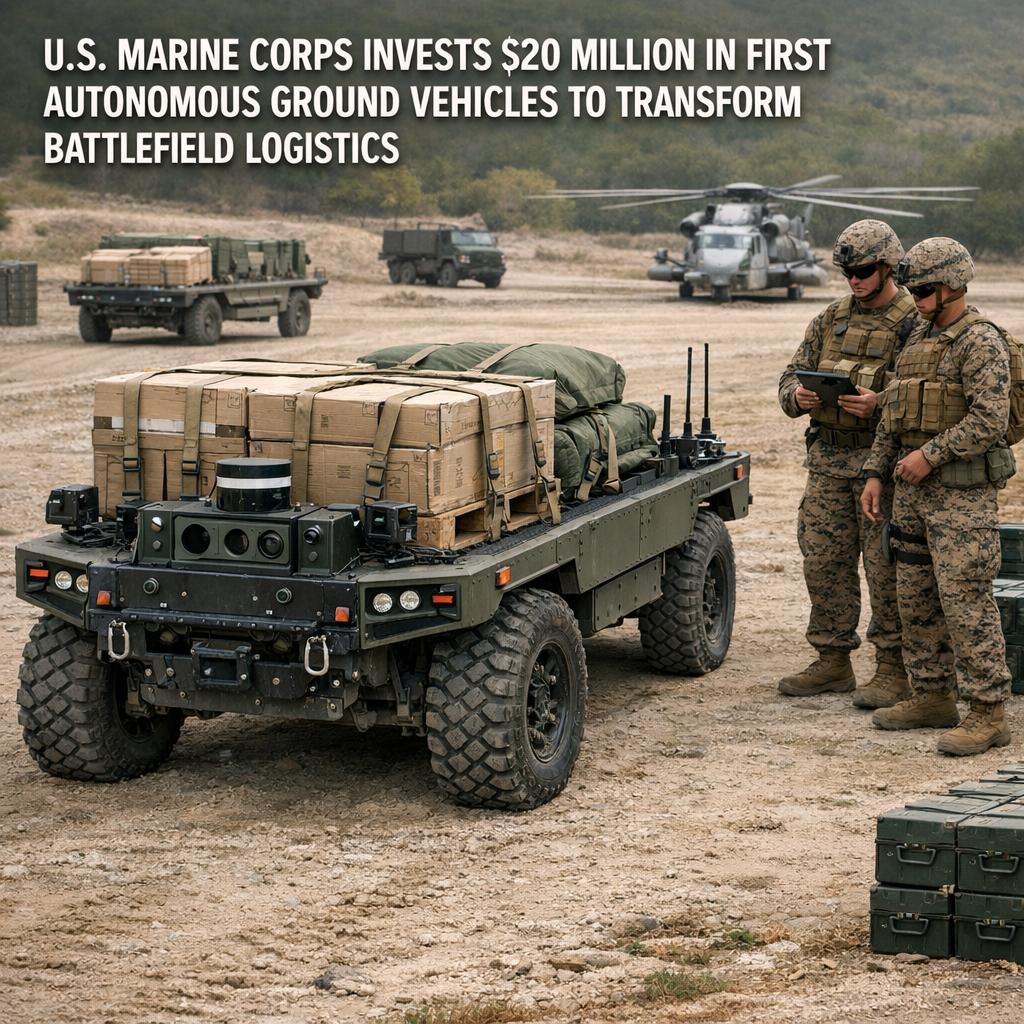
The U.S. Marine Corps has taken another step toward integrating autonomous technology into its operational framework, awarding a $20 million contract aimed at developing its first generation of autonomous ground vehicles. The move, first reported in the Military Times article, signals a continued shift toward unmanned systems designed to enhance mobility, reduce risk to personnel, and expand logistical capabilities in contested environments.
According to the report published by Military Times, the contract focuses on the development of advanced ground platforms capable of operating with limited or no direct human control. These vehicles are expected to support a range of missions, including resupply, reconnaissance, and casualty evacuation. By reducing the need for Marines to physically accompany convoys or operate in high-risk areas, the initiative aligns with broader Pentagon efforts to integrate autonomy across multiple domains.
Officials have emphasized that the effort is not about replacing Marines on the battlefield but rather augmenting their capabilities. Autonomous ground vehicles could take on repetitive or dangerous tasks such as transporting equipment across exposed terrain or navigating areas where threats like improvised explosive devices are prevalent. This would allow personnel to concentrate on decision-making and mission-critical operations.
The contract also reflects the Marine Corps’ evolving doctrine, particularly its emphasis on distributed operations and expeditionary maneuver. In such scenarios, smaller, more dispersed units require reliable logistics without relying on large, vulnerable supply lines. Autonomous systems could help sustain these units by enabling more flexible and less predictable resupply methods, consistent with concepts outlined in Marine Corps doctrine.
While the initiative marks a significant technological step, challenges remain. Autonomous navigation in complex, unpredictable environments—especially in combat conditions—continues to pose technical and ethical questions. Issues such as system reliability, cybersecurity vulnerabilities, and rules of engagement for autonomous platforms will likely be key considerations as development progresses, areas actively studied by organizations like DARPA.
Still, defense analysts view the contract as part of a broader trend across the U.S. military, which is increasingly investing in unmanned and semi-autonomous systems to maintain a technological edge. The Marine Corps’ effort mirrors similar initiatives within the U.S. Army Futures Command and other branches, underscoring a joint push to integrate robotics and artificial intelligence into future force structures.
As the program moves forward, its success will depend on balancing innovation with operational practicality, ensuring that new technologies can function effectively in the unpredictable realities of warfare. For now, the $20 million investment represents both an experiment and a strategic signal of where the Marine Corps sees the future of ground operations heading.