America’s Air and Missile Defense Industrial Base Faces Urgent Need for Expansion and Reform
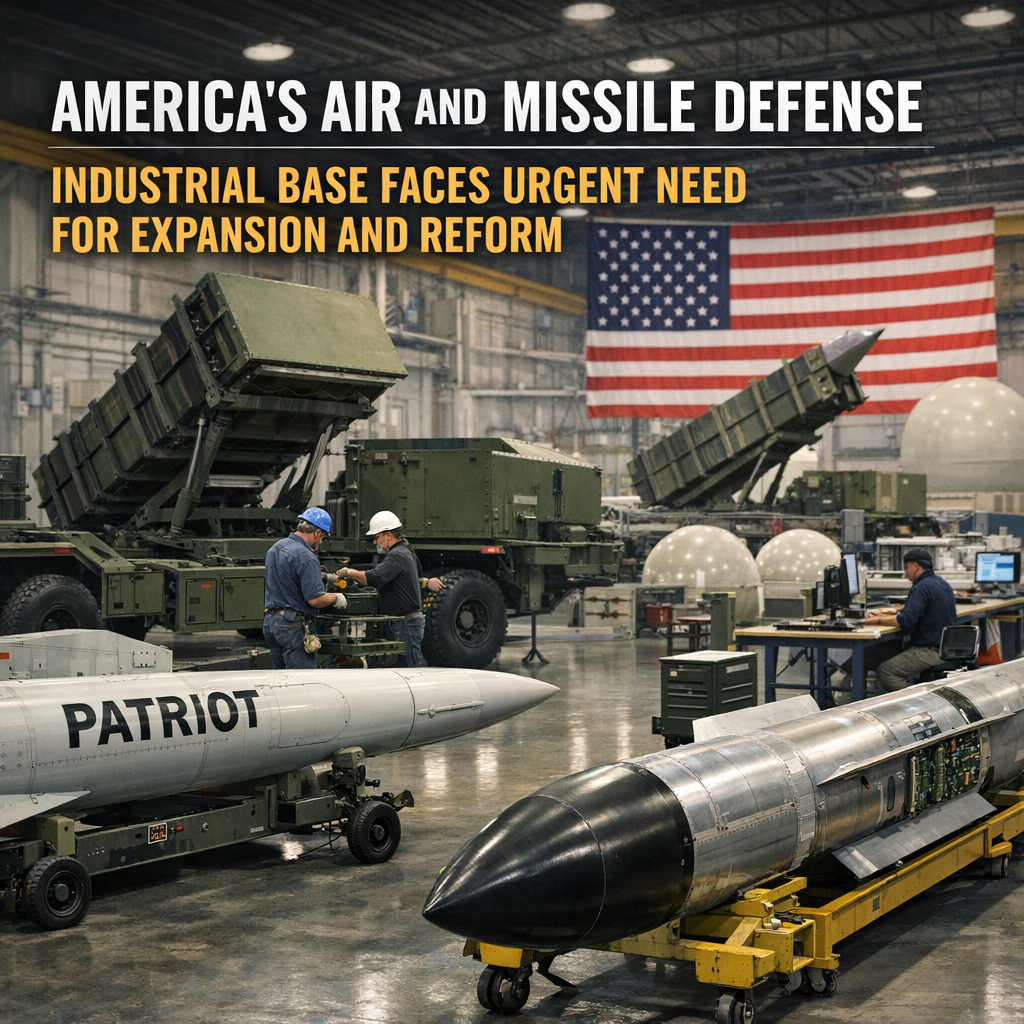
A recent article published by Breaking Defense, titled “Built for another era, our air and missile defense industrial base needs more builders,” argues that the United States faces a mounting mismatch between modern security demands and an industrial base still structured for a different strategic moment. The piece highlights growing concern among defense experts that the capacity to produce critical air and missile defense systems has not kept pace with emerging threats, particularly from near-peer competitors and the rapid proliferation of advanced missile technologies.
The Breaking Defense report emphasizes that the current industrial framework was largely shaped in the post-Cold War period, when defense production was streamlined, consolidated, and optimized for efficiency rather than surge capacity. While that model reduced costs and redundancy, it also narrowed the pool of manufacturers and suppliers capable of producing sophisticated systems such as interceptors, radars, and command-and-control networks. As global tensions rise, that limited capacity is increasingly viewed as a strategic vulnerability, a concern echoed in the Pentagon’s National Defense Industrial Strategy.
Central to the article’s argument is the notion that demand for air and missile defense has expanded dramatically in both scale and complexity. Modern battlefields now feature a wider array of threats, including hypersonic weapons, cruise missiles, drones, and ballistic systems, often deployed in coordinated salvos designed to overwhelm defenses. The war in Ukraine and ongoing tensions in the Indo-Pacific region are cited as evidence that sustained, high-volume production of defensive systems is no longer a theoretical requirement but an immediate necessity, as reflected in analyses of the Ukraine conflict.
However, according to Breaking Defense, the U.S. industrial base is not currently structured to meet such sustained demand. Production lines for key components are limited, and the workforce skilled in manufacturing advanced defense systems has not grown proportionally. Supply chain fragility further compounds the issue, with reliance on specialized parts and, in some cases, overseas sources adding risk to already strained production timelines.
The article underscores that expanding capacity will require more than incremental adjustments. It calls for a broader rethinking of how the defense industrial base is organized and incentivized. One of the key proposals involves encouraging new entrants into the market to increase competition and resilience. By lowering barriers to entry and fostering a more diverse ecosystem of suppliers, policymakers could reduce bottlenecks and improve responsiveness to shifting strategic needs, a point frequently examined by the CSIS Missile Defense Project.
At the same time, the Breaking Defense piece notes that attracting new manufacturers will depend on providing clearer and more consistent demand signals from the government. Defense companies are unlikely to invest in new facilities, workforce development, or supply chains without confidence in long-term procurement commitments. This suggests a need for more predictable funding and procurement strategies, as well as closer collaboration between the Pentagon and industry.
Workforce challenges are also highlighted as a critical constraint. The specialized skills required to design and produce advanced air and missile defense systems are in short supply, and training pipelines have not kept pace with demand. Addressing this issue will likely require coordinated efforts involving industry, government, and educational institutions to cultivate the next generation of engineers, technicians, and manufacturing specialists, an issue also examined in reports from the U.S. Government Accountability Office.
Another issue raised in the article is the regulatory and contracting environment, which can slow down production and deter potential entrants. Streamlining acquisition processes and reducing bureaucratic friction could help accelerate timelines and make the defense sector more attractive to a broader range of firms, including those with commercial or dual-use expertise.
The Breaking Defense analysis ultimately frames the challenge as one of strategic urgency. As adversaries continue to expand and modernize their missile arsenals, the ability of the United States and its allies to defend against large-scale attacks will depend not only on technological superiority but also on industrial strength. Without significant changes, the article warns, the gap between operational requirements and production capacity may continue to widen.
The piece concludes that rebuilding and expanding the air and missile defense industrial base will require sustained political will, long-term investment, and a willingness to rethink established models. In an era defined by rapid technological change and renewed great-power competition, the capacity to produce at scale may prove as decisive as the systems themselves.