New Memorial Design Seeks to Capture the Global and Complex Legacy of Post-9/11 Wars
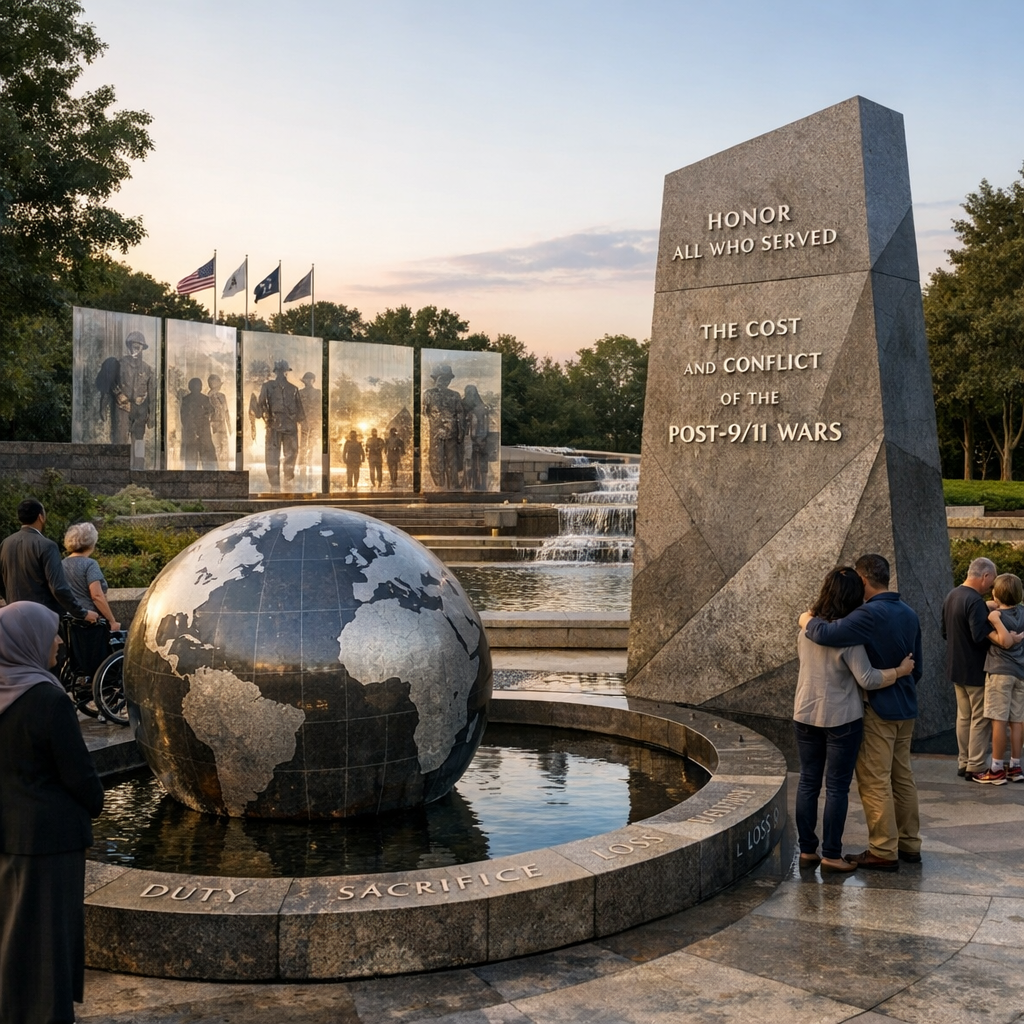
A newly unveiled concept for the Global War on Terrorism Memorial offers the clearest indication yet of how designers intend to commemorate more than two decades of conflict defined by its geographic breadth and complex legacy. The proposal, highlighted in the Military Times video report “A first look at the Global War on Terrorism Memorial design”, reflects an effort to balance traditional elements of remembrance with a more contemporary, experiential approach to public memory.
According to the Military Times feature, the early design emphasizes an immersive, landscape-driven experience rather than a single dominant structure. Planners appear to be steering away from monumentalism in favor of a space that invites reflection through movement, symbolism, and layered storytelling. The concept suggests an environment where visitors can engage with the narrative of the post-9/11 conflicts at their own pace, rather than being directed toward a singular focal point.
Designers involved in the memorial have sought to capture not only the scale of the Global War on Terrorism, but also its decentralized and ongoing nature. Unlike previous conflicts with clearly defined timelines and theaters, the campaigns launched after the September 11, 2001 attacks spanned multiple continents and involved a wide range of military and civilian roles. The proposed design, as presented by Military Times, attempts to reflect that complexity through spatial elements that evoke both connection and dispersion.
A key challenge for the memorial effort has been representing a conflict that remains recent in public memory and, in certain respects, unresolved. Veterans, families of the fallen, policymakers, and the broader public continue to hold differing perspectives on the meaning and outcomes of the war. The conceptual design appears to address this tension by avoiding overt political messaging, instead focusing on service, sacrifice, and the human dimension of war.
The report indicates that the memorial will likely incorporate names or other forms of individual recognition, though specific details remain under development. Equally important is the intention to create a space that acknowledges not only those who died, but also those who served and continue to live with the physical and psychological consequences of the conflict, including conditions such as post-traumatic stress disorder. This broader framing aligns with evolving approaches to military commemoration, which increasingly recognize the long-term impacts of war beyond the battlefield.
Location and integration into the surrounding environment are also central considerations. As with other national memorials in Washington, D.C., the site must navigate historical context, aesthetic expectations, and regulatory oversight, often guided by agencies like the National Park Service. The preliminary design presented in the Military Times video suggests a careful effort to harmonize with existing landmarks while establishing a distinct identity.
The unveiling of the concept marks a significant step in a process that has been shaped by years of advocacy and legislative action. The Global War on Terrorism Memorial Foundation has worked to gather input from veterans and stakeholders, aiming to ensure that the final result resonates with those most closely connected to the conflict. Public feedback is expected to continue playing a role as the design evolves, alongside broader engagement with institutions such as the U.S. Department of Defense.
While still in its conceptual phase, the memorial design underscores the difficulty of commemorating a conflict defined as much by its ambiguity as by its scale. The approach outlined in “A first look at the Global War on Terrorism Memorial design” signals an attempt to move beyond conventional forms, creating a space that reflects not only loss, but also the enduring and often complicated legacy of the wars fought in the aftermath of 9/11.