Apache Incident Near Oman Highlights Growing Risks for Legacy Aircraft in Contested Airspace
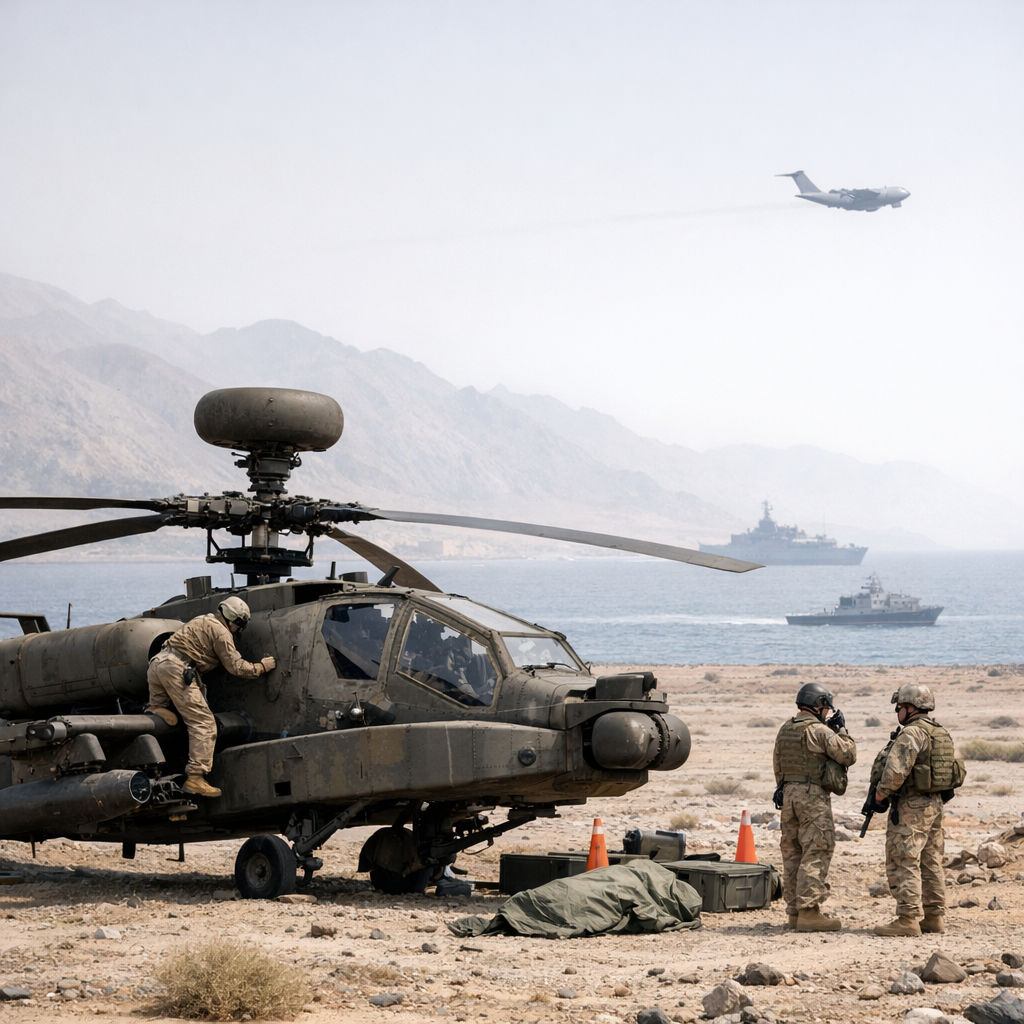
A recent incident involving a U.S. AH-64 Apache attack helicopter operating near Oman is prompting renewed scrutiny among defense analysts, who say the episode underscores a broader shift in the character of modern air combat.
According to reporting by Military Times in its article “Apache going down near Oman a sign of air combat evolution, analysts warn,” the event has drawn attention not simply because of the loss or damage of a high-value platform, but because of what it may reveal about the increasingly contested environments in which such aircraft now operate. While details surrounding the specific circumstances remain limited, analysts cited in the report argue that even isolated incidents can signal deeper vulnerabilities in legacy systems when confronted with modern threats.
The AH-64 Apache attack helicopter has long been regarded as one of the most capable and battle-tested platforms in the U.S. arsenal, designed for close air support, anti-armor missions, and operations in relatively permissive or semi-contested airspace. However, the evolving threat landscape, particularly in regions near strategic chokepoints like the Arabian Peninsula, is challenging longstanding assumptions about rotary-wing survivability.
Military Times notes that analysts are increasingly concerned about the proliferation of advanced air defense systems, including portable surface-to-air missiles, radar-guided weapons, and man-portable air-defense systems (MANPADS). These systems, even when operated by non-state actors or smaller regional powers, can complicate the operating environment for aircraft that were originally optimized for different threat conditions.
The incident near Oman appears to reinforce a growing consensus that air superiority can no longer be taken for granted, even for platforms with a long history of operational success. Analysts suggest that the boundaries between traditionally “safe” and “high-risk” airspace are eroding, driven by the wider availability of precision targeting tools and improved surveillance capabilities.
Some experts also emphasize that adversaries are becoming more adept at integrating disparate technologies into cohesive defensive networks. This trend reduces reaction times and increases the likelihood that slower, lower-flying aircraft like helicopters could be detected and engaged before completing their missions.
At the same time, the situation raises questions about the balance between legacy systems and emerging technologies. While the Apache continues to receive upgrades, including improved sensors and defensive countermeasures, critics argue that incremental improvements may not be sufficient against rapidly evolving threats. Instead, they advocate for a broader shift toward unmanned combat aerial vehicles (UCAVs), stand-off weapons, and next-generation aircraft designed with contested environments in mind from the outset.
Others caution against drawing sweeping conclusions from a single event. They note that operational factors, maintenance issues, or human error can also play significant roles in aviation incidents, and that without complete information, it is difficult to isolate the precise cause. Even so, they acknowledge that the strategic implications raised by the Military Times reporting are consistent with longer-term trends identified across multiple theaters.
The region near Oman, situated along critical maritime routes and within reach of several geopolitical flashpoints, has become an increasingly complex operating environment. U.S. forces in the area must contend not only with traditional state actors but also with irregular groups equipped with increasingly sophisticated weaponry.
In this context, the reported Apache incident is being interpreted less as an isolated mishap and more as a data point in a broader transformation of warfare. Analysts argue that the future of air combat will likely be defined by greater reliance on stealth technology, automation, and networked systems capable of operating in environments where detection and engagement can occur almost simultaneously.
As Military Times highlights, the implications extend beyond a single platform or mission. The incident feeds into ongoing debates within defense circles about procurement priorities, training adaptations, and the need to rethink how airpower is projected in contested regions.
For military planners, the central challenge lies in adapting quickly enough to keep pace with technological diffusion. As adversaries gain access to more capable defensive tools, the margin for error narrows, and even highly advanced systems like the Apache face increasing risks.
The episode near Oman, while still under examination, serves as a reminder that the evolving dynamics of air combat are no longer theoretical. They are already shaping real-world operations, with consequences that may influence strategic decisions for years to come.