Pentagon Weighs Cutting Traditional Weapons Funding to Accelerate Drone and Autonomous Warfare Shift
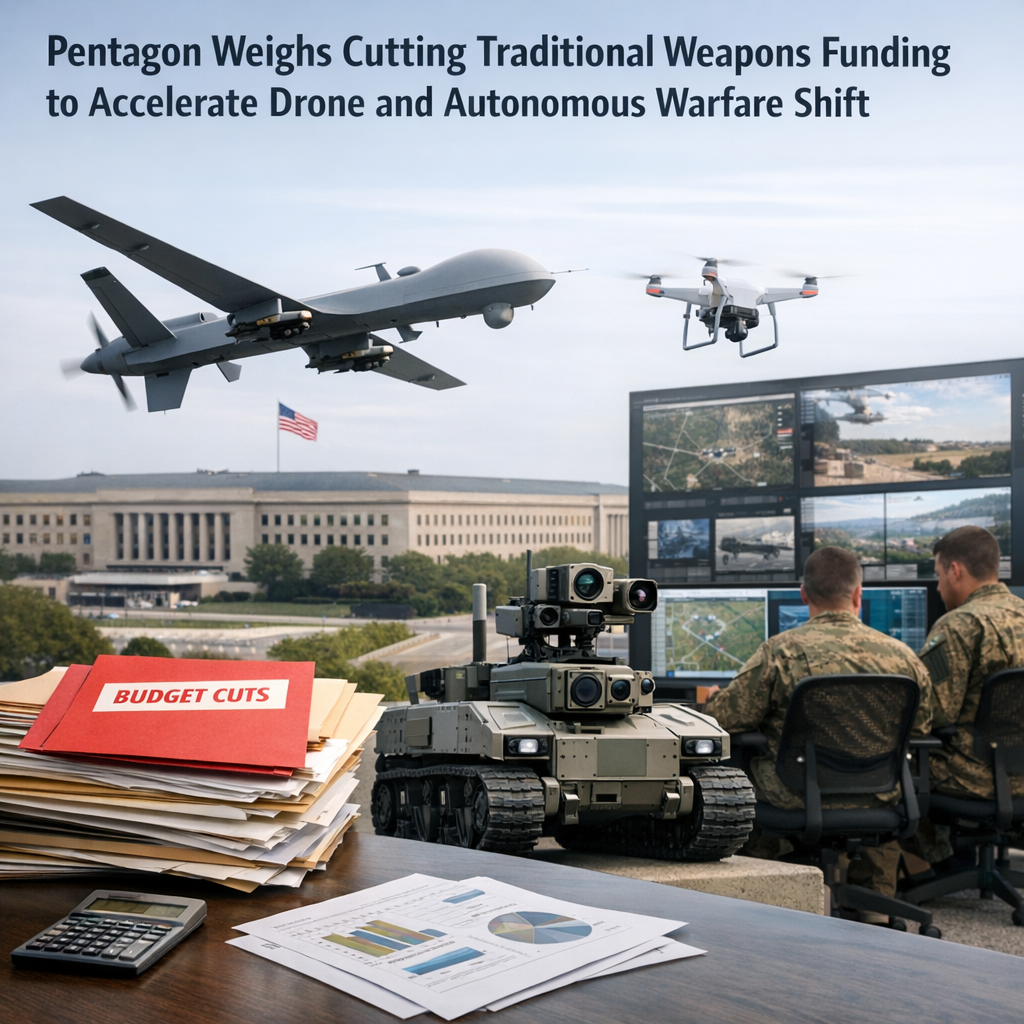
A senior Pentagon technology official has signaled that the U.S. military may be forced to shift funding away from traditional weapons systems and toward drones and autonomous platforms if Congress fails to pass a budget reconciliation measure, underscoring the growing urgency around adapting to modern warfare.
According to reporting by Breaking Defense in the article titled “Pentagon may sacrifice traditional weapons to buy more drones if reconciliation fails: CTO,” the Department of Defense is increasingly concerned that budget constraints could hinder its ability to scale up investments in unmanned systems—capabilities that military planners view as essential in future conflicts, particularly against technologically sophisticated adversaries.
The Pentagon’s Chief Technology Officer indicated that without additional funding flexibility, difficult trade-offs may be unavoidable. In practical terms, that could mean reducing procurement or delaying upgrades to legacy platforms such as crewed aircraft, armored vehicles, or large naval assets in order to redirect limited resources toward mass-producible, lower-cost autonomous systems.
The warning reflects a broader strategic shift already underway within the U.S. military. Defense leaders have repeatedly emphasized the importance of drones and autonomous systems, artificial intelligence, and networked systems in countering threats from countries like China, where large-scale production of unmanned technologies is seen as a potential advantage. The war in Ukraine has also reinforced the operational value of relatively inexpensive drones in surveillance and strike roles, as documented in analyses by the International Institute for Strategic Studies, accelerating calls within the Pentagon to expand similar capabilities.
However, the transition presents significant institutional and political challenges. Traditional weapons programs are often tied to long-standing defense contracts, regional economic interests, and congressional priorities. Scaling back such programs can encounter resistance on Capitol Hill, particularly when jobs and industrial base considerations are at stake.
The reconciliation process referenced in the Breaking Defense report is central to determining how much flexibility the Pentagon will have in reallocating funds. Without it, defense officials may be constrained by existing budget caps and line-item appropriations, as outlined in Congressional Research Service reports on the defense budget, limiting their ability to pivot quickly toward emerging technologies.
The CTO’s comments suggest that time is a critical factor. Autonomous systems, particularly drones, are valued not only for their capabilities but also for their scalability and cost-effectiveness. In a potential high-intensity conflict, the ability to produce and deploy large numbers of such systems quickly could prove decisive.
At the same time, experts caution that abandoning or significantly reducing investment in traditional platforms carries its own risks. Crewed systems still play vital roles in deterrence, power projection, and complex missions that autonomous technologies are not yet fully equipped to handle, a balance discussed in RAND Corporation research on future warfare. The challenge for defense planners lies in balancing near-term readiness with long-term transformation.
The debate highlights a larger question facing the Pentagon: how to restructure a defense budget and acquisition system built for industrial-age warfare to meet the demands of a rapidly evolving technological landscape. As the Breaking Defense report makes clear, the outcome of current budget negotiations could have lasting implications for that transformation and for the future shape of the U.S. military.