How Flashpoint Campaigns Brings the OODA Loop to Life in Modern Wargaming
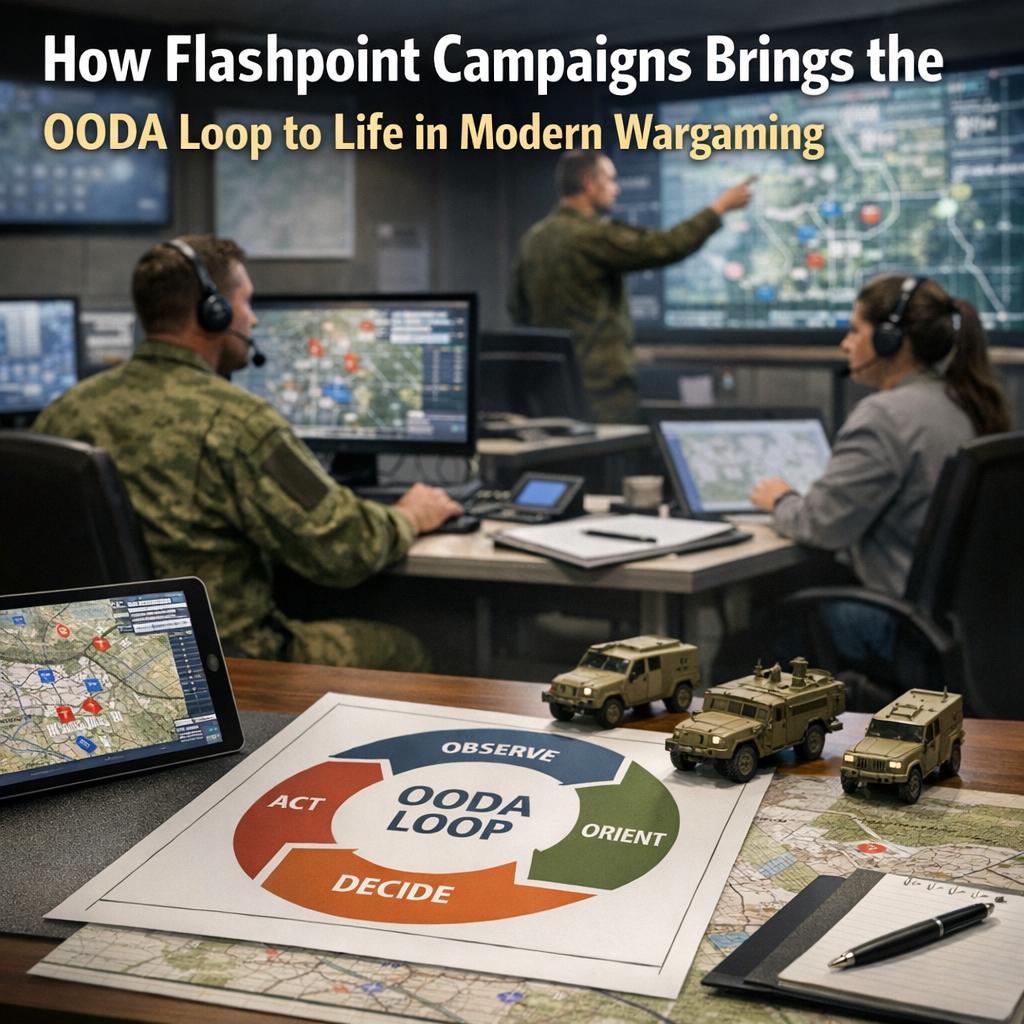
A new generation of military simulation is drawing renewed attention to an old concept at the heart of modern warfare: decision speed. In its recent feature, “Flashpoint Campaigns: Cold War is the ultimate OODA loop wargame,” Military Times examines how a niche but highly detailed computer wargame is being used to model the compressed timelines and uncertainty that define real-world command.
Developed by a small team of veterans and simulation enthusiasts, Flashpoint Campaigns: Cold War places players in command of NATO or Warsaw Pact forces during a hypothetical late-Cold War confrontation in Central Europe. Unlike many strategy games that reward rapid micromanagement, this simulation forces players to confront delays, incomplete information, and the friction that typifies actual military operations.
At the center of the experience is the OODA loop — observe, orient, decide, act — a framework popularized by U.S. Air Force Col. John Boyd (see OODA loop). The concept emphasizes the importance of processing information and adapting faster than an adversary. Military-focused analyses, such as those from the U.S. Air University, note that the game’s design builds this principle into every layer of decision-making, from reconnaissance and communications to the execution of orders on the battlefield.
What distinguishes Flashpoint Campaigns is its portrayal of command latency. Orders are not executed instantly; instead, they move through a simulated chain of command, subject to delays based on unit cohesion, leadership, and battlefield conditions. This mechanic compels players to think ahead and accept that once an order is issued, it may not be immediately alterable — mirroring real operational constraints described in doctrine such as U.S. Army field manuals.
The result is a markedly different pacing from typical real-time strategy titles. Players must anticipate developments and manage uncertainty rather than react instantaneously. As described in the Military Times article, this creates a “cognitive tension” that aligns more closely with the pressures faced by actual commanders, where incomplete situational awareness and time pressure are constant factors.
The simulation also places a premium on reconnaissance and intelligence gathering. Units operate with limited visibility, and enemy positions are often uncertain or misidentified. This fog of war concept, widely discussed in military theory (see fog of war), reinforces the centrality of the OODA loop, as players must continuously reassess their understanding of the battlefield and adjust their plans accordingly.
Defense professionals and serious hobbyists have shown growing interest in such tools, not only for entertainment but for education. While Flashpoint Campaigns is not an official military training system, similar concepts are explored by organizations like RAND Corporation wargaming research, highlighting enduring operational challenges, particularly in large-scale conventional warfare scenarios that have regained relevance amid renewed great-power competition.
Military Times points out that the game’s Cold War setting resonates with contemporary strategic concerns. As NATO and allied forces revisit doctrines for high-intensity conflict in Europe, simulations that explore command-and-control limitations and decision cycles offer a way to think through complex scenarios without real-world consequences.
At the same time, the game underscores a broader shift in how wargaming is perceived. Once the domain of specialized military institutions, sophisticated simulations are increasingly accessible to the public, blurring the line between professional analysis and civilian interest. This accessibility may contribute to a wider understanding of the challenges inherent in military decision-making, even as it raises questions about how accurately such systems can capture the human and political dimensions of conflict.
Ultimately, as highlighted in Military Times’ coverage, Flashpoint Campaigns: Cold War demonstrates that technological sophistication in simulation does not necessarily mean faster gameplay. Instead, it can mean forcing players to slow down, think critically, and grapple with uncertainty — conditions that define the reality of command far more than the immediacy often portrayed in popular depictions of war.