Space Force Pushes Faster More Flexible Capabilities
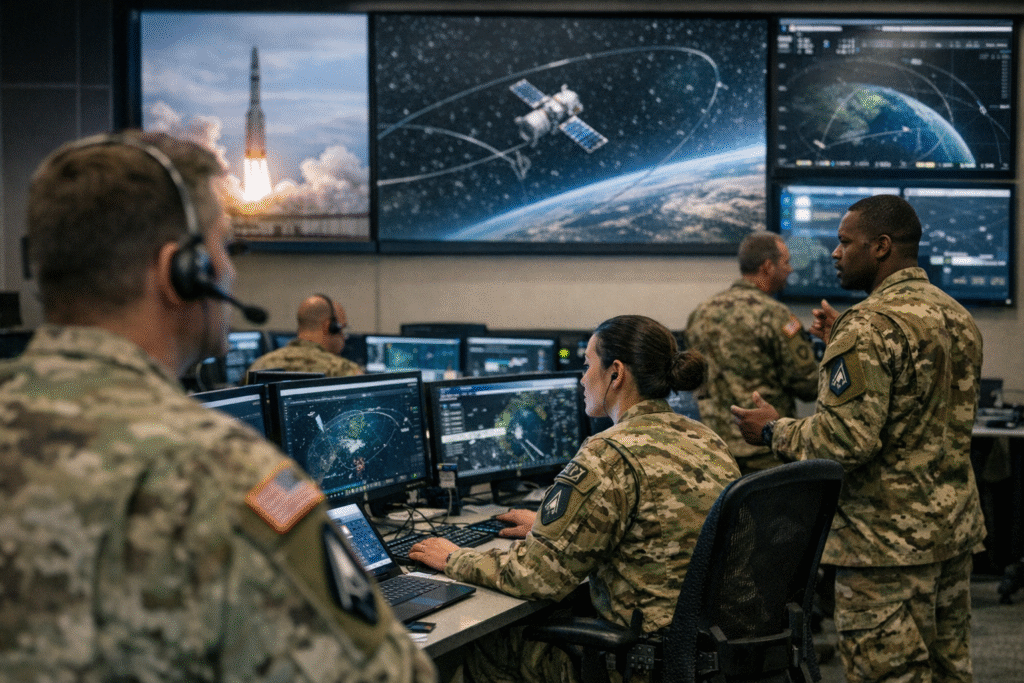
U.S. Space Force Chief of Space Operations Gen. B. Chance Saltzman is urging a fundamental shift in how the service develops and fields new capabilities, arguing that speed and adaptability must take precedence over pursuing technically exquisite systems that take years to deliver.
Speaking at a recent forum, Saltzman emphasized that the Space Force should prioritize what he described as “minimum viable capabilities,” a model that focuses on deploying functional, usable systems quickly and improving them incrementally over time. The approach, detailed in the Breaking Defense article “CSO Saltzman: Focus space acquisition on minimum viable capabilities,” reflects growing concern within the Pentagon that traditional acquisition methods are too slow to keep pace with evolving threats, particularly from China.
Saltzman’s remarks highlight an ongoing tension within U.S. defense acquisition: the balance between sophistication and timeliness. Historically, space programs have pursued highly advanced, often bespoke systems designed for long service lives. While these platforms can offer superior performance, they are also expensive, vulnerable to disruption, and slow to field. In an era of rapid technological change and intensifying strategic competition, Saltzman suggested that such an approach may no longer be viable.
Instead, he advocated for a more iterative development cycle, where capabilities are deployed sooner, even if they are less refined, and then upgraded continuously. This model mirrors practices in the commercial technology sector and aligns with broader Defense Department efforts to adopt agile development principles. According to Saltzman, delivering something “good enough” quickly can provide operational advantages while allowing the service to adapt as threats evolve.
The shift also has implications for how the Space Force works with industry. Saltzman indicated that acquisition processes must become more flexible to enable faster contracting and integration of emerging technologies. That includes lowering barriers for commercial firms that can contribute innovative solutions but may be deterred by complex procurement requirements.
Underlying these changes is a strategic calculation about resilience. Rather than relying on a small number of highly capable satellites, the Space Force is increasingly exploring more distributed architectures that can withstand attack or disruption. Minimum viable capability, in this context, supports the deployment of larger constellations of smaller, more rapidly produced systems, complicating adversaries’ targeting strategies.
Saltzman’s emphasis on speed reflects broader concerns about the timeline of potential conflict. U.S. officials have repeatedly warned that China is advancing quickly in space capabilities, from anti-satellite weapons to sophisticated orbital systems. The Space Force’s leadership has argued that maintaining a technological edge will require not just innovation, but the ability to field that innovation at operational tempo.
While the concept of minimum viable capability promises faster delivery, it also raises questions about risk and performance. Critics of the approach caution that fielding less mature systems could create operational gaps or require costly retrofits. Saltzman acknowledged these challenges but framed the trade-off as necessary in a security environment where delay itself carries significant risk.
The push for acquisition reform is not new, but Saltzman’s comments suggest a growing urgency within the Space Force to translate rhetoric into practice. As the service continues to define its role and structure, its ability to adapt procurement strategies may prove decisive in shaping the future of U.S. military space power.