China’s AI Boom Faces Self-Inflicted Limits
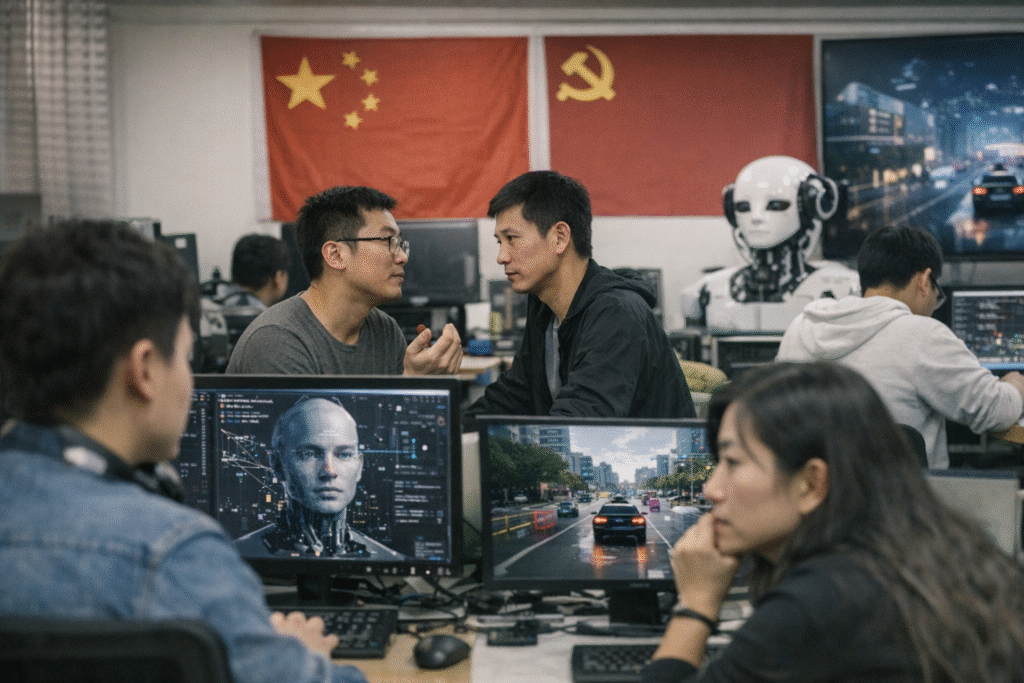
China’s rapid push to dominate artificial intelligence has produced striking breakthroughs, but it is also generating structural contradictions that could slow long-term progress. A recent Defense News opinion article titled “Inside China, artificial intelligence is a snake eating its own tail” argues that the country’s AI ecosystem is increasingly constrained by the very political and economic forces that propelled its rise.
The piece contends that China’s AI development model relies heavily on centralized state direction, vast data accumulation, and aggressive industrial policy. While these elements have enabled swift scaling, they are now contributing to inefficiencies and distortions. Heavy government involvement, the article suggests, prioritizes politically aligned outcomes over genuinely innovative research, leading to duplication of effort across state-backed firms and institutions.
At the core of the critique is the idea that China’s data advantage—long considered a decisive edge—has become less transformative. Tighter regulations on data use, combined with an increasingly restrictive information environment, have reduced the diversity and openness of datasets needed to train cutting-edge models. The Defense News article argues that this dynamic creates a feedback loop: systems trained on constrained or homogenized data produce less original outputs, which in turn feed back into the ecosystem, reinforcing stagnation.
The author also highlights how U.S. export controls on advanced semiconductors are compounding these challenges. China has invested heavily in domestic chip production, but gaps remain in high-end manufacturing capabilities. This technological bottleneck limits the training of large-scale AI models and forces firms to optimize around scarcity rather than push the frontier. According to the article, such constraints risk diverting resources toward workarounds instead of foundational innovation.
Another issue raised is talent allocation. China produces a large number of STEM graduates, yet top-tier AI researchers often face incentives that favor short-term applications or alignment with state priorities over exploratory research. The result, the article argues, is an ecosystem that excels at implementation and iteration but struggles to generate paradigm-shifting advances.
Despite these headwinds, China remains a formidable AI competitor. Its companies continue to deploy AI systems at scale across sectors such as surveillance, finance, and logistics, and the government maintains a long-term strategic commitment to technological leadership. However, the Defense News analysis suggests that without adjustments—particularly in fostering more open research environments and reducing political constraints—the system risks becoming self-limiting.
The notion of AI as “a snake eating its own tail” encapsulates this tension: a powerful engine of growth that, under certain conditions, begins to consume the very foundations of its success. As global competition in artificial intelligence intensifies, whether China can resolve these internal contradictions may prove as निर्णative as any external pressure.