Iran’s Drone Warfare Evolves Beyond Ukraine
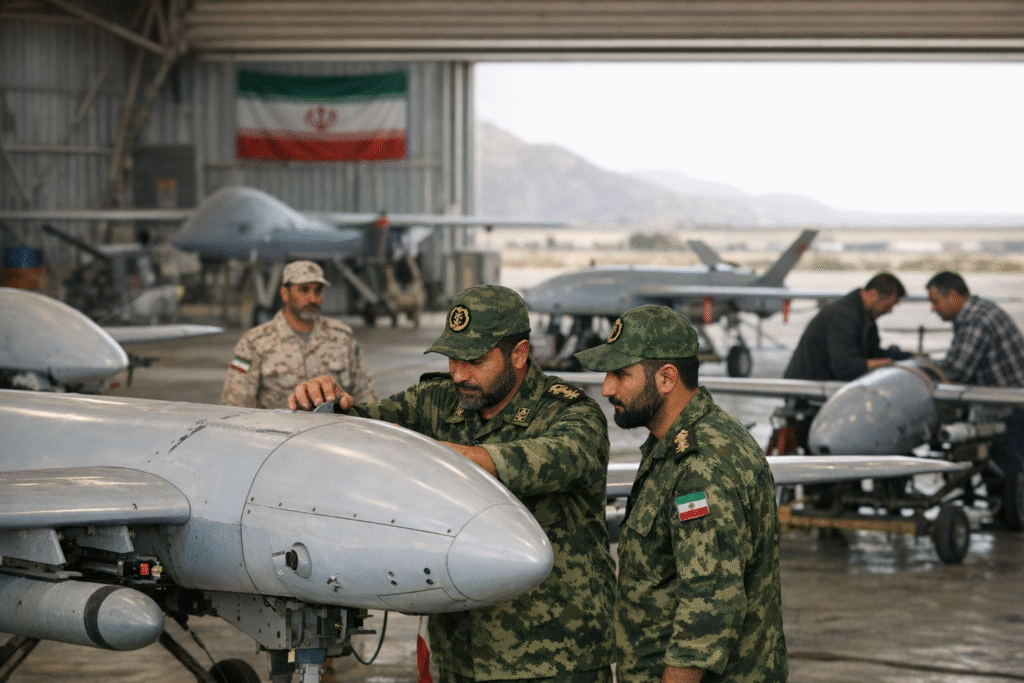
A Wall Street Journal report, “Iran’s Drone Warfare Expands From Ukraine to the Middle East,” examines how Tehran has refined and proliferated its unmanned aerial capabilities through the battlefield experience of Russia’s war in Ukraine, reshaping conflict dynamics far beyond Eastern Europe.
According to the Wall Street Journal, Iran’s supply of drones to Russia—most notably the Shahed series—has given Moscow a relatively low-cost, high-volume strike option against Ukrainian infrastructure. In turn, the large-scale and sustained use of these systems has provided Iranian engineers with a real-world testing ground, allowing them to iterate on design, improve guidance systems, and adapt tactics under combat conditions. The feedback loop created by the Ukraine war has accelerated Iran’s drone development in ways that peacetime experimentation could not.
The article describes how these advancements are now influencing Iran’s broader military posture and its network of regional allies. Groups aligned with Tehran, including militias in the Middle East, have increasingly deployed drones with greater range, accuracy, and resistance to electronic countermeasures. This diffusion of technology has complicated defense planning for Iran’s adversaries, who must now contend with more capable and more widely distributed aerial threats.
Western officials cited in the report express concern that Iran’s growing expertise is narrowing the technological gap with more advanced militaries in certain domains. While Iranian drones remain less sophisticated than some Western systems, their affordability and scalability give them strategic value, particularly in asymmetric warfare. The Wall Street Journal notes that their effectiveness lies not only in precision but in their ability to overwhelm defenses through sheer numbers.
The report also highlights the evolving partnership between Iran and Russia. What began as a transactional exchange—drones for political and possibly economic incentives—has expanded into deeper military-technical cooperation. Analysts say this relationship could have longer-term implications for global security, especially if lessons learned in Ukraine are integrated into future joint projects or shared with other partners.
At the same time, efforts to counter these systems are intensifying. Ukraine has adapted its air defenses to better intercept incoming drones, while the United States and its allies have imposed sanctions targeting Iran’s drone supply chain. Still, officials acknowledge that stopping the spread of such technology is difficult given its relatively low barriers to production and the adaptability of its manufacturers.
The Wall Street Journal’s reporting underscores a broader shift in modern warfare, where inexpensive, unmanned systems are increasingly shaping tactical and strategic outcomes. Iran’s experience in Ukraine appears to be accelerating that trend, with consequences that extend well beyond the original battlefield.