USS Boxer and 11th MEU bolster US Middle East presence
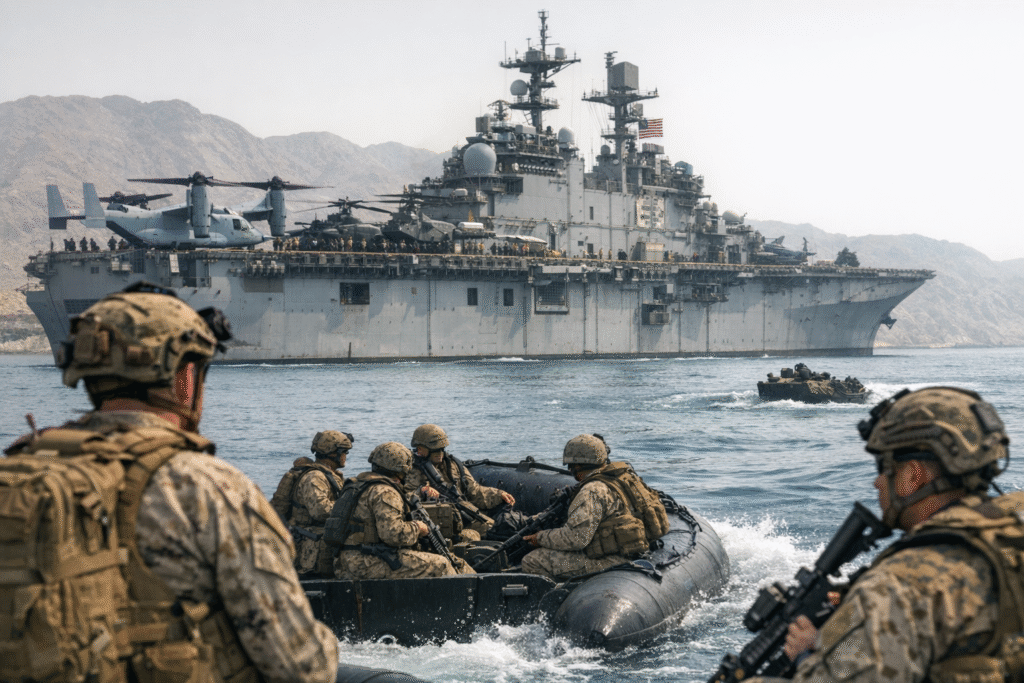
The U.S. Navy has dispatched the amphibious assault ship USS Boxer along with the 11th Marine Expeditionary Unit to the Middle East, reinforcing Washington’s posture in a region marked by persistent volatility. The deployment, first reported by Military Times in its article “USS Boxer and 11th Marine Expeditionary Unit deploy to Middle East,” reflects a broader effort to maintain rapid-response capabilities and reassure partners amid ongoing security concerns.
The Boxer, a Wasp-class amphibious assault ship, carries a mix of aircraft, landing craft, and Marines capable of conducting a wide range of missions, from crisis response to limited combat operations. Embarked with it, the 11th Marine Expeditionary Unit brings a self-contained force structured for flexibility, including infantry, aviation, and logistics elements. Together, they form a highly mobile presence able to respond quickly to contingencies across the region.
U.S. officials have framed the deployment as part of routine force rotations, while also underscoring its deterrent value. The Middle East continues to experience tensions involving state and non-state actors, maritime security risks, and sporadic flare-ups that can threaten shipping lanes and regional stability. Amphibious ready groups such as the Boxer’s provide an option short of larger-scale deployments, offering both visibility and restraint.
The move aligns with U.S. Central Command’s emphasis on maintaining a calibrated but credible presence. In recent years, Washington has adjusted its force posture to balance commitments in Europe and the Indo-Pacific while still addressing Middle Eastern flashpoints. Deployments like this one are intended to ensure readiness without signaling a long-term expansion of forces.
As highlighted in the Military Times report, the Boxer and the 11th Marine Expeditionary Unit are expected to conduct joint exercises and be prepared for a spectrum of missions, from humanitarian assistance to security operations. Their arrival adds another layer to the United States’ efforts to deter escalation and preserve freedom of navigation in strategically important waterways.