Ukraine Drone Industry Eyes Global Breakthrough
Ukraine’s fast-evolving drone industry is positioning itself for a new phase of growth, drawing lessons from the expanding use of unmanned systems in conflicts involving Iran while seeking to transform battlefield innovation into export-ready products.
According to a report titled “Ukraine’s drone masters eye Iran war to kickstart export ambitions,” published by Defense News, Ukrainian developers and officials are closely studying how Iranian-designed drones and loitering munitions have been employed in recent conflicts. The goal is not imitation, but adaptation—leveraging Ukraine’s own combat experience to refine systems that could compete on the global market.
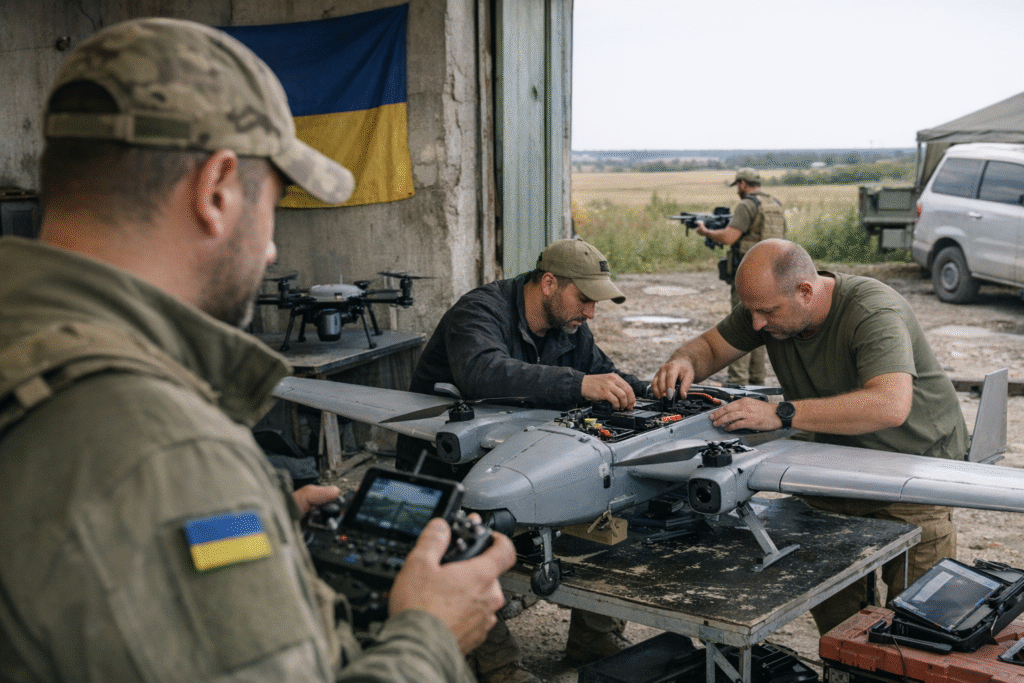
Since Russia’s full-scale invasion began, Ukraine has rapidly expanded its domestic drone production, turning necessity into a catalyst for innovation. Small private firms, government-backed initiatives, and volunteer-driven engineering teams have collaborated to produce reconnaissance drones, strike UAVs, and electronic warfare tools at scale. This ecosystem has thrived under wartime pressure, with rapid prototyping cycles and direct battlefield feedback shaping designs.
Now, Ukrainian manufacturers are looking beyond immediate operational needs. Officials and industry leaders see exports as a critical next step, both to sustain production capacity and to strengthen Ukraine’s economic resilience. The global demand for relatively low-cost, combat-proven drone systems has grown sharply, particularly among countries seeking alternatives to more expensive Western platforms or politically sensitive suppliers.
Iran’s approach has drawn particular scrutiny. Its drone program has prioritized affordability, mass production, and operational simplicity, enabling widespread deployment by both state and non-state actors. Ukrainian engineers are analyzing these characteristics while aiming to differentiate their own systems through higher precision, improved software integration, and adaptability to NATO standards.
At the same time, Ukraine faces structural challenges in turning wartime ingenuity into a stable export industry. Regulatory frameworks, intellectual property protections, and export controls remain under development. There is also the issue of scaling production from decentralized workshops to standardized manufacturing lines capable of meeting international demand.
Western partners are watching with interest. Ukraine’s proximity to European defense markets and its alignment with Western military standards could make it an attractive supplier if it succeeds in formalizing its industrial base. However, competition is intensifying, with established drone manufacturers in the United States, Israel, Turkey, and China already occupying significant market share.
Another complicating factor is the ongoing war itself. While combat conditions have accelerated technological advancement, they also limit Ukraine’s capacity to fully commercialize its innovations. Resources remain focused on immediate defense needs, and the security risks of sharing sensitive technologies must be carefully managed.
Still, Ukrainian officials appear determined to capitalize on what they see as a unique window of opportunity. By translating battlefield experience into exportable products, the country hopes not only to bolster its economy but also to cement its role as a leading player in the rapidly evolving domain of unmanned warfare.
As the Defense News report suggests, the convergence of wartime necessity, global demand, and close observation of competitors like Iran may define the next chapter of Ukraine’s drone sector—one in which survival-driven innovation could evolve into a sustained industrial advantage.